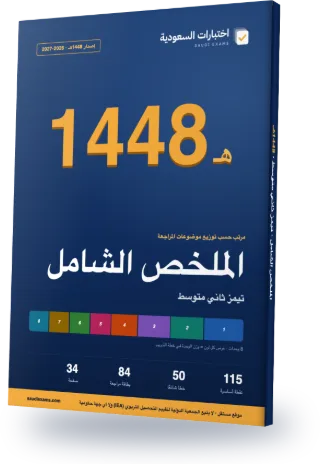
TIMSS Grade 8 Complete Review Guide 2026–2027
A 36-page PDF ordered by unit weight. The first three chapters cover 48% of the published syllabus weight.
- 36Pages
- 115Key points
- 50Common mistakes
- 84Flashcards
Guide map
Each chapter is one exam unit, ordered by its weight in the real exam.
| Chapter | Unit | Weight | Key points |
|---|---|---|---|
| 1 | Biology | 18% | 17 |
| 2 | Number | 15% | 12 |
| 3 | Algebra | 15% | 12 |
| 4 | Physics | 13% | 15 |
| 5 | Geometry and Measurement | 10% | 14 |
| 6 | Data and Probability | 10% | 14 |
| 7 | Chemistry | 10% | 16 |
| 8 | Earth Science | 10% | 15 |
Chapter 1 in full: Biology
This chapter accounts for 18% of the published syllabus weight. These are its key points.
- Mammals feed their young with milk. Fish use gills to take up oxygen from water, and humans use lungs to take up oxygen from air.
- Blood gains oxygen in the lungs, and the heart pumps oxygen-rich blood to tissues.
- Photosynthesis uses light energy to make sugar from carbon dioxide and water and releases oxygen.
The rest of chapter 1, on this page
- Aerobic cellular respiration uses oxygen to release usable energy from sugars and produces carbon dioxide and water.
- The cell membrane controls the movement of substances, the nucleus contains chromosomes, and mitochondria help make energy available from food.
- In plant cells, the wall provides support, chloroplasts capture light, and a large central vacuole can store water and help keep the cell firm.
- Cell division adds new cells. Specialized cells work together in tissues, and different tissues form organs.
- Fertilization joins genetic material from an egg and a sperm cell, and the resulting offspring inherits a combination of parental DNA.
- An inherited feature can become more common if individuals with it leave more surviving offspring in a particular environment.
- Lower layers in an undisturbed sequence are usually older. Detailed structural similarities among fossils and living forms can support common ancestry.
- Natural, rural, and urban ecosystems differ in land use, vegetation, and the mix of organisms they support.
- Producers capture energy, consumers obtain it from food, and decomposers obtain it by breaking down dead organic matter.
- Plants release water vapor during transpiration. Photosynthesis brings carbon dioxide into plants and respiration returns carbon dioxide to the surroundings.
- A shortage of food or water can limit population size. Habitat restoration and pollution reduction can improve conditions for local organisms.
- Some white blood cells produce antibodies. Vaccines can prepare immune defenses to recognize specific threats.
- Carbohydrates and fats supply energy, protein supplies building material, and vitamins and minerals help support normal body functions.
- Use a microscope to observe cells, keep a fair comparison between treatment and control, and repeat measurements when practical.
Common mistakes in this chapter
- Living plants use cellular respiration as well as photosynthesis.
- A plant cell from a bulb or root can have a cell wall even when it has no green chloroplasts.
- An offspring can resemble one parent for a particular trait while carrying DNA from both parents.
- Natural selection changes how common an inherited trait is across generations.
- In a food web, an arrow from grass to a rabbit shows energy transferred from the grass to the rabbit.
- A difference between two field sites alone may have several explanations.
- When groups start at different sizes, compare changes over time for a clearer picture of their growth.
The other chapters are in the full guide
One purchase · lifetime access · review guide included
7-day review plan
The chapters are spread over 6 days by weight so each day carries a similar load. Day 7 is a full exam.
Day 1 · 18% of the exam
Chapter 1: Biology
Day 2 · 15% of the exam
Chapter 2: Number
Day 3 · 15% of the exam
Chapter 3: Algebra
Day 4 · 13% of the exam
Chapter 4: Physics
Day 5 · 20% of the exam
Chapter 5: Geometry and Measurement
Chapter 7: ChemistryDay 6 · 20% of the exam
Chapter 6: Data and Probability
Chapter 8: Earth ScienceDay 7
Complete a timed supplementary practice set and review the units where you lost marks.
Before you read: see your score today
10 free questions from the main units, no sign-up. Then you know which chapter to start with.
Try 10 free questions and see your levelA look at each chapter
The first three key points of each chapter, as they appear in the guide (in Arabic in the PDF).
Chapter 1: Biology
- Mammals feed their young with milk. Fish use gills to take up oxygen from…
- Blood gains oxygen in the lungs, and the heart pumps oxygen-rich blood to tissues.
- Photosynthesis uses light energy to make sugar from carbon dioxide and water and releases…
Chapter 2: Number
- The factors in a pair multiply to the original number.
- A least common multiple is the smallest positive multiple shared by the given numbers.
- A negative base raised to an odd power gives a negative result. An even…
Chapter 3: Algebra
- In 3x², square x before multiplying the result by 3.
- Expand 4(a − b) as 4a − 4b.
- A single value that gives different results in two expressions disproves their equivalence.
Chapter 4: Physics
- A gas is much easier to compress than a liquid because its particles have…
- Heating gas in a rigid sealed container increases the pressure as particles collide faster…
- The total mass stays constant during a change of state in a sealed container.
Chapter 5: Geometry and Measurement
- Adjacent angles that form a straight line total 180°.
- A transversal cutting parallel lines makes equal corresponding angles.
- Move horizontally by x before moving vertically by y.
Chapter 6: Data and Probability
- Equal-width histogram bars show how many values fall in each interval.
- One scatter point brings together two measurements from the same item.
- A line joining readings by date highlights change over time.
Chapter 7: Chemistry
- A nucleus contains positively charged protons and uncharged neutrons. Negatively charged electrons occupy the…
- A molecule contains bonded atoms. Electrons participate in the attraction that holds bonded atoms…
- A pure element has one kind of atom. A pure compound has different elements…
Chapter 8: Earth Science
- The thin crust lies above the mantle, and the liquid outer core surrounds the…
- Most water on Earth is salty and in the oceans. Glaciers store freshwater as…
- Cooling lava forms rock, and weathering and erosion can break down and transport rock…
The full guide comes with lifetime access
Lifetime access includes the full guide (36 pages), all questions and supplementary practice. Chapter 1 is free for everyone.
Questions about the guide
Is the guide free?
Chapter 1 is free to read on the guide page. The full guide comes with lifetime access to this exam; 7-day access does not include it.
Is it up to date for 2026–2027?
Yes. Unit weights and exam facts follow what the exam body last published, and the last check date is printed in the guide. If the standards change we update the file and buyers download the new version.
Does the guide have questions?
No. The guide covers key points and common mistakes; scoring, weak-area practice and full mock exams are on the site.
Can I read it on my phone?
Yes. A5 pages in a single column, with chapters linked from the contents.
- Pages
- 36
- Edition
- 1448 AH · 2026–2027
- Language
- English
- Last updated
Full prep for this exam
All of this in one purchase.
- Timed supplemental practice sessions40 questions in 90 minutes. You get a total score and a score for every unit.
- Practice unit by unit501 questions, every option explained with its source. Starts with your weakest units.
- Complete Review Guide 2026–2027 (PDF)Ordered by each unit's weight in the exam. With lifetime access only.
Choose your access
Continue with your Google account and you go straight to the payment page.