National Assessments (Nafs) – Grade 6: free practice test

Start with 10 free questions to see what needs more practice. Finish to see your score, weakest units and every option explained.

Back to National Assessments (Nafs) – Grade 6

Practice test questions with answers and explanations

Try the questions in the test above first, then open each one here to see the correct answer and why every other option is wrong.

01Read the two sentences: 1) "We filled our bottles at the spring in the valley." 2) "Flowers bloom in the spring." What does the word "spring" mean in the first sentence?

Practice question Unit: Vocabulary and Word Meaning

  1. Awater source ✓ Correct answer

    Filling bottles in a valley shows that "spring" here is a place where water comes out of the ground.

  2. Bseason of the year

    "Spring" is a season in the second sentence, but filling bottles in a valley points to a water source.

  3. Cguard

    "Spring" does not mean a guard, and the sentence gives no clue for that meaning.

  4. Dcolor

    "Spring" is not a color, and color does not fit filling bottles with water.

Reference: ETEC Learning Outcomes Document for the National Assessments (3rd edition, 2026), Reading domain, outcome 6-2-1-1-1, indicator 1, p. 12

02Which idea brings together the grandfather’s words and Salim’s observations in the story?

Practice question Unit: Reading Comprehension

Salim went out with his grandfather before sunrise to the edge of the desert near their village. Salim was carrying a small notebook because he liked to write down what he saw of the desert animals. Grandfather said, “The desert seems quiet, but it is full of life for whoever observes carefully.” The two walked among the dunes, and they saw light footprints near a dry bush. Then they spotted a wild rabbit quickly hiding behind a small hill. Salim smiled and wrote, “Animals know how to protect themselves.”

  1. AThe best time to watch animals is long after sunrise.

    They went out before sunrise, and the text does not say a much later time is best.

  2. BThe desert looks still, but careful observers find hidden life in it. ✓ Correct answer

    This joins Grandfather’s “full of life for whoever observes carefully” with seeing tracks, the rabbit, and Salim’s note.

  3. CAll desert animals live near villages and do not go far from them.

    The text mentions the desert edge near the village only; it never says all animals live near villages.

  4. DWriting notes is more important than watching the animals themselves in the desert.

    The notebook is a tool for recording, while the story centers on noticing desert life, not valuing writing above seeing.

Reference: ETEC Learning Outcomes Document for the National Assessments (3rd edition, 2026), Reading domain, outcome 6-2-1-1-2, indicator 1, p. 12

03Nearby classes at school complain about noise and papers being thrown around the corridor. Which proposal is most persuasive based on the text’s message?

Practice question Unit: Reading Comprehension

When people take care of the neighborhood where they live, not only humans benefit; small creatures benefit as well. A tree in front of the house works like a natural filter for the air: it catches some dust, reduces the heat of the place with its shade, and gives birds a resting spot. Researchers in cities have also noticed that lanes with many plants are less noisy, because leaves and branches absorb part of the sound, so residents feel more comfortable.

One form of kindness to neighbors is for each home to plant a small plant by its door, water the sidewalk tree when it needs water, or place a small bowl for birds on hot days. These actions seem simple, but they make a clear difference. When plants grow, the streets breathe quietly, and windows become closer to a gentle breeze than to dust. Shared care for the place also reduces littering, because people usually protect what they helped to build.

There is another scientific side to being considerate to neighbors: reducing disturbance. Lowering the volume of devices at night, arranging cleaning times, and not pouring water into walkways are all behaviors that protect both comfort and health. Therefore, specialists believe that a clean, quiet neighborhood is not only the result of rules, but also the fruit of compassionate daily habits. The earlier a child begins these habits at home, the greater his or her effect on the community will be.

  1. AWe agree on a shared plan to lower voices, set cleaning times and plant a green corner together. ✓ Correct answer

    This proposal combines nearly all the text’s solutions: reducing disturbance, organizing cleaning, and shared care of the place to reduce littering.

  2. BWe completely ban students from going into the corridor, because comfort can only be achieved through total isolation.

    This is an extreme solution not supported by the text; it calls for organizing behavior and reducing harm, not complete isolation.

  3. CWe move the noisy classes to the far edge of the school, away from others.

    The text encourages cooperation among neighbors, not separating them, and links comfort to shared compassionate habits.

  4. DWe hang a poster only about the benefits of trees, because noise will disappear by itself if students know this information.

    Knowledge alone is not enough in the text; what is needed is practical daily behavior, not just an information poster about trees.

Reference: ETEC Learning Outcomes Document for the National Assessments (3rd edition, 2026), Reading domain, outcome 6-2-1-1-3, indicator 5, p. 12

04Which number satisfies both conditions? - The value of the digit 6 is 60,000,000. - When rounded to the nearest hundred million, the number becomes 4,300,000,000.

Practice question Unit: Numbers and Operations

  1. A4,206,431,250

    This number rounds to 4,200,000,000, not 4,300,000,000, and the digit 6 is only in the millions place.

  2. B4,248,631,250

    In this number, the digit 6 is not in the ten-millions place, and the number rounds to 4,200,000,000.

  3. C4,267,431,250 ✓ Correct answer

    The digit 6 is in the ten-millions place, and 4,267,431,250 rounds to 4,300,000,000.

  4. D4,367,431,250

    The digit 6 is in the ten-millions place, but the number rounds to 4,400,000,000, not 4,300,000,000.

Reference: ETEC Learning Outcomes Document for the National Assessments (3rd edition, 2026), Mathematics domain, outcome 6-4-1-1-1, indicator 1, p. 22

05Khalid started saving money in a box. In the first week he saved 8 riyals, and in each following week the new amount equals double the previous week's amount, then he adds 2 riyals. How many riyals did he save in the fourth week?

Practice question Unit: Algebra: Patterns, Relations and Expressions

  1. A38

    This is the amount for the third week, not the required fourth week.

  2. B64

    This comes from doubling 8 three times without adding 2 in each week.

  3. C78 ✓ Correct answer

    The weeks are 8, then 18, then 38, then 78 because we double and add 2 each time.

  4. D80

    This is close to correct but results from a calculation mistake after reaching 38.

Reference: ETEC Learning Outcomes Document for the National Assessments (3rd edition, 2026), Mathematics domain, outcome 6-4-2-1-1, indicator 1, p. 24

06In a geometric drawing, points M, N, and O lie on one straight path, with N between M and O, and the figure extends beyond M and beyond O with two arrows. Another figure is drawn starting at N and passing through point P only. Which of the following statements is correct?

Practice question Unit: Geometry and Measurement

  1. AMO is a line segment, NP is a line, and P is a point

    Two arrows do not represent a line segment, and a figure that starts only at N cannot be a line.

  2. BMO is a line, NP is a ray, and P is a point ✓ Correct answer

    The two arrows beyond M and O show a line, the figure starting at N through P is a ray, and P is a point.

  3. CMO is a ray, NP is a line segment, and P is a line

    MO is not a ray because it extends in two directions, and P names a point, not a line.

  4. DMO is a line, PN is a ray, and NP is a point

    PN changes the starting point; the given ray starts at N, not at P, and NP is not a point.

Reference: ETEC Learning Outcomes Document for the National Assessments (3rd edition, 2026), Mathematics domain, outcome 6-4-3-1-1, indicator 1, p. 24

07A teacher recorded the number of pages memorized by 12 students in one week. The data were: 1, 3, 2, 1, 4, 2, 3, 1, 2, 4, 3, 2. After organizing them in a frequency table and representing them with bars, by how many do the students in the 2-page and 3-page categories together exceed the students in the 1-page category?

Practice question Unit: Statistics and Probability

  1. A3

    This answer comes from combining only one category with the 1-page count or forgetting to compare after adding.

  2. B4 ✓ Correct answer

    This is correct; 2 pages appears 4 times and 3 pages appears 3 times, making 7. The 1-page category appears 3 times, so the difference is 4.

  3. C5

    This result comes from a counting mistake, such as counting the 3-page category four times instead of three.

  4. D7

    This is only the total of the 2-page and 3-page categories, without subtracting the 1-page frequency.

Reference: ETEC Learning Outcomes Document for the National Assessments (3rd edition, 2026), Mathematics domain, outcome 6-4-4-1-1, indicator 1, p. 25

08Maryam recorded observations about four living things in a table. Which organism is unicellular?

Practice question Unit: Life Science

A table titled Maryam's Observations. Columns: Organism, Observation. Row 1: Its body is made of a large number of similar cells. Row 2: Its body is made of many cells with different functions. Row 3: Its body is made of one cell that performs all life functions. Row 4: Its body is made of tissues and organs.
  1. AOrganism 1

    This is wrong because it is made of a large number of similar cells, so it is not unicellular.

  2. BOrganism 2

    This is wrong; having many cells with different types and functions shows a multicellular organism.

  3. COrganism 4

    This is wrong because it is made of tissues, and tissues mean many cells joined together.

  4. DOrganism 3 ✓ Correct answer

    This is correct because it is made of only one cell, and that single cell performs all life processes.

Reference: ETEC Learning Outcomes Document for the National Assessments (3rd edition, 2026), Natural Sciences domain, outcome 6-5-1-1-1, indicator 1, p. 35

09Grade 6 students measured the masses and volumes of three solid pieces as shown in the table. Which piece has the greatest density, and what is the appropriate unit of density?

Practice question Unit: Physical Science

A table titled Mass and Volume of Three Solid Pieces. Piece A: mass 36 g, volume 9 cm3. Piece B: mass 30 g, volume 5 cm3. Piece C: mass 45 g, volume 15 cm3.
  1. APiece C, 60 g/cm3

    This comes from using an incorrect operation; piece C’s density should be found by division, not multiplication or addition.

  2. BPiece B, 6 g/cm3 ✓ Correct answer

    Correct; density = mass ÷ volume. For piece B: 30 ÷ 5 = 6 g/cm3, which is greater than the others.

  3. CPiece A, 4 g/cm3

    This is indeed piece A’s density because 36 ÷ 9 = 4, but it is not the greatest density in the table.

  4. DPiece C, 3 g/cm3

    This is piece C’s density because 45 ÷ 15 = 3, and it is less than the densities of pieces A and B.

Reference: ETEC Learning Outcomes Document for the National Assessments (3rd edition, 2026), Natural Sciences domain, outcome 6-5-2-1-1, indicator 1, p. 37

10During a night observation trip, students took 4 photos of the Moon at different times in the first half of the lunar month. Which order of the photo numbers shows the correct sequence from earliest to latest?

Practice question Unit: Earth and Space Science

A table titled Descriptions of the Moon photos. Photo 1: a fully lit disk. Photo 2: a thin lit part. Photo 3: the Moon is almost not visible. Photo 4: half of the disk is lit.
  1. A1, 4, 2, 3

    This starts with the full moon, but the full moon comes near the middle of the month, not the beginning.

  2. B2, 4, 1, 3

    This puts the new moon at the end, but the new moon comes before the crescent and the other phases.

  3. C3, 2, 4, 1 ✓ Correct answer

    This order starts with new moon, then crescent, then first quarter, then full moon, matching the first half of the month.

  4. D3, 4, 2, 1

    This places the first quarter before the crescent, although the lit part grows from crescent to first quarter.

Reference: ETEC Learning Outcomes Document for the National Assessments (3rd edition, 2026), Natural Sciences domain, outcome 6-5-3-1-1, indicator 1, p. 39

Nafs Grade 6

Full prep for this exam

All of this in one purchase.

  • Full mock exam, same as the real one70 questions in 135 minutes. You get a total score and a score for every unit.
  • Practice unit by unit611 questions, every option explained with its source. Starts with your weakest units.
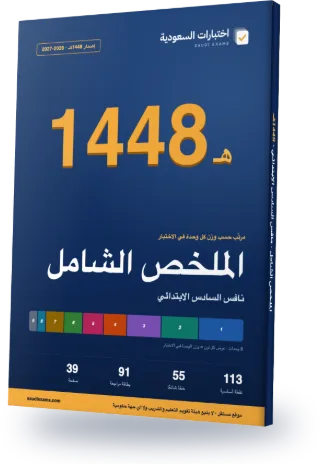
  • Complete Review Guide 2026–2027 (PDF)Ordered by each unit's weight in the exam. With lifetime access only.
Choose your access

One step before payment

Continue with your Google account and you go straight to the payment page.

Check my score freeFull prep