National Science and Mathematics Olympiad (NSMO) – Cities and Provinces Test: Mathematics (Juniors): free practice test

Start with 10 free questions to see what needs more practice. Finish to see your score, weakest units and every option explained.

Back to National Science and Mathematics Olympiad (NSMO) – Cities and Provinces Test: Mathematics (Juniors)

Practice test questions with answers and explanations

Try the questions in the test above first, then open each one here to see the correct answer and why every other option is wrong.

01How many integers x satisfy -10<x<10 and (x-3)(x+2)<0?

Practice question Unit: Algebra

  1. A4 ✓ Correct answer

    The product is negative when its factors have opposite signs, i.e. -2<x<3, giving -1,0,1,2: 4 solutions.

  2. B5

    This uses the difference 3-(-2) without excluding the endpoints, an off-by-one error.

  3. C6

    This includes -2 and 3, which make the product zero rather than negative.

  4. D13

    This counts the integers where the product is positive, not negative.

Reference: Mawhiba, NSMO Mathematics Bag 1 (Cities and Provinces Competition 2026), Unit 1: Algebra, Integers and their properties, Rule for removing brackets, p. 8

02What is the smallest value of |x-3|+|x+2| when x is an integer?

Practice question Unit: Algebra

  1. A0

    This assumes both terms can be zero together, which would need x=3 and x=-2 at once.

  2. B1

    This uses the difference between 3 and 2 instead of the distance between 3 and -2.

  3. C5 ✓ Correct answer

    The expression is the sum of the distances from x to 3 and to -2, which is at least the distance between 3 and -2, namely 5, reached when x lies between them.

  4. D6

    This counts the integers from -2 to 3, which is 6, instead of finding the distance.

Reference: Mawhiba, NSMO Mathematics Bag 1 (Cities and Provinces Competition 2026), Unit 1: Algebra, Integers and their properties, Absolute value of an integer, p. 7

03How many fractions have denominator 30, a positive integer numerator, are in simplest form, and lie between \frac{1}{3} and \frac{5}{6}?

Practice question Unit: Algebra

  1. A5 ✓ Correct answer

    The numerator must lie strictly between 10 and 25 (11 to 24) and share no factor with 30, i.e. not divisible by 2, 3 or 5: 11, 13, 17, 19, 23.

  2. B7

    This counts the odd numerators 11 to 23, but 15, 21 and others are divisible by 3 or 5, so those fractions are not in simplest form.

  3. C14

    This counts every numerator from 11 to 24, without requiring simplest form.

  4. D16

    This counts the numerators from 10 to 25 including both ends and ignores simplest form; the ends are excluded because the fractions must lie strictly between.

Reference: Mawhiba, NSMO Mathematics Bag 1 (Cities and Provinces Competition 2026), Unit 1: Algebra, Rational numbers and operations, Properties of addition and subtraction of rational numbers, p. 14

04The sum of a father's age and his son's age is 60 years now. Five years ago, the father was 4 times as old as the son. How old is the father now?

Practice question Unit: Algebra

  1. A15

    This is the son's age now, not the father's.

  2. B44

    The 5 years were taken off the son only, giving a son of 16 and a father of 44.

  3. C45 ✓ Correct answer

    Five years ago the ages summed to 50, so the son was 10 and the father 40 (4 times), making the father 45 now.

  4. D48

    The 4 to 1 ratio was applied to the ages now instead of 5 years ago.

Reference: Mawhiba, NSMO Mathematics Bag 1 (Cities and Provinces Competition 2026), Unit 1: Algebra, Rational Numbers, Challenge Questions, p. 20

05Points A, B, C and D lie on one line in this order. If AC = 14, BD = 17 and BC = 9, what is the length of AD?

Practice question Unit: Geometry

  1. A13

    13 subtracts BC twice (14 + 17 - 2 \times 9) instead of once.

  2. B22 ✓ Correct answer

    AC + BD counts BC twice, so AD = 14 + 17 - 9 = 22.

  3. C31

    31 is AC + BD without removing the overlap BC.

  4. D40

    40 adds BC instead of subtracting it.

Reference: Mawhiba, NSMO Mathematics Bag 1 (Cities and Provinces Competition 2026), Unit 2: Geometry, Points, Lines and Angles, p. 23

06The angles of a triangle measure x^\circ, 2x^\circ and (180 - 3x)^\circ, where x is a positive integer. For how many values of x is the triangle obtuse?

Practice question Unit: Geometry

  1. A14

    14 counts only the case 2x > 90, that is x = 46 to 59, and ignores the case where the third angle is obtuse.

  2. B29

    29 counts only the case 180 - 3x > 90, that is x = 1 to 29, and ignores the case 2x > 90.

  3. C43 ✓ Correct answer

    The third angle is obtuse for x = 1 to 29 (29 values) and 2x is obtuse for x = 46 to 59 (14 values), giving 43.

  4. D44

    44 counts x = 45 or x = 30 as obtuse, but in both cases the largest angle is exactly 90^\circ, a right angle.

Reference: Mawhiba, NSMO Mathematics Bag 1 (Cities and Provinces Competition 2026), Unit 2: Geometry, Triangles, pp. 29–30

07A convex polygon has 20 diagonals in total. What is the sum of its interior angles?

Practice question Unit: Geometry

  1. A900^\circ

    This is (8-3)\times180^\circ: 3 was subtracted from the 8 sides instead of 2.

  2. B1080^\circ ✓ Correct answer

    Each vertex has n-3 diagonals, so \frac{n(n-3)}{2}=20 gives n=8 and the sum is 6\times180^\circ=1080^\circ.

  3. C1260^\circ

    This is (8-1)\times180^\circ: 1 was subtracted from the 8 sides instead of 2.

  4. D1440^\circ

    This is 8\times180^\circ: the number of sides was multiplied by 180 without subtracting 2.

Reference: Mawhiba, NSMO Mathematics Bag 1 (Cities and Provinces Competition 2026), Unit 2: Geometry, Polygons, p. 33

08What is the largest number of the form \overline{3a47b} that is divisible by 45, where a and b are digits?

Practice question Unit: Number Theory

  1. A34470

    It is divisible by 45 (b=0, a=4), but it is smaller than 38475, which is also divisible.

  2. B34475

    It ends in 5, but its digit sum 23 is not divisible by 9, so it is not divisible by 45.

  3. C38470

    It ends in 0, but its digit sum 22 is not divisible by 9, so it is not divisible by 45.

  4. D38475 ✓ Correct answer

    Since 45=5\times9, b must be 0 or 5 and the digit sum 14+a+b must be divisible by 9. b=5 gives a=8 and b=0 gives a=4; the larger number is 38475.

Reference: Mawhiba, NSMO Mathematics Bag 1 (Cities and Provinces Competition 2026), Unit 3: Number Theory, Divisibility Rules, p. 40

09In a group of 50 people, 32 like tea and 27 like coffee, and some may like neither. What is the difference between the greatest and the smallest possible numbers of people who like both drinks?

Practice question Unit: Combinatorics

  1. A9

    9 is the smallest possible overlap, 32 + 27 − 50, not the difference.

  2. B18 ✓ Correct answer

    The greatest is 27 and the smallest is 32 + 27 − 50 = 9, so the difference is 27 − 9 = 18.

  3. C27

    27 is the greatest possible overlap, not its difference from the smallest.

  4. D59

    59 is the sum 32 + 27, which does not describe the overlap.

Reference: Mawhiba, NSMO Mathematics Bag 1 (Cities and Provinces Competition 2026), Unit 4: Combinatorics, Counting with Venn diagrams, p. 47

10A strip is divided into 4 regions in a straight row. Each region is to be coloured with one of 4 colours so that no two neighbouring regions have the same colour. In how many ways can it be coloured?

Practice question Unit: Combinatorics

  1. A24

    24 is 4!, which makes all four colours different, but the rule applies only to neighbouring regions.

  2. B64

    64 is 4³, which leaves one region out of the count.

  3. C81

    81 is 3⁴, which also gives the first region only 3 choices although it can take any of the 4 colours.

  4. D108 ✓ Correct answer

    The first region has 4 choices, and each later region has 3 because it only has to differ from the previous neighbour: 4 × 3 × 3 × 3 = 108.

Reference: Mawhiba, NSMO Mathematics Bag 1 (Cities and Provinces Competition 2026), Unit 4: Combinatorics, Counting (Combinatorics), p. 47

NSMO Math Juniors

Full prep for this exam

All of this in one purchase.

  • Full mock exam, same as the real one25 questions in 120 minutes. You get a total score and a score for every unit.
  • Practice unit by unit537 questions, every option explained with its source. Starts with your weakest units.
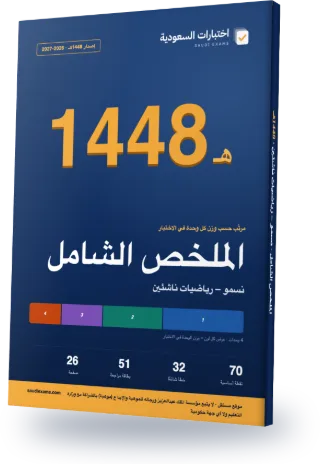
  • Complete Review Guide 2026–2027 (PDF)Ordered by each unit's weight in the exam. With lifetime access only.
Choose your access

One step before payment

Continue with your Google account and you go straight to the payment page.

Check my score freeFull prep