NSMO Junior Maths Syllabus: The Four Branches and What Each Tests
What the Juniors maths Cities and Provinces test covers: algebra, geometry, number theory and combinatorics, with 25 questions in 120 minutes and no calculator.
- Questions and time
- 25 questions · 120 minutes
- Pass mark
- Mawhiba does not publish a pass mark; students who qualify move on to the next stage
- Exam fee
- Free: registration in both tracks of the National Gifted Olympiad has no fee
Start with 10 free questions to find what needs more work. No sign-up, with answer explanations.
Try 10 free questions and see your levelPut what you just read into practice
Start with 10 free questions to find what needs more work. No sign-up, with answer explanations.
Try 10 free questions and see your levelLast verified: 17 November 2026. The question count, duration and test instructions in this guide come from Mawhiba's published 2026 Cities and Provinces sample test (Mathematics 1), and the content from Mathematics Bag 1. They may change, so check before the test. This is an independent guide, not affiliated with Mawhiba, the Ministry of Education or any government body, and it does not promise any score.
The Cities and Provinces test is the first stage of the NSMO scientific track in the National Gifted Olympiad, and each specialization has its own test. This guide is for the Juniors mathematics test, for first and second intermediate students. Third intermediate and first secondary students sit the Seniors test, which has a different bag. The day-by-day plan is in the study plan guide and the sign-up steps are in the registration guide.
The key numbers
| Item | Details | What it means for you |
|---|---|---|
| Grades | First and second intermediate (grades 7 and 8) | Third intermediate and first secondary sit the Seniors test |
| Questions | 25 | Each question is 4% of the test |
| Duration | 120 minutes | 120 ÷ 25 = 4.8 minutes per question on average |
| Question type | Multiple choice A–D | Answered on a separate answer sheet in pencil, one circle per question |
| Language | Arabic and English together | Every question appears in both on the same page |
| Calculator | Not allowed in the maths test | The numbers are designed for mental and pen-and-paper work |
| Fee | Free | Registration in both tracks of the National Gifted Olympiad has no fee |
The four branches in Mathematics Bag 1
The bag splits the material into four units, and our question bank follows the same order. Mawhiba does not publish how many questions each branch has, so the split in the table is our estimate, based on the size of each unit in the bag and on the questions of the 2026 sample test.
| Unit | What it covers | Bag pages | Estimated questions out of 25 |
|---|---|---|---|
| Algebra | Integers and their properties, rational numbers, word problems and substitution into expressions | 5–21 | 9 |
| Geometry | Lines and angles, triangles, polygons, quadrilaterals, perimeter and area | 22–38 | 7 |
| Number theory | Divisibility and remainders, prime factorization, counting divisors, simplifying | 39–45 | 4 |
| Combinatorics | Counting with Venn diagrams, the basic counting principles, counting numbers in a list | 46–50 | 5 |
A small example from each branch
Algebra. The product of four positive integers is 2. What is their sum? Three of them are 1 and the fourth is 2, so the sum is 5. Students slip by thinking the 2 repeats.
Geometry. A triangle has angles of 50° and 60°, so the third angle is 180° − 110° = 70°. Students slip by using 360° instead of 180°.
Number theory. 1,254 is divisible by 3 because its digit sum 1 + 2 + 5 + 4 = 12 is divisible by 3.
Combinatorics. In a class of 30 students, 18 like maths and 20 like science, and everyone likes at least one. The number who like both is 18 + 20 − 30 = 8.
Where students lose marks
- Reading only the Arabic or only the English version: the wording may be clearer in one of them, so read both when the meaning is unclear.
- Off-by-one counting errors: the integers from 5 to 20 number 16, not 15.
- Negative signs in integers and fractions.
- Mixing up perimeter and area, and complementary and supplementary angles.
- Relying on a calculator in practice, when none is allowed in the test.
Try the study plan after you solve the free questions on this site and see your weakest branch.
Finished reading? Try a set of questions
Start with 10 free questions to find your weakest units. Keep practising with the full question bank and mock exams from SAR 26.
Put the plan to work here
SAR 34 $9
One purchase · lifetime access · review guide included
- 537 questions, every option explained with its source
- Full mock exams: 25 questions in 120 minutes, like the real one
- Practice that starts with your weakest units, plus a review of your mistakes
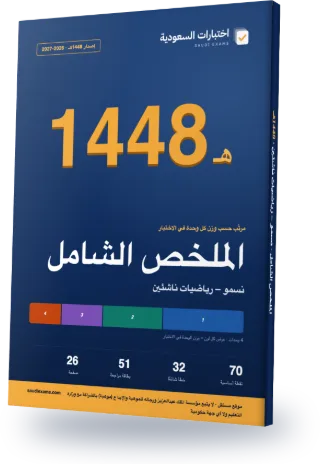 Complete Review Guide 2026–2027 included (PDF)Ordered by the weight of each unit in the examBuy now · SAR 34or 7 days for SAR 26
See everything included
Full mock exams like the real one and 537 explained questions that find your weak spots and train them
- Unlimited full mock exams to practise your pace and check your performance across the whole exam
- Practise 10 weak-area questions, starting where you lose the most marks
- 537 questions explaining why every option is right or wrong
- Arabic and English with one pass
- Unit notes and flashcards, then questions to check your understanding
The Cities and Provinces test is the first gate on the NSMO path: students who pass it train and continue through the later stages to the finals and then the national-team programs for the international olympiads. Source Last verified: 2026-11-17