NSMO Junior Maths Study Plan by Days Left
A plan for the Cities and Provinces maths test by time left: 4+ weeks, 2 to 3 weeks, the last week, the day before and test day.
- Questions and time
- 25 questions · 120 minutes
- Pass mark
- Mawhiba does not publish a pass mark; students who qualify move on to the next stage
- Exam fee
- Free: registration in both tracks of the National Gifted Olympiad has no fee
Start with 10 free questions to find what needs more work. No sign-up, with answer explanations.
Try 10 free questions and see your levelPut what you just read into practice
Start with 10 free questions to find what needs more work. No sign-up, with answer explanations.
Try 10 free questions and see your levelLast verified: 17 November 2026. The question count and duration come from Mawhiba's published 2026 sample test, and the content from Mathematics Bag 1. In the pages we checked, Mawhiba has not yet announced the date of this year's Cities and Provinces test, so ask your school coordinator for the timetable. This is an independent guide, not affiliated with Mawhiba, the Ministry of Education or any government body, and it does not promise any score.
The test is 25 questions in 120 minutes with no calculator, about 4.8 minutes per question. So the plan is built on timed pen-and-paper practice and on knowing which branch costs you marks. For the content in detail see the syllabus guide, and for sign-up see the registration guide.
By time left
| Time left | What to do |
|---|---|
| More than 4 weeks | Solve the free questions on this site to find your weakest branch. Read one unit of the bag each week and do its challenge questions after every page with no calculator. Start with algebra, then geometry. |
| 2 to 3 weeks | Train on your two weakest branches: ten explained questions a day, and read the explanation of every wrong option to see which mistake you made. Redo number theory and combinatorics, because they are short and pay off fast once the rules are solid. |
| Last week | One full mock exam: 25 questions in 120 minutes with no calculator, then review every question you missed. Do not start new topics; review the flashcards, the divisibility rules and the angle rules. |
| The day before | Read the flashcards only and sleep early. Pack a good pencil, an eraser and a watch, because shading must be in pencil. |
| Test day | Read the test instructions, start with the questions you can solve, mark the hard ones and return to them. Shade exactly one circle per question, fully. |
Managing the time
- The average is 4.8 minutes a question. If a question passes 6 minutes, move on and come back.
- Keep 10 minutes at the end to copy answers and recheck the counting questions, where off-by-one slips cost the most marks.
- Questions appear in Arabic and English, so if one wording is unclear, use the other to interpret it.
Start from the free questions on this site so you know your weakest branch before you set the plan.
Finished reading? Try a set of questions
Start with 10 free questions to find your weakest units. Keep practising with the full question bank and mock exams from SAR 26.
Put the plan to work here
SAR 34 $9
One purchase · lifetime access · review guide included
- 537 questions, every option explained with its source
- Full mock exams: 25 questions in 120 minutes, like the real one
- Practice that starts with your weakest units, plus a review of your mistakes
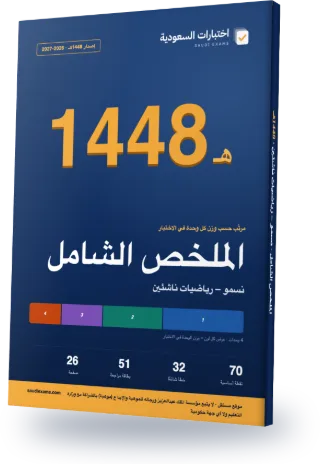 Complete Review Guide 2026–2027 included (PDF)Ordered by the weight of each unit in the examBuy now · SAR 34or 7 days for SAR 26
See everything included
Full mock exams like the real one and 537 explained questions that find your weak spots and train them
- Unlimited full mock exams to practise your pace and check your performance across the whole exam
- Practise 10 weak-area questions, starting where you lose the most marks
- 537 questions explaining why every option is right or wrong
- Arabic and English with one pass
- Unit notes and flashcards, then questions to check your understanding
The Cities and Provinces test is the first gate on the NSMO path: students who pass it train and continue through the later stages to the finals and then the national-team programs for the international olympiads. Source Last verified: 2026-11-17