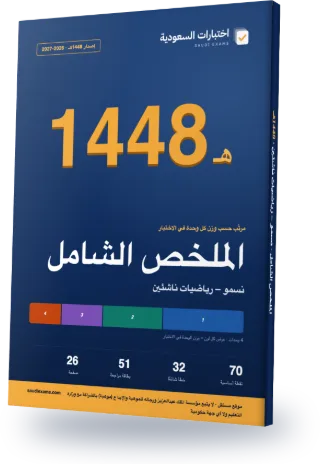
NSMO Math Juniors Complete Review Guide 2026–2027
Every exam topic in a 26-page Arabic PDF, ordered from the heaviest unit to the lightest. The first three chapters alone cover about 84% of the exam questions.
- 26Pages
- 70Key points
- 32Common mistakes
- 51Flashcards
Guide map
Each chapter is one exam unit, ordered by its weight in the real exam.
| Chapter | Unit | Weight | Exam questions | Key points |
|---|---|---|---|---|
| 1 | Algebra | 36% | 9 | 18 |
| 2 | Geometry | 28% | 7 | 17 |
| 3 | Combinatorics | 20% | 5 | 18 |
| 4 | Number Theory | 16% | 4 | 17 |
Chapter 1 in full: Algebra
36% of the exam, about 9 questions. These are its key points, as in the guide.
- (Integers and their properties) Natural numbers \(\mathbb{N}=\{1,2,3,\dots\}\), whole numbers \(\mathbb{W}=\{0,1,2,\dots\}\), integers \(\mathbb{Z}=\{\dots,-2,-1,0,1,2,\dots\}\).
- (Integers and their properties) The numbers \(a\) and \(-a\) are additive inverses with sum zero, equally far from zero; zero is its own additive inverse.
- (Integers and their properties) Absolute value: \(|5|=|-5|=5\) and \(|0|=0\); the expression \(|a-b|\) is the distance between points \(a\) and \(b\).
The rest of chapter 1, on this page
- (Integers and their properties) Addition and multiplication are commutative and associative: \(a+b=b+a\) and \((ab)c=a(bc)\); distributive law: \(a(b+c)=ab+ac\).
- (Integers and their properties) Sign rules: \(x-(-y)=x+y\), \((-x)(-y)=xy\), \(x(-y)=-xy\).
- (Integers and their properties) Exponents: \(a^n\) means multiplying \(a\) by itself n times, \(x^{-1}=\frac{1}{x}\), and \((xy)^n=x^ny^n\).
- (Rational numbers and operations) A rational number is any number of the form \(\frac{a}{b}\) with integers \(a,b\) and \(b\neq 0\); every integer is rational because \(5=\frac{5}{1}\).
- (Rational numbers and operations) Terminating and repeating decimals are rational; non-terminating non-repeating decimals, such as \(\pi\), are irrational.
- (Rational numbers and operations) Equivalence: \(\frac{a}{b}=\frac{a\cdot k}{b\cdot k}=\frac{a\div k}{b\div k}\) for any \(k\neq 0\); lowest terms means the greatest common divisor of numerator and denominator is 1.
- (Rational numbers and operations) Adding and subtracting fractions: use a common denominator (preferably the least common multiple), add the numerators and keep the denominator: \(\frac{1}{3}+\frac{2}{5}=\frac{5}{15}+\frac{6}{15}=\frac{11}{15}\).
- (Rational numbers and operations) Multiplying fractions: \(\frac{a}{b}\times\frac{c}{d}=\frac{ac}{bd}\); dividing: \(\frac{a}{b}\div\frac{c}{d}=\frac{a}{b}\times\frac{d}{c}=\frac{ad}{bc}\).
- (Rational numbers and operations) The number 1 is the multiplicative identity, and the multiplicative inverse of \(\frac{a}{b}\) (with \(a\neq 0\)) is \(\frac{b}{a}\); their product is 1.
- (Rational numbers and operations) Converting a repeating decimal: for \(x=0.\overline{7}\) multiply by 10 and subtract \(x\): \(9x=7\), so \(x=\frac{7}{9}\).
- (Expressions, equations and word problems) In age problems: after \(t\) years every age increases by \(t\), so the sum of n people's ages increases by \(nt\), and the difference between two ages stays constant.
- (Expressions, equations and word problems) Time problems: convert every 60 minutes into an hour; for example 12 hours 71 minutes equals 13 hours 11 minutes, and after 24:00 a new day starts.
- (Expressions, equations and word problems) When numbers are split into consecutive groups of three, the first number of group k is \(3k-2\) and the group sum is \(9k-3\).
- (Expressions, equations and word problems) Counting gaps: n points have \(n-1\) gaps between them; if each gap takes the same time, multiply the time by the number of gaps.
- (Expressions, equations and word problems) Substituting in an algebraic expression: put the value in brackets first; if \(a=-1\) then \(a+a^2=-1+1=0\).
Common mistakes in this chapter
- Confusing \(-3^2\) with \((-3)^2\): the first is \(-9\), the second is 9.
- Subtracting a negative means adding: \(5-(-2)=7\), not 3.
- Division is not closed on the integers: \(1\div 2\) is not an integer.
- Adding the denominators when adding fractions is wrong: \(\frac{1}{3}+\frac{1}{4}\) is not \(\frac{2}{7}\).
- Zero is neither positive nor negative, has no multiplicative inverse, and division by zero is not defined.
- When removing a bracket preceded by a minus, every term inside changes sign, not just the first.
- For \(0.1\overline{7}\) many answer \(\frac{17}{99}\); the correct value is \(\frac{8}{45}\) because the repeating part does not start right after the decimal point.
- In time problems extra minutes must be converted: 71 minutes is 1 hour 11 minutes, and the answer may fall on the next day.
The other chapters are in the full guide
One purchase · lifetime access · review guide included
7-day review plan
The chapters are spread over 6 days by weight so each day carries a similar load. Day 7 is a full exam.
Day 1 · 36% of the exam
Chapter 1: Algebra
Day 2 · 28% of the exam
Chapter 2: Geometry
Day 3 · 20% of the exam
Chapter 3: Combinatorics
Day 4 · 16% of the exam
Chapter 4: Number Theory
Day 5
Full mock exam: 25 questions in 120 minutes, then review the common mistakes in the units where you lost marks.
Before you read: see your score today
10 free questions from the main units, no sign-up. Then you know which chapter to start with.
Try 10 free questions and see your levelA look at each chapter
The first three key points of each chapter, as they appear in the guide (in Arabic in the PDF).
Chapter 1: Algebra
- (Integers and their properties) Natural numbers \(\mathbb{N}=\{1,2,3,\dots\}\), whole numbers \(\mathbb{W}=\{0,1,2,\dots\}\), integers \(\mathbb{Z}=\{\dots,-2,-1,0,1,2,\dots\}\).
- (Integers and their properties) The numbers \(a\) and \(-a\) are additive inverses with sum…
- (Integers and their properties) Absolute value
Chapter 2: Geometry
- (Points, lines and angles) An acute angle is less than \(90^\circ\), a right angle…
- (Points, lines and angles) Complementary angles sum to \(90^\circ\), supplementary angles sum to \(180^\circ\)…
- (Points, lines and angles) When two lines intersect, each pair of vertical angles is…
Chapter 3: Combinatorics
- (Counting with Venn diagrams) Overlapping types are drawn as overlapping circles, and each region…
- (Counting with Venn diagrams) Two sets X and Y give four regions: X only…
- (Counting with Venn diagrams) The total of set X equals its "X only" region…
Chapter 4: Number Theory
- (Divisibility and remainders) An integer \(a\) divides \(b\), written \(a \mid b\), if there…
- (Divisibility and remainders) A number is divisible by 2 if its last digit is…
- (Divisibility and remainders) A number is divisible by 3 if its digit sum is…
The full guide comes with lifetime access
The full guide (26 pages) is included with lifetime access to this exam, together with every question and full mock exam. Chapter 1 is free for everyone.
Questions about the guide
Is the guide free?
Chapter 1 is free to read on the guide page. The full guide comes with lifetime access to this exam; 7-day access does not include it.
Is it up to date for 2026–2027?
Yes. Unit weights and exam facts follow what the exam body last published, and the last check date is printed in the guide. If the standards change we update the file and buyers download the new version.
Does the guide have questions?
No. The guide covers key points and common mistakes; scoring, weak-area practice and full mock exams are on the site.
Can I read it on my phone?
Yes. A5 pages in a single column, with chapters linked from the contents.
- Pages
- 26
- Edition
- 1448 AH · 2026–2027
- Language
- Arabic
- Last updated
Full prep for this exam
All of this in one purchase.
- Full mock exam, same as the real one25 questions in 120 minutes. You get a total score and a score for every unit.
- Practice unit by unit537 questions, every option explained with its source. Starts with your weakest units.
- Complete Review Guide 2026–2027 (PDF)Ordered by each unit's weight in the exam. With lifetime access only.
Choose your access
Continue with your Google account and you go straight to the payment page.