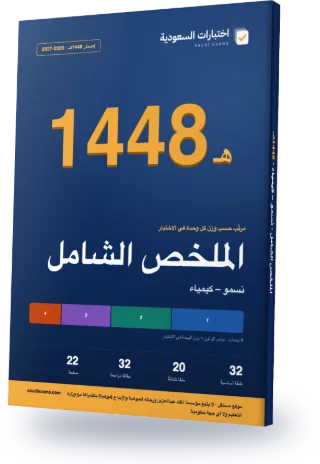
NSMO Chemistry Complete Review Guide 2026–2027
Every exam topic in a 22-page Arabic PDF, ordered from the heaviest unit to the lightest. The first three chapters alone cover about 84% of the exam questions.
- 22Pages
- 32Key points
- 20Common mistakes
- 32Flashcards
Guide map
Each chapter is one exam unit, ordered by its weight in the real exam.
| Chapter | Unit | Weight | Exam questions | Key points |
|---|---|---|---|---|
| 1 | The Periodic Table and Classification of Elements | 32% | 8 | 8 |
| 2 | Atomic Structure | 28% | 7 | 8 |
| 3 | Ionic Bonds and Compounds | 24% | 6 | 8 |
| 4 | Covalent Bonds and Compounds | 16% | 4 | 8 |
Chapter 1 in full: The Periodic Table and Classification of Elements
32% of the exam, about 8 questions. These are its key points, as in the guide.
- (Modern law) Properties repeat periodically when elements are arranged by increasing atomic number.
- (Blocks) s-block groups 1–2, p-block groups 13–18, d-block groups 3–12, f-block the inner transition elements.
- (Period) The period number equals the highest main energy level in the configuration.
The rest of chapter 1, on this page
- (Atomic radius) Covalent radius is half the distance between two identical bonded nuclei.
- (Ions) Cations shrink because the same nuclear charge holds fewer electrons; anions grow from extra repulsion.
- (Electronegativity) Increases across a period and up a group; fluorine is the highest at 4.0.
- (Ionization energy) Rises across a period, falls down a group; every successive ionization costs more energy.
- (Metallic character) Metals have low ionization energies and form cations; nonmetals have high electron affinities.
Common mistakes in this chapter
- Reading the d-block group number as the number of outer s electrons only: count ns + (n−1)d electrons.
- Thinking ionization energy rises down a group: it falls because the outer electron is farther away and more shielded.
- Ranking isoelectronic ions by electrons instead of protons: same electrons, so more protons gives the smaller ion.
- Forgetting the ends of the electronegativity scale: fluorine is the highest at 4.0, and caesium and francium the lowest at about 0.7.
- Treating electron affinity like ionization energy: noble gases and half-filled p³ atoms do not readily accept an electron.
The other chapters are in the full guide
One purchase · lifetime access · review guide included
7-day review plan
The chapters are spread over 6 days by weight so each day carries a similar load. Day 7 is a full exam.
Day 1 · 32% of the exam
Chapter 1: The Periodic Table and Classification of Elements
Day 2 · 28% of the exam
Chapter 2: Atomic Structure
Day 3 · 24% of the exam
Chapter 3: Ionic Bonds and Compounds
Day 4 · 16% of the exam
Chapter 4: Covalent Bonds and Compounds
Day 5
Full mock exam: 25 questions in 120 minutes, then review the common mistakes in the units where you lost marks.
Before you read: see your score today
10 free questions from the main units, no sign-up. Then you know which chapter to start with.
Try 10 free questions and see your levelA look at each chapter
The first three key points of each chapter, as they appear in the guide (in Arabic in the PDF).
Chapter 1: The Periodic Table and Classification of Elements
- (Modern law) Properties repeat periodically when elements are arranged by increasing atomic number.
- (Blocks) s-block groups 1–2, p-block groups 13–18, d-block groups 3–12, f-block the inner transition…
- (Period) The period number equals the highest main energy level in the configuration.
Chapter 2: Atomic Structure
- (Conservation of mass) In a closed system the total mass does not change during…
- (Definite proportions) A pure compound always contains its elements in the same mass ratio…
- (Dalton) Matter is made of atoms; atoms of different elements combine in simple whole-number…
Chapter 3: Ionic Bonds and Compounds
- (Ions) Metals lose valence electrons to form cations; nonmetals gain electrons to form anions…
- (Polyatomic ions) A group of covalently bonded atoms with one overall charge, e.g. SO₄²⁻…
- (Ionic bond) The electrostatic attraction between oppositely charged ions in a crystal lattice.
Chapter 4: Covalent Bonds and Compounds
- (Covalent bond) Formed when attraction of both nuclei for shared electrons balances the repulsions…
- (Bond energy) Energy to break one mole of a bond; higher bond order means…
- (Naming) Prefixes give the number of each atom; mono- is not used for the…
The full guide comes with lifetime access
The full guide (22 pages) is included with lifetime access to this exam, together with every question and full mock exam. Chapter 1 is free for everyone.
Questions about the guide
Is the guide free?
Chapter 1 is free to read on the guide page. The full guide comes with lifetime access to this exam; 7-day access does not include it.
Is it up to date for 2026–2027?
Yes. Unit weights and exam facts follow what the exam body last published, and the last check date is printed in the guide. If the standards change we update the file and buyers download the new version.
Does the guide have questions?
No. The guide covers key points and common mistakes; scoring, weak-area practice and full mock exams are on the site.
Can I read it on my phone?
Yes. A5 pages in a single column, with chapters linked from the contents.
- Pages
- 22
- Edition
- 1448 AH · 2026–2027
- Language
- Arabic
- Last updated
All School Student Exams review guides
Back to National Science and Mathematics Olympiad (NSMO) – Cities and Provinces Test: Chemistry
Full prep for this exam
All of this in one purchase.
- Full mock exam, same as the real one25 questions in 120 minutes. You get a total score and a score for every unit.
- Practice unit by unit500 questions, every option explained with its source. Starts with your weakest units.
- Complete Review Guide 2026–2027 (PDF)Ordered by each unit's weight in the exam. With lifetime access only.
Choose your access
Continue with your Google account and you go straight to the payment page.