NSMO Chemistry Syllabus: Four Chapters and Test Format
What the chemistry Cities and Provinces test covers: 25 questions in 120 minutes on the bag's four chapters, from atomic structure to covalent bonding.
- Questions and time
- 25 questions · 120 minutes
- Pass mark
- Mawhiba does not publish a pass mark; students who qualify move on to the next stage
- Exam fee
- Free: registration in both tracks of the National Gifted Olympiad has no fee
Start with 10 free questions to find what needs more work. No sign-up, with answer explanations.
Try 10 free questions and see your levelPut what you just read into practice
Start with 10 free questions to find what needs more work. No sign-up, with answer explanations.
Try 10 free questions and see your levelLast verified: 18 November 2026. The number of questions, time and points come from Mawhiba's published 2026 chemistry sample test and its answer key, and the content comes from the Stage 1 bag: Chemistry. They may change, so check before the test. This is an independent guide, not affiliated with Mawhiba, the Ministry of Education or any government body, and it does not promise any score.
The Cities and Provinces test is the first stage of the NSMO scientific track of the National Gifted Olympiad, and each subject has its own test. This guide is about the chemistry test, which is for third intermediate and first secondary students. Registration steps are in the registration guide.
Test format
- 25 multiple-choice questions with four options (A–D).
- 120 minutes.
- Points rise through the paper according to the answer key: questions 1–8 are worth 3, 9–17 are worth 4 and 18–25 are worth 5, for a total of 100.
- Each question is printed in Arabic and English on the same sheet.
- Answers go on a separate answer sheet in pencil, one circle per question.
- The instructions ban calculators "in the mathematics test only" and do not say outright that they are allowed in this test; ask your school coordinator.
Bag chapters and questions in the 2026 sample
Mawhiba does not publish how questions are split across chapters. The numbers below are how the 25 questions of the 2026 sample test fall across the bag's four chapters by our count; next year's split may differ.
| Chapter | Questions in 2026 | What it covers |
|---|---|---|
| Atomic Structure | 7 | Chapter 1 of the bag (pp. 3–27): laws of chemical combination, atomic models, subatomic particles and isotopes, electron configuration, quantum numbers. |
| The Periodic Table and Classification of Elements | 8 | Chapter 2 (pp. 28–47): classifying elements, blocks, groups and periods, atomic and ionic size, electronegativity, ionization energy and electron affinity. |
| Ionic Bonds and Compounds | 6 | Chapter 3 (pp. 48–59): simple and polyatomic ions, the ionic bond, properties of ionic compounds and lattice energy, writing formulas and naming, the metallic bond. |
| Covalent Bonds and Compounds | 4 | Chapter 4 (pp. 60–80): forming covalent bonds, bond energy and length, naming molecular compounds, polarity, Lewis structures, octet exceptions, resonance and formal charge, VSEPR and molecular shapes. |
How to prepare
- Start with the periodic table and atomic structure, which gave 15 of the 25 questions in 2026.
- Practise writing electron configurations, including ions and the Cr and Cu exceptions, and reading an element's period and group from them.
- Learn each periodic trend together with its reason, and the exceptions in first ionization energy.
- Learn the bag's ion table so you can write formulas and names quickly.
- Draw Lewis structures and predict shapes for the molecules in the bag's examples, then try new ones.
- Read the question in both Arabic and English when a term is unclear.
Each chapter of the bag ends with practice exercises and their answers, and the sample test and its key are on Mawhiba's website; solve them under time. Our questions are written in their style, not copied from them.
Finished reading? Try a set of questions
Start with 10 free questions to find your weakest units. Keep practising with the full question bank and mock exams from SAR 26.
Put the plan to work here
SAR 34 $9
One purchase · lifetime access · review guide included
- 500 questions, every option explained with its source
- Full mock exams: 25 questions in 120 minutes, like the real one
- Practice that starts with your weakest units, plus a review of your mistakes
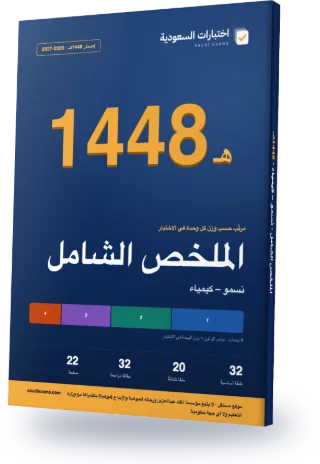 Complete Review Guide 2026–2027 included (PDF)Ordered by the weight of each unit in the examBuy now · SAR 34or 7 days for SAR 26
See everything included
Full mock exams like the real one and 500 explained questions that find your weak spots and train them
- Unlimited full mock exams to practise your pace and check your performance across the whole exam
- Practise 10 weak-area questions, starting where you lose the most marks
- 500 questions explaining why every option is right or wrong
- Arabic and English with one pass
- Unit notes and flashcards, then questions to check your understanding
The Cities and Provinces test is the first gate on the NSMO path: students who pass it train and continue through the later stages to the finals and then the national-team programs for the international olympiads. Source Last verified: 2026-11-18
Sources and references
- موهبة: أولمبياد الموهبة الوطني (المسار العلمي نسمو) mawhiba.sa
- موهبة: حقيبة المرحلة الأولى – الكيمياء mawhiba.sa
- موهبة: نموذج اختبار الكيمياء 2026 mawhiba.sa
- موهبة: مفتاح إجابات نموذج الكيمياء mawhiba.sa