Cambridge B1 Preliminary for Schools Practice: free practice test
Start with 10 free questions to see what needs more practice. Finish to see your score, weakest units and every option explained.
The qualification uses the Cambridge English Scale. This is your practice accuracy. It cannot be converted to the exam’s scaled score or used to determine whether you pass.
Practice test questions with answers and explanations
Try the questions in the test above first, then open each one here to see the correct answer and why every other option is wrong.
01What should a passenger check before taking the 16.10 bus on Friday?
From Friday, the 16.10 bus will leave through the sports gate when the front drive is busy. The departure time and all stops stay the same. A sign by the main gate will show where to go.
Reference: Cambridge English B1 Preliminary for Schools, Reading Part 1 skills. combine time and place conditions.
02Rana can come on Sunday afternoon. She would like to make something with a friend and let her family taste it when she finishes. Where should she go?
After-school and weekend activities
Tree Watch Meet at the nature reserve on Saturday morning. Count birds and mark trees on a map. The leader brings binoculars and pencils. Wear walking shoes. There is no indoor session.
Print Room Make prints from simple drawings after school on Fridays. Bring an apron. The teacher supplies ink and paper. Your work can be taken home when the room closes at five.
Bread Lab Meet in the school kitchen on Sunday afternoon. Work in pairs to make bread, using ingredients provided. Families can taste the bread at the end, but they cannot join the lesson.
Studio Lunch Come to the recording room at Wednesday lunchtime. Learn to make a short podcast. Beginners can borrow a microphone. Bring your lunch to eat before the session.
Reference: Cambridge English B1 Preliminary for Schools, Reading Part 2 skills. match venue and guest access.
03What do the writer's instructions about tickets suggest?
A Concert in Another Room
Our music club set out chairs in the main hall for a short concert on Friday. I played the chimes, which are a row of metal tubes. I had practised carrying them with our teacher because the stand was taller than I was.
At lunch the hall was still full of boxes from the science fair. The caretaker suggested the smaller art room instead. I thought we would have to take turns performing because there wasn't room to set up every instrument at once. But the drummer left his largest drum behind, and Amina played the keyboard with her back against a cupboard. I moved my chimes next to the entrance. That left an open path to the seats.
I had liked the idea of playing in a big hall. In the art room, though, I could see people smiling when they recognised the tune. My little brother asked if he could help make tickets for the next concert. I asked him to make fewer than last time. I'd already gone to the caretaker to see whether the art room was free next month.
Reference: Cambridge English B1 Preliminary for Schools, Reading Part 3 skills. inference.
04Which sentence best fits gap [1] in “The Kite That Would Not Fly”?
The Kite That Would Not Fly
Our school planned a kite display on the field. Tarek and I had made a blue kite from paper and thin sticks. We expected it to be easy to fly.
[1] In the same field, however, the other kites kept rising. I looked more closely at ours.
[2] The right side stayed flat. I began to think the two sides did not weigh the same.
[3] Tarek held the kite steady while I slid that part a few centimetres across the frame. We made no other change and added no material.
[4] This time both sides stayed flat. A longer tail was the next thing we decided to try.
[5] The added length stopped the turning, and the kite rose above the edge of the field. The best moment came when Tarek let me hold the string.
Reference: Cambridge English B1 Preliminary for Schools, Reading Part 4 skills. track a contrast.
05Complete the report. We stopped working every fifteen minutes to ___ our progress against the checklist. By the final session, every step had been completed.
Reference: Cambridge English B1 Preliminary for Schools, Reading Part 5 skills. verb–noun collocation.
06What will happen before the film starts?
Transcript
A: The film club is still on this Thursday, Ben, but the school hall has a dance exam in it. The media room was my first idea, until I found out its projector is broken. We can use the room over the library.
B: Should we tell people it's at four as usual?
A: Ask them to come fifteen minutes early. The guest who made the film has to leave at five, so she wants to talk to us before we watch it.
B: And should I bring my copy on a memory stick?
A: Leave that at home. I've sent the film to the guest already, and she'll show it from her laptop. Could you print two extra signs for the stairs?
B: Sure. I'll make the arrows bigger this time.
Reference: Cambridge English B1 Preliminary for Schools, Listening Part 1 skills. action.
07How should the lamps on that side of the stage be arranged?
Transcript
A: There's plenty of room backstage now that the three tall boxes have been moved. Is your costume still in the changing room, Luis?
B: I was told to keep it there overnight, but I checked the office first. It wasn't in either room. Mia took it to the music room with the other jackets, so I'll get it from there.
A: Good. Before we start, Mrs Bell wants three lamps on the left, with two at floor level and the other one high up.
B: Are they all white?
A: The higher one has a yellow cover. The two on the floor are white. Is your first scene just after the song?
B: It used to be. Now there's a short speech before I come in. I'll carry a map printed on a sheet of paper. I won't use the book from yesterday's rehearsal.
Reference: Cambridge English B1 Preliminary for Schools, Listening Part 1 skills. quantity.
08Why does Malik want listeners to know when the presenters are using notes?
Transcript
A: Thanks for coming, Malik. I want your help saving the second part of our school podcast. The recording with Mr Harris is all noise after the first minute. I'm not going to ask him to come in again. He's already busy with the school show.
B: Then we could ask Maya to answer the same questions.
A: I'd rather keep him in it. The start still sounds good, and I made notes during the rest. We could use the beginning and then explain what he said in our own voices.
B: Good idea, if we make it clear when we're reading from your notes. I don't want it to sound as if he's saying your exact words. I'll check the notes with you now.
A: Great. I feel much better about it.
Reference: Cambridge English B1 Preliminary for Schools, Listening Part 2 skills. attitude.
09How did Karim's attitude to Sam working on the doors change?
Transcript
A: Today I'm talking to Karim, who painted the scenery for our school play. How did you get involved?
B: My friend Sam was already helping. I'd been asked to take photos, but the art teacher saw my drawing of a street and invited me to switch jobs.
A: Was your drawing used as it was?
B: We kept the buildings but moved the bakery to the other end. There was more room for actors to enter from that side of the stage.
A: I liked those real-looking bricks. Did you enjoy painting them?
B: They were easy enough. The windows took most of my time. They looked square up close, but from the audience seats some looked much too tall.
A: What was the hardest thing to get used to?
B: Other people adding to my work. I wanted every door done my way at first. Once I saw the bright handles Sam painted, I asked him to do the rest.
A: Would you paint the next show too?
B: Yes, if I can see a practice with the actors before we start.
Reference: Cambridge English B1 Preliminary for Schools, Listening Part 4 skills. Attitude change.
10What approach helped Mei get the information across more quickly?
Transcript
A: Our school station has a new weather slot. Mei, were you asked to read out a forecast?
B: I was, but my group suggested adding recordings from the playground. We wanted listeners to hear what a windy day was like near the basketball court.
A: Where did you make the first recording?
B: I tried it by the tall fence. A loose gate banged so loudly I couldn't hear the wind. We ended up beside the benches.
A: I'd have thought listeners wanted numbers, like the temperature.
B: We put those on the website. On air, I hope to tell students something they can use, like which side of the field is dry enough to play on.
A: Did recording your own voice worry you?
B: At first I kept reading faster than usual. The producer took the paper away and asked what I would tell a friend. I got the information across in half the time.
A: What's coming up?
B: Next week a younger pupil will present while I handle the sound.
Reference: Cambridge English B1 Preliminary for Schools, Listening Part 4 skills. Detail.
Full prep for this exam
All of this in one purchase.
- Timed supplemental practice sessions38 questions in 90 minutes. You get a total score and a score for every unit.
- Practice unit by unit500 questions, every option explained with its source. Starts with your weakest units.
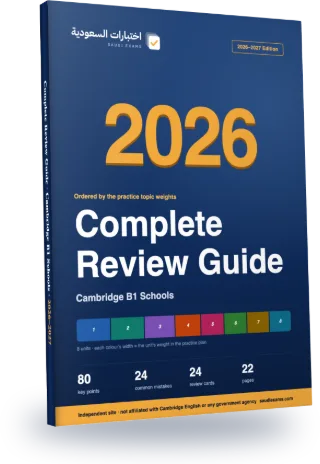
- Complete Review Guide 2026–2027 (PDF)Ordered by each unit's weight in the exam. With lifetime access only.
Choose your access
Continue with your Google account and you go straight to the payment page.