General Aptitude Test, English version (GAT English): free practice test
Start with 10 free questions to see what needs more practice. Finish to see your score, weakest units and every option explained.
Back to General Aptitude Test, English version (GAT English)
Practice test questions with answers and explanations
Try the questions in the test above first, then open each one here to see the correct answer and why every other option is wrong.
01Choose the pair of words whose relationship is most similar to that of the pair in capitals: OBSTINATE : FLEXIBLE
Reference: ETEC, The General Aptitude Test (GAT) Test-Taker's Guide (English, current edition), test content: Verbal Analogies
02Choose the answer that best completes the sentence: The scientist was known for her ______ approach: she never accepted a claim until she had checked the evidence herself.
Reference: ETEC, The General Aptitude Test (GAT) Test-Taker's Guide (English, current edition), test content: Sentence Completion
03Each sentence contains four words in CAPITALS. Choose the word that does not fit the overall meaning of the sentence (the error is neither spelling nor grammar): The library was so QUIET that you could hear a pin DROP; students spoke in WHISPERS and the only sound was the LOUD chatter of visitors.
Reference: ETEC, The General Aptitude Test (GAT) Test-Taker's Guide (English, current edition), test content: Contextual Error
04What is one result of crowding among desert locusts?
(1) Desert locusts do not always live in huge clouds. For long periods, they exist in a solitary phase. In this state, the insects avoid one another, fly mostly at night, and remain relatively hard to notice across dry landscapes. Their numbers stay low when food is scarce and breeding places are limited.
(2) The change often begins after periods of rain. Moist soil and fresh vegetation allow locusts to breed successfully, sometimes for several generations. As more young hatch in the same areas, the insects are forced into closer contact. This crowding is important because repeated touching of the hind legs triggers chemical changes in the nervous system, including a rise in serotonin.
(3) After that shift, their behavior and bodies begin to change. They become attracted to other locusts instead of avoiding them. Young locusts form marching bands on the ground, while adults gather into flying groups. Their coloring also becomes more noticeable, and they feed more actively. These changes make coordinated movement easier and increase the pressure on crops and wild plants.
(4) If favorable conditions continue, small groups can grow into swarms that travel with the wind over great distances. The swarm is not planned by a leader; rather, it results from dense populations, altered behavior, and repeated breeding in green areas. This is why experts monitor rainy zones closely: the transformation from scattered insects to destructive swarms can happen surprisingly fast.
Reference: ETEC, The General Aptitude Test (GAT) Test-Taker's Guide (English, current edition), test content: Reading Comprehension
05In paragraph (3), what does "That touching point" refer to?
(1) In the eleventh century, the scholar al-Biruni described a way to estimate the Earth's radius without traveling across a large distance. His method depended on geometry and careful observation from a mountain. Instead of comparing observations in two faraway cities, he used one elevated location and the visible horizon.
(2) First, he needed the mountain's height. He could find this by measuring angles to the peak from two points on level ground whose separation was known. With trigonometry, the height could then be calculated. After climbing the mountain, he measured the small angle between the true horizontal and the line of sight to the horizon. This angle is often called the dip of the horizon.
(3) The key idea is that the line of sight to the horizon just touches the curved surface of the Earth. That touching point forms a right angle with a line drawn from the Earth's center. Using the mountain's height and the dip angle, al-Biruni could set up a geometric relationship and solve for the Earth's radius.
(4) The method was elegant because it required only local measurements, a suitable mountain, and a clear view. In principle, better instruments lead to a better result, since the horizon dip is very small and errors can affect the final calculation. Even so, the approach shows how geometry can turn a simple observation into knowledge about the planet's size.
Reference: ETEC, The General Aptitude Test (GAT) Test-Taker's Guide (English, current edition), test content: Reading Comprehension
06a and b are integers with a > b. Compare the following two values: First value: a − b Second value: b − a
Reference: ETEC, The General Aptitude Test (GAT) Test-Taker's Guide (English, current edition), test content: Arithmetic
07What is the units digit of 7^23 ?
Reference: ETEC, The General Aptitude Test (GAT) Test-Taker's Guide (English, current edition), test content: Arithmetic
08What is the smaller angle between the hands of a clock at 4:30?
Reference: ETEC, The General Aptitude Test (GAT) Test-Taker's Guide (English, current edition), test content: Geometry
09Which values of x satisfy −3x + 4 ≥ 13 ?
Reference: ETEC, The General Aptitude Test (GAT) Test-Taker's Guide (English, current edition), test content: Algebra
10The chart shows the number of visitors (in thousands) to a museum in the first six months of a year. What is the mean number of visitors per month, in thousands?

Reference: ETEC, The General Aptitude Test (GAT) Test-Taker's Guide (English, current edition), test content: Data Analysis
Full prep for this exam
All of this in one purchase.
- Full mock exam, same as the real one120 questions in 125 minutes. You get a total score and a score for every unit.
- Practice unit by unit534 questions, every option explained with its source. Starts with your weakest units.
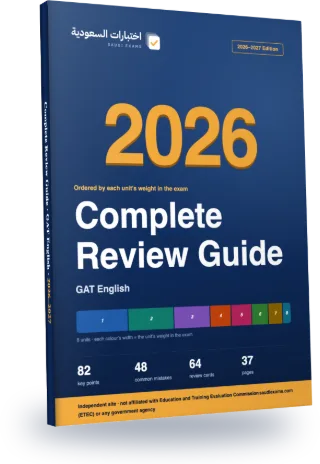
- Complete Review Guide 2026–2027 (PDF)Ordered by each unit's weight in the exam. With lifetime access only.
Choose your access
Continue with your Google account and you go straight to the payment page.