CDMP
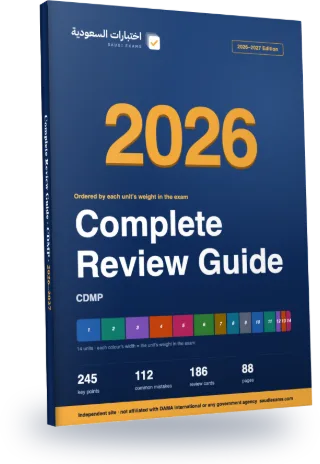
CDMP Complete Review Guide 2026–2027
Every exam topic in a 88-page Arabic PDF, ordered from the heaviest unit to the lightest. The first three chapters alone cover about 33% of the exam questions.
- 88Pages
- 245Key points
- 112Common mistakes
- 186Flashcards
Guide map
Each chapter is one exam unit, ordered by its weight in the real exam.
| Chapter | Unit | Weight | Exam questions | Key points |
|---|---|---|---|---|
| 1 | Data Governance | 11% | 11 | 18 |
| 2 | Data Modeling and Design | 11% | 11 | 18 |
| 3 | Metadata Management | 11% | 11 | 16 |
| 4 | Data Quality | 11% | 11 | 18 |
| 5 | Master and Reference Data Management | 10% | 10 | 18 |
| 6 | Data Warehousing and Business Intelligence | 10% | 10 | 17 |
| 7 | Data Architecture | 6% | 6 | 18 |
| 8 | Data Storage and Operations | 6% | 6 | 18 |
| 9 | Data Security | 6% | 6 | 16 |
| 10 | Data Integration and Interoperability | 6% | 6 | 16 |
| 11 | Document and Content Management | 6% | 6 | 18 |
| 12 | Data Management Process | 2% | 2 | 18 |
| 13 | Big Data | 2% | 2 | 18 |
| 14 | Data Ethics | 2% | 2 | 18 |
Chapter 1 in full: Data Governance
11% of the exam, about 11 questions. These are its key points, as in the guide.
- (Governance concepts, drivers and principles) Data governance is the exercise of authority, control and shared decision-making (planning, monitoring, enforcement) over the management of data assets.
- (Governance concepts, drivers and principles) Governance decides and oversees; data management carries out. Governance sets the rules and checks compliance, while the other knowledge areas do the work.
- (Governance concepts, drivers and principles) Governance should be tied to business strategy. If poor quality blocks a key outcome, the program starts with quality; if a single customer view matters, master data comes first.
The rest of chapter 1, on this page
- (Governance concepts, drivers and principles) Benefits fall into three groups: business value (better decisions, trust), efficiency (less duplication, less time finding data) and risk mitigation (compliance, ethics, privacy).
- (Governance operating models and structures) Four common operating models are centralized, replicated (independent), federated and network. They differ in where decision rights sit and how much local freedom units keep.
- (Governance operating models and structures) A federated model gives each business unit its own governance with common enterprise standards, balancing local needs and consistency in large or diverse organizations.
- (Governance operating models and structures) A typical structure layers an executive steering committee, an enterprise council, a governance office, and working groups for specific issues such as quality or privacy.
- (Governance roles: owners, stewards and councils) A data owner is a senior person accountable for a data domain: approves changes, sets access rules and answers for quality and compliance. They do not need to know the data at record level.
- (Governance roles: owners, stewards and councils) A data steward handles day-to-day work in a domain: maintains definitions and the glossary, monitors quality, handles issues and acts as a subject matter expert.
- (Governance roles: owners, stewards and councils) A data custodian is technical. They capture, store, secure and dispose of data in systems according to the owner's requirements, and implement access rules and technical controls.
- (Governance roles: owners, stewards and councils) A data governance council or board is the cross-functional decision-making body. It sets direction, approves policy, prioritizes work and resolves escalated disputes.
- (Policies, standards and issue management) A data policy states what must be done and why, at a high level. Standards set specific measurable requirements, and procedures describe the steps to meet them.
- (Policies, standards and issue management) Policies need an approving authority, an owner, communication to staff, a review cycle and a way to monitor and enforce compliance. A policy no one enforces has little value.
- (Policies, standards and issue management) Issue management logs a data problem, assigns an owner, assesses its impact, escalates it to the right level and tracks resolution, with the council deciding unresolved cases.
- (Governance metrics, value and implementation) Governance metrics measure value and effectiveness: for example, number of data assets with named owners, issues resolved on time, policy compliance rate and quality scores.
- (Governance metrics, value and implementation) Value is shown by linking governance to business outcomes such as lower costs, avoided fines, faster reporting and better decisions, not only to activity counts.
- (Governance metrics, value and implementation) Good implementation steps: define the business problem, assess current capability, choose focus areas, plan policies and structures, set SMART metrics, communicate wins and repeat.
- (Governance metrics, value and implementation) Implementation depends on sustained leadership support, a data-driven culture and staff skills. Without them, structures and policies stay on paper.
Common mistakes in this chapter
- Ownership means accountability for a data domain, not legal possession of the data.
- Stewards are not the same as owners: stewards do operational work, owners make decisions and answer for them.
- Custodians are technical system roles, not business decision makers.
- Governance is not an IT-only job. Responsibilities should be shared across business and IT.
- A federated model is not the same as a replicated one: federated units follow common enterprise standards, replicated units work independently.
- A policy is not a procedure. Policies state rules; procedures give the steps.
- Counting governance activities (meetings held) is weaker than measuring outcomes such as quality gains or risk reduced.
- Do not launch governance everywhere at once. Starting small on a defined problem is the recommended approach.
The other chapters are in the full guide
One purchase · lifetime access · review guide included
7-day review plan
The chapters are spread over 6 days by weight so each day carries a similar load. Day 7 is a full exam.
Day 1 · 17% of the exam
Chapter 1: Data Governance
Chapter 9: Data SecurityDay 2 · 17% of the exam
Chapter 2: Data Modeling and Design
Chapter 10: Data Integration and InteroperabilityDay 3 · 17% of the exam
Chapter 3: Metadata Management
Chapter 11: Document and Content ManagementDay 4 · 17% of the exam
Chapter 4: Data Quality
Chapter 12: Data Management Process
Chapter 13: Big Data
Chapter 14: Data EthicsDay 5 · 16% of the exam
Chapter 5: Master and Reference Data Management
Chapter 7: Data ArchitectureDay 6 · 16% of the exam
Chapter 6: Data Warehousing and Business Intelligence
Chapter 8: Data Storage and OperationsDay 7
Full mock exam: 100 questions in 90 minutes, then review the common mistakes in the units where you lost marks.
How many correct answers do you need?
- Pass mark 60%60 correct out of 100
Before you read: see your score today
10 free questions from the main units, no sign-up. Then you know which chapter to start with.
Try 10 free questions and see your levelA look at each chapter
The first three key points of each chapter, as they appear in the guide (in Arabic in the PDF).
Chapter 1: Data Governance
- (Governance concepts, drivers and principles) Data governance is the exercise of authority, control and…
- (Governance concepts, drivers and principles) Governance decides and oversees; data management carries out. Governance…
- (Governance concepts, drivers and principles) Governance should be tied to business strategy. If poor…
Chapter 2: Data Modeling and Design
- (Entities, attributes, relationships and keys) An entity represents a person, place, thing, event or…
- (Entities, attributes, relationships and keys) A relationship is an association between entities. Its cardinality…
- (Entities, attributes, relationships and keys) A primary key uniquely identifies each row, cannot be…
Chapter 3: Metadata Management
- (Metadata types and definitions) Metadata is data that describes other data: what it is…
- (Metadata types and definitions) The common categories are business metadata (definitions, owners, rules), technical…
- (Metadata types and definitions) Structural metadata describes how a resource is organized. Descriptive metadata…
Chapter 4: Data Quality
- (Data quality dimensions) Accuracy is the degree to which data matches the real-world thing…
- (Data quality dimensions) Completeness is the degree to which required records and values are…
- (Data quality dimensions) Consistency means values do not contradict each other within a record…
Chapter 5: Master and Reference Data Management
- (Reference data and code sets) Reference data is made of codes, descriptions and definitions…
- (Reference data and code sets) ISO country codes are a standard example of a…
- (Reference data and code sets) A code set should have an owner, a steward…
Chapter 6: Data Warehousing and Business Intelligence
- (Data warehouse concepts and architectures) A data warehouse is an integrated, subject-oriented, time-variant and…
- (Data warehouse concepts and architectures) OLTP systems handle many small reads and writes with…
- (Data warehouse concepts and architectures) The two classic approaches differ in direction: the Inmon…
Chapter 7: Data Architecture
- (Enterprise architecture and data architecture concepts) Enterprise architecture describes how business, data, applications and…
- (Enterprise architecture and data architecture concepts) Data architecture is the part of enterprise architecture…
- (Enterprise architecture and data architecture concepts) Good data architecture links business needs to data…
Chapter 8: Data Storage and Operations
- (Database types and transaction concepts) A transaction is a unit of work that either…
- (Database types and transaction concepts) ACID stands for atomicity, consistency, isolation and durability.
- (Database types and transaction concepts) A dirty read sees uncommitted changes from another transaction.
Chapter 9: Data Security
- (Security principles and data classification) The CIA triad
- (Security principles and data classification) Data classification assigns a sensitivity level, such as public…
- (Security principles and data classification) A common rating scheme uses low, moderate and high…
Chapter 10: Data Integration and Interoperability
- (ETL, ELT and batch integration) ETL extracts data from sources, transforms it in a…
- (ETL, ELT and batch integration) ELT extracts and loads raw data into the target…
- (ETL, ELT and batch integration) ELT suits cloud platforms and large volumes, because the…
Chapter 11: Document and Content Management
- (Records management and retention) A record is information created or received as evidence of…
- (Records management and retention) A retention schedule lists record types, how long each is…
- (Records management and retention) Retention periods are driven by legal and regulatory requirements, operational…
Chapter 12: Data Management Process
- (Data management definition, principles and the knowledge-area framework) Data management covers the whole lifecycle…
- (Data management definition, principles and the knowledge-area framework) Data is treated as an organizational…
- (Data management definition, principles and the knowledge-area framework) Managing data means managing its quality…
Chapter 13: Big Data
- (Big data definitions and characteristics) Big data refers to datasets that exceed what traditional…
- (Big data definitions and characteristics) The NIST core characteristics are volume, velocity, variety and…
- (Big data definitions and characteristics) Variety covers structured, semi-structured and unstructured data such as…
Chapter 14: Data Ethics
- (Ethical principles for data handling) Data ethics asks how data is collected, shared and…
- (Ethical principles for data handling) Key ethical questions cover the impact on individuals and…
- (Ethical principles for data handling) Transparency means people can understand what data is used…
The full guide comes with lifetime access
The full guide (88 pages) is included with lifetime access to this exam, together with every question and full mock exam. Chapter 1 is free for everyone.
Questions about the guide
Is the guide free?
Chapter 1 is free to read on the guide page. The full guide comes with lifetime access to this exam; 7-day access does not include it.
Is it up to date for 2026–2027?
Yes. Unit weights and exam facts follow what the exam body last published, and the last check date is printed in the guide. If the standards change we update the file and buyers download the new version.
Does the guide have questions?
No. The guide covers key points and common mistakes; scoring, weak-area practice and full mock exams are on the site.
Can I read it on my phone?
Yes. A5 pages in a single column, with chapters linked from the contents.
- Pages
- 88
- Edition
- 1448 AH · 2026–2027
- Language
- Arabic
- Last updated
Full prep for this exam
All of this in one purchase.
- Full mock exam, same as the real one100 questions in 90 minutes. You get a total score and a score for every unit.
- Practice unit by unit632 questions, every option explained with its source. Starts with your weakest units.
- Complete Review Guide 2026–2027 (PDF)Ordered by each unit's weight in the exam. With lifetime access only.
Choose your access
Continue with your Google account and you go straight to the payment page.