Medical Devices Technician Syllabus: 12 Sections and Their Weights
The twelve Medical Devices Technician exam sections with official weights, what each covers, how our 150-question mock exam splits them, and the SCFHS reference books.
- Questions and time
- 150 questions · 3 hours
- Pass mark
- 55%
- correct answers to pass (55%)
- 83 of 150
- Exam fee
- Paid to SCFHS online when you apply through Mumaris Plus; the amount is shown in your application
Start with 10 free questions to find what needs more work. No sign-up, with answer explanations.
Try 10 free questions and see your levelPut what you just read into practice
Start with 10 free questions to find what needs more work. No sign-up, with answer explanations.
Try 10 free questions and see your levelLast checked: 17 November 2026. Weights and rules can change at any time, so check the classification exams page on the SCFHS website and the Medical Devices Technician content guideline (PDF) before you start. This is an independent website, not affiliated with the Saudi Commission for Health Specialties (SCFHS), Prometric or any government body.
The SCFHS Medical Devices Technician exam is a single exam with twelve sections. Biomedical Equipment Technology and Advanced Electronics and Electricity carry 15% each, and four more sections carry 10% each, so the six largest sections make up 70% of the exam. Use this page to decide where to start.
Exam format at a glance
| Item | Details |
|---|---|
| Questions | 150 multiple-choice questions |
| Time | 3 hours |
| Pass mark | 55% (technician level), for tests from 21 June 2022 onward |
| Distribution | The real distribution can differ from the published weights by up to 5% (plus or minus) in each section |
| Exam language | English (our inference from the English reference books; the guideline does not state it) |
The twelve sections and their weights
SCFHS publishes one percentage per section. The last column is the split we use in our full mock exam (150 questions): the official percentage times 150, rounded to a whole number, so the total is 150.
| Section | Official weight | Questions in our mock exam |
|---|---|---|
| 1. Biomedical Equipment Technology | 15% | 23 |
| 2. Advanced Electronics and Electricity | 15% | 22 |
| 3. Anatomy and Physiology | 10% | 15 |
| 4. Mathematics | 5% | 8 |
| 5. Physics | 5% | 7 |
| 6. Chemistry | 5% | 8 |
| 7. Medical Informatics | 10% | 15 |
| 8. Professionalism | 10% | 15 |
| 9. Practical Experience | 5% | 7 |
| 10. Research and Design | 5% | 8 |
| 11. Patient Safety, Electrical Safety and Hazards | 10% | 15 |
| 12. Regulation and Standards | 5% | 7 |
| Total | 100% | 150 |
A note on detail: the SCFHS guideline names the twelve sections and gives their weights, but it has no detailed topic list. The topic lists below are our own breakdown, built from the chapters of the reference books SCFHS names, and are not an official outline.
Section 1: Biomedical Equipment Technology (15%, 23 questions)
- Patient monitoring and biosignals (ECG, pulse oximetry, blood pressure, temperature)
- Life-support and therapeutic devices (ventilators, defibrillators, infusion pumps, anaesthesia, electrosurgery)
- Diagnostic imaging equipment (X-ray, CT, ultrasound, MRI)
- Support equipment (sterilizers, oxygen supply, incubators, dialysis)
- Sensors, transducers and electrodes
How to prepare: Learn each device as three things: what it measures or delivers, its main blocks, and the faults you would check first. Group devices by function (monitoring, life support, imaging, support) so that similar ones stay together. Resources from the SCFHS reference list: Webster, Medical Instrumentation: Application and Design (4th or latest edition); Carr and Brown, Introduction to Biomedical Equipment Technology (4th or latest); Ritter, Hazelwood, Valdevit and Ascione, Biomedical Engineering Principles (2nd or latest); Bushberg, Seibert, Leidholdt and Boone, The Essential Physics of Medical Imaging (3rd or latest).
Section 2: Advanced Electronics and Electricity (15%, 22 questions)
- DC circuits (Ohm's law, Kirchhoff, series-parallel, power)
- AC circuits (reactance, impedance, resonance, transformers)
- Semiconductors (diodes, rectifiers, transistors)
- Operational amplifiers and analog signal processing
- Digital logic and number systems
How to prepare: This is the section where hand calculation pays off. Do Ohm's and Kirchhoff's laws, series-parallel networks and power until they are automatic, then move to reactance, impedance, rectifier circuits, op-amp gain and binary and hexadecimal conversion. Resources from the SCFHS reference list: Floyd, Electronic Devices (Conventional Current Version) (10th or latest); Tocci, Digital Systems: Principles and Application (6th or latest).
Section 3: Anatomy and Physiology (10%, 15 questions)
- Cardiovascular system and cardiac electrophysiology
- Respiratory system and gas exchange
- Nervous system and nerve conduction
- Renal, musculoskeletal and other body systems
How to prepare: Link structure to function and to what a device measures: the cardiac cycle with the ECG waves, ventilation with gas exchange, the neuron with nerve conduction. Resources from the SCFHS reference list: Guyton and Hall, Textbook of Medical Physiology (13th or latest); Johnson, Biology for Engineers (2nd or latest).
Section 4: Mathematics (5%, 8 questions)
- Algebra, functions and logarithms
- Trigonometry and exponential functions
- Differentiation and integration
How to prepare: Keep it short and regular: algebra, logarithms, trigonometry and exponentials first, then basic derivatives and integrals. A few problems a day beats a long session. Resources from the SCFHS reference list: Barnett, Ziegler, Byleen and Sobecki, Precalculus (7th or latest); Croft and Davison, Mathematics for Engineers: A Modern Interactive Approach (3rd or latest); McGraw-Hill, Precalculus: Student Edition (Advanced Math Concepts) (1st or latest).
Section 5: Physics (5%, 7 questions)
- Mechanics, fluids and pressure
- Heat and thermodynamics
- Waves, sound and optics
- Electricity, magnetism and radiation
How to prepare: Know the formulas and, above all, the units: pressure, flow, heat, wave speed and frequency, then the basics of electricity, magnetism and radiation that the imaging and electronics sections build on. Resources from the SCFHS reference list: Vasudeva, Modern Engineering Physics (revised edition); Bushberg, Seibert, Leidholdt and Boone, The Essential Physics of Medical Imaging (3rd or latest).
Section 6: Chemistry (5%, 8 questions)
- Atoms, bonding and the periodic table
- Moles, stoichiometry and solutions
- Acids, bases and pH
- Gases and electrochemistry
How to prepare: Cover atoms and bonding, moles and concentration, pH, and gas laws. Practise a mole or concentration calculation by hand every day. Resources from the SCFHS reference list: Ryan and Norris, Chemistry Course book (2nd or latest); Gallagher and Ingram, Complete Chemistry for Cambridge IGCSE (3rd or latest).
Section 7: Medical Informatics (10%, 15 questions)
- Computer fundamentals, memory and microprocessors
- Health data standards (HL7, FHIR, DICOM) and interoperability
- Health information systems, PACS and data quality
- Cybersecurity of connected medical devices
How to prepare: Separate hardware from data: memory and processors on one side, then standards (HL7, FHIR, DICOM), PACS and cybersecurity for connected devices on the other. Resources from the SCFHS reference list: Sinha, An Introduction to Computer: Basic Knowledge to computer (latest edition); Hall, Microprocessor and Interfacing Programming and Hardware (2nd or latest).
Section 8: Professionalism (10%, 15 questions)
- Ethics and professional conduct
- Patient rights, confidentiality and consent
- Professional accountability and practice standards
How to prepare: Questions are scenario-based: a patient, a colleague or a manager, and a decision. Learn the principles (confidentiality, consent, honesty, accountability) and apply them to cases. The reference list on pages 3 and 4 of the content guideline has no book for this section, so use the practice questions and their explanations as your main resource.
Section 9: Practical Experience (5%, 7 questions)
- Preventive and corrective maintenance
- Inspection, testing and troubleshooting
- Inventory, CMMS and equipment lifecycle
How to prepare: Think like a workshop: the order of inspection, testing and repair, what goes in a maintenance record, and how a maintenance system tracks a device from purchase to disposal. Resources from the SCFHS reference list: Carr and Brown, Introduction to Biomedical Equipment Technology (4th or latest).
Section 10: Research and Design (5%, 8 questions)
- Biostatistics and study design
- Medical device design process and human factors
- Risk analysis and verification/validation
How to prepare: Know the vocabulary of study design (mean, standard deviation, sample, bias, p-value), the stages of the design process, and how risk is analysed, verified and validated. Resources from the SCFHS reference list: Essentials of Bio-Statistics: An overview with the help of Software (IJSMI); Glantz, Primer of Biostatistics (5th or latest); Rao and Richard, Introduction to Biostatistics and Research Methods (5th or latest).
Section 11: Patient Safety, Electrical Safety and Hazards (10%, 15 questions)
- Electrical shock, grounding and leakage current
- IEC 60601-1 classes, applied part types and test limits
- Alarms, human factors and device-related patient harm
- Infection control, radiation, fire and other hazards
How to prepare: Learn why each limit exists, not only its number. Know the device classes and applied part types, what ground and leakage currents are, and which alarms and hazards matter at the bedside. Resources from the SCFHS reference list: Webster, Medical Instrumentation: Application and Design (4th or latest edition); Carr and Brown, Introduction to Biomedical Equipment Technology (4th or latest).
Section 12: Regulation and Standards (5%, 7 questions)
- Device classification and marketing authorization
- Quality management systems (ISO 13485 / QMSR)
- Adverse event reporting, recalls and post-market surveillance
- Standards bodies and Saudi regulatory framework (SFDA)
How to prepare: Learn the ideas, not the paperwork: how devices are classified by risk, what a quality management system does, when an adverse event is reported, and which bodies set standards. The reference list on pages 3 and 4 of the content guideline has no book for this section, so use the practice questions and their explanations as your main resource.
Official reference list
SCFHS lists these books as a study aid only. It states that the list does not imply endorsement of these references, and that exam questions are not necessarily taken from them.
- Webster, Medical Instrumentation: Application and Design (4th or latest edition)
- Carr and Brown, Introduction to Biomedical Equipment Technology (4th or latest)
- Ritter, Hazelwood, Valdevit and Ascione, Biomedical Engineering Principles (2nd or latest)
- Bushberg, Seibert, Leidholdt and Boone, The Essential Physics of Medical Imaging (3rd or latest)
- Floyd, Electronic Devices (Conventional Current Version) (10th or latest)
- Tocci, Digital Systems: Principles and Application (6th or latest)
- Johnson, Biology for Engineers (2nd or latest)
- Guyton and Hall, Textbook of Medical Physiology (13th or latest)
- Barnett, Ziegler, Byleen and Sobecki, Precalculus (7th or latest)
- Croft and Davison, Mathematics for Engineers: A Modern Interactive Approach (3rd or latest)
- McGraw-Hill, Precalculus: Student Edition (Advanced Math Concepts) (1st or latest)
- Essentials of Bio-Statistics: An overview with the help of Software (IJSMI)
- Glantz, Primer of Biostatistics (5th or latest)
- Rao and Richard, Introduction to Biostatistics and Research Methods (5th or latest)
- Vasudeva, Modern Engineering Physics (revised edition)
- Ryan and Norris, Chemistry Course book (2nd or latest)
- Gallagher and Ingram, Complete Chemistry for Cambridge IGCSE (3rd or latest)
- Sinha, An Introduction to Computer: Basic Knowledge to computer (latest edition)
- Hall, Microprocessor and Interfacing Programming and Hardware (2nd or latest)
How it differs from the specialist exam
This is the technician exam, with a 55% pass mark. SCFHS has a separate exam for Biomedical Engineering – Medical Devices Specialists, with a 60% pass mark. This site does not cover the specialist exam yet, so check which one applies to your classification before you study.
How our practice follows this syllabus
Our questions are in English. The section split in our full mock exam is the one in the table above, and every practice set ends with your result in each section so you know where to start. Begin with the free practice test (10 free questions, no sign-up), then read the study plan.
Finished reading? Try a set of questions
Start with 10 free questions to find your weakest units. Keep practising with the full question bank and mock exams from SAR 26.
Put the plan to work here
SAR 34 $9
One purchase · lifetime access · review guide included
- 525 questions, every option explained with its source
- Full mock exams: 150 questions in 180 minutes, like the real one
- Practice that starts with your weakest units, plus a review of your mistakes
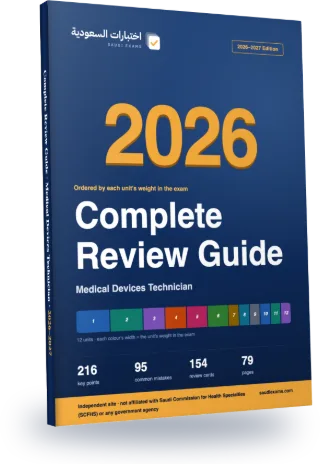 Complete Review Guide 2026–2027 included (PDF)Ordered by the weight of each unit in the examBuy now · SAR 34or 7 days for SAR 26
See everything included
Full mock exams like the real one and 525 explained questions that find your weak spots and train them
- Unlimited full mock exams to practise your pace and check your performance across the whole exam
- Practise 10 weak-area questions, starting where you lose the most marks
- 525 questions explaining why every option is right or wrong
- Arabic and English with one pass
- Unit notes and flashcards, then questions to check your understanding
This exam is part of professional classification as a medical devices technician, and you cannot get a practice licence without classification. If you do not pass you get further attempts under SCFHS rules and pay the evaluation fee. Source Last verified: 2026-11-17