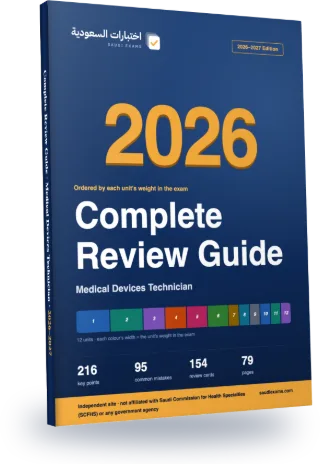
Medical Devices Technician Complete Review Guide 2026–2027
Every exam topic in a 79-page Arabic PDF, ordered from the heaviest unit to the lightest. The first three chapters alone cover about 40% of the exam questions.
- 79Pages
- 216Key points
- 95Common mistakes
- 154Flashcards
Guide map
Each chapter is one exam unit, ordered by its weight in the real exam.
| Chapter | Unit | Weight | Exam questions | Key points |
|---|---|---|---|---|
| 1 | Biomedical Equipment Technology | 15% | 23 | 18 |
| 2 | Advanced Electronics and Electricity | 15% | 22 | 18 |
| 3 | Anatomy and Physiology | 10% | 15 | 18 |
| 4 | Medical Informatics | 10% | 15 | 18 |
| 5 | Professionalism | 10% | 15 | 18 |
| 6 | Patient Safety, Electrical Safety and Hazards | 10% | 15 | 18 |
| 7 | Mathematics | 5% | 8 | 18 |
| 8 | Physics | 5% | 7 | 18 |
| 9 | Chemistry | 5% | 8 | 18 |
| 10 | Practical Experience | 5% | 7 | 18 |
| 11 | Research and Design | 5% | 8 | 18 |
| 12 | Regulation and Standards | 5% | 7 | 18 |
Chapter 1 in full: Biomedical Equipment Technology
15% of the exam, about 23 questions. These are its key points, as in the guide.
- (Patient monitoring) Lead II is the voltage between the right arm and left leg, and a 12-lead ECG derives 12 leads from only 10 electrodes.
- (Patient monitoring) WHO ECG monitor procedure: check the patient cable and lead selector switch, gain and calibration, frequency response and common-mode rejection, heart-rate meter accuracy at 3 points within ±3%, and the high and low alarms.
- (Patient monitoring) A pulse oximeter derives SpO2 from the different absorption of red and infrared light by haemoglobin. WHO guidance favours a soft flexible probe for long monitoring because it avoids pressure injury and limits ambient light interference.
The rest of chapter 1, on this page
- (Patient monitoring) For an unstable reading: insert the finger fully to the end of the clamp, remove dark nail polish and clean the probe, and shield the probe from strong light.
- (Patient monitoring) Cuff and stethoscope: diastolic is the last Korotkoff sound, and MAP = diastolic + one-third of pulse pressure. Automated cuff monitors are checked with a non-invasive blood pressure simulator, and electronic thermometers use a thermistor.
- (Life-support devices) Ventilator equation of motion: airway pressure = (volume × elastance) + (resistance × flow) + PEEP, and time constant = resistance × compliance (for example 15 × 0.04 = 0.6 s).
- (Life-support devices) A defibrillator discharges a capacitor: E = ½CV², so 400 J at 10,000 V needs 8 μF. Larger paddles spread the current over a bigger area and lower the burn risk.
- (Life-support devices) Electrosurgery: a facility with many operating rooms may buy an electrosurgical analyser, and insulated diathermy forceps are tested with an insulation pinpoint tester.
- (Life-support devices) WHO anaesthesia machine maintenance: leak test the internal circuits, check vaporizer and flowmeter calibration, verify the gas scavenger system and ventilator operation (rate, volume, flow).
- (Life-support devices) WHO infusion pump maintenance: battery test, pressure calibration, auto pinch-off test and rate accuracy. Hard limits in the drug library cannot be overridden, so the nurse must edit the value.
- (Diagnostic imaging) X-ray: the continuous spectrum comes from electrons slowing in the anode, and maximum photon energy equals tube voltage (90 kV gives 90 keV). A step-up transformer conserves power: 10 A at 120 V gives about 12 mA at 100 kV.
- (Diagnostic imaging) Ultrasound: a piezoelectric crystal sends pulses and detects echoes. Reflector depth = speed of sound × echo time ÷ 2, and the Doppler shift is proportional to blood speed.
- (Diagnostic imaging) CT rotates around the patient and gives a much higher dose than plain X-ray. MRI uses a superconducting magnet and excludes iron implants, and its rooms use aluminium alloy oxygen cylinders.
- (Support equipment) Steam sterilization needs air removal: prevacuum sterilizers run at 132 to 135 °C and gravity ones at 121 °C or higher. The Bowie-Dick test is run daily on prevacuum units.
- (Support equipment) Chemical indicators (ISO 11140) have six types: 1 process, 2 specific tests such as Bowie-Dick, 3 single variable, 4 multivariable, 5 integrating, 6 emulating. A biological indicator contains viable spores.
- (Support equipment) An oxygen concentrator uses pressure swing adsorption with zeolite sieve beds that adsorb nitrogen. It should deliver above 82% oxygen and alarm below 82%, and the gross particle filter is cleaned weekly or more often in dusty places.
- (Support equipment) Oxygen cylinders: white under ISO, the Pin Index system prevents the wrong gas connection, they are secured with a chain or strap, kept free of oil and grease and away from ignition sources. Low-temperature steam formaldehyde suits hemodialysis materials.
- (Sensors, transducers and electrodes) Wet Ag/AgCl electrodes are the clinical standard because the gel lowers the electrode-skin interface impedance. Dry electrodes avoid skin preparation but give a weaker, noisier signal.
Common mistakes in this chapter
- A steady SpO2 near 85% with a flat waveform is not a true saturation. It is a default value shown when the signal is invalid.
- A two-wavelength oximeter cannot tell carboxyhaemoglobin from oxyhaemoglobin, so SpO2 looks normal in carbon monoxide poisoning.
- In volume control with fixed flow and volume, a steadily rising peak pressure points to higher resistance (a kink or secretions), not to a change in volume.
- In pressure control the volume follows compliance (volume = pressure × compliance), so it falls when lung disease worsens while the set pressure stays the same.
- The bubble test on an oxygen concentrator finds only gross leaks. It does not confirm purity, which is checked with the oxygen monitor or an oxygen analyser.
- Dry electrodes give lower amplitude, higher impedance and more noise than wet Ag/AgCl electrodes, and wet gel can dry out and coagulate with long use.
- Maximum X-ray photon energy equals the tube voltage in keV (90 kV gives at most 90 keV), not an average energy.
- The Bowie-Dick test checks air removal and steam penetration and does not replace the biological indicator, and immediate-use (flash) sterilization should be avoided when possible.
The other chapters are in the full guide
One purchase · lifetime access · review guide included
7-day review plan
The chapters are spread over 6 days by weight so each day carries a similar load. Day 7 is a full exam.
Day 1 · 20% of the exam
Chapter 1: Biomedical Equipment Technology
Chapter 11: Research and DesignDay 2 · 20% of the exam
Chapter 2: Advanced Electronics and Electricity
Chapter 12: Regulation and StandardsDay 3 · 15% of the exam
Chapter 3: Anatomy and Physiology
Chapter 7: MathematicsDay 4 · 15% of the exam
Chapter 4: Medical Informatics
Chapter 8: PhysicsDay 5 · 15% of the exam
Chapter 5: Professionalism
Chapter 9: ChemistryDay 6 · 15% of the exam
Chapter 6: Patient Safety, Electrical Safety and Hazards
Chapter 10: Practical ExperienceDay 7
Full mock exam: 150 questions in 180 minutes, then review the common mistakes in the units where you lost marks.
How many correct answers do you need?
- Pass mark 55%83 correct out of 150
Before you read: see your score today
10 free questions from the main units, no sign-up. Then you know which chapter to start with.
Try 10 free questions and see your levelA look at each chapter
The first three key points of each chapter, as they appear in the guide (in Arabic in the PDF).
Chapter 1: Biomedical Equipment Technology
- (Patient monitoring) Lead II is the voltage between the right arm and left leg…
- (Patient monitoring) WHO ECG monitor procedure
- (Patient monitoring) A pulse oximeter derives SpO2 from the different absorption of red and…
Chapter 2: Advanced Electronics and Electricity
- (DC circuits) Ohm's law
- (DC circuits) In series the current is common and voltages and resistances add; in…
- (DC circuits) Power P = V × I = I²R = V²/R. A resistor…
Chapter 3: Anatomy and Physiology
- (Cardiovascular system) The SA node in the right atrium has the highest inherent depolarization…
- (Cardiovascular system) The PR interval is more clinically useful than the PR segment, and…
- (Cardiovascular system) Atrial contraction (the atrial kick) adds about 20-30% of ventricular filling; 70-80%…
Chapter 4: Medical Informatics
- (Computer fundamentals) RAM is volatile and loses data when power is removed; ROM, EEPROM…
- (Computer fundamentals) EEPROM is erased electrically, so stored programs can be updated without removing…
- (Computer fundamentals) DRAM stores bits in tiny capacitors that leak, so it needs periodic…
Chapter 5: Professionalism
- (Ethics and professional conduct) Truthfulness, honesty and integrity, humbleness, patience, passion and love, and…
- (Ethics and professional conduct) Self-accountability (Chapter 1 (C)) covers even the smallest lapses, such…
- (Ethics and professional conduct) The practitioner does not answer a patient's irritability with anger…
Chapter 6: Patient Safety, Electrical Safety and Hazards
- (Electrical shock) Shock hazard needs all of these
- (Electrical shock) Typical effects of a 1 s, 60 Hz shock through the trunk…
- (Electrical shock) Body resistance sits mostly in dry skin. In the OpenStax example, 120…
Chapter 7: Mathematics
- (Algebra, functions and logarithms) log(ab) = log a + log b, log(a/b) = log…
- (Algebra, functions and logarithms) Change of base
- (Algebra, functions and logarithms) To solve an exponential equation with the unknown in the…
Chapter 8: Physics
- (Mechanics, fluids and pressure) Work-energy theorem
- (Mechanics, fluids and pressure) Flow rate Q = V/t = A·v; the SI unit…
- (Mechanics, fluids and pressure) Bernoulli's equation
Chapter 9: Chemistry
- (Atoms, bonding) The modern periodic table is ordered by atomic number; main-group elements sit…
- (Atoms, bonding) Family names
- (Atoms, bonding) Metals form cations with a charge equal to the group number; nonmetals…
Chapter 10: Practical Experience
- (Preventive and corrective maintenance) Maintenance has two major categories: inspection and preventive maintenance (IPM)…
- (Preventive and corrective maintenance) Preventive maintenance (PM) includes calibration, part replacement, lubrication and cleaning…
- (Preventive and corrective maintenance) A performance inspection compares the device to the manufacturer's specifications;…
Chapter 11: Research and Design
- (Biostatistics and study design) Stratified sample
- (Biostatistics and study design) A convenience sample uses readily available results and is non-random…
- (Biostatistics and study design) In an experiment, units are assigned to treatments at random…
Chapter 12: Regulation and Standards
- (Device classification) GHTF proposed classes
- (Device classification) US classification
- (Device classification) General controls include
The full guide comes with lifetime access
The full guide (79 pages) is included with lifetime access to this exam, together with every question and full mock exam. Chapter 1 is free for everyone.
Questions about the guide
Is the guide free?
Chapter 1 is free to read on the guide page. The full guide comes with lifetime access to this exam; 7-day access does not include it.
Is it up to date for 2026–2027?
Yes. Unit weights and exam facts follow what the exam body last published, and the last check date is printed in the guide. If the standards change we update the file and buyers download the new version.
Does the guide have questions?
No. The guide covers key points and common mistakes; scoring, weak-area practice and full mock exams are on the site.
Can I read it on my phone?
Yes. A5 pages in a single column, with chapters linked from the contents.
- Pages
- 79
- Edition
- 1448 AH · 2026–2027
- Language
- Arabic
- Last updated
Full prep for this exam
All of this in one purchase.
- Full mock exam, same as the real one150 questions in 180 minutes. You get a total score and a score for every unit.
- Practice unit by unit525 questions, every option explained with its source. Starts with your weakest units.
- Complete Review Guide 2026–2027 (PDF)Ordered by each unit's weight in the exam. With lifetime access only.
Choose your access
Continue with your Google account and you go straight to the payment page.