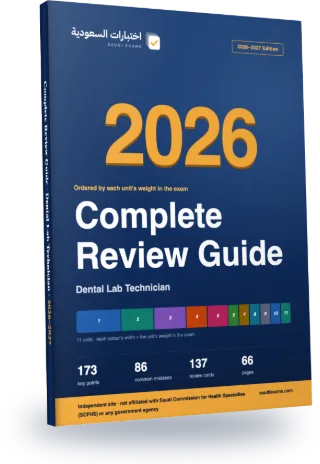
Dental Lab Technician Complete Review Guide 2026–2027
Every exam topic in a 66-page Arabic PDF, ordered from the heaviest unit to the lightest. The first three chapters alone cover about 50% of the exam questions.
- 66Pages
- 173Key points
- 86Common mistakes
- 137Flashcards
Guide map
Each chapter is one exam unit, ordered by its weight in the real exam.
| Chapter | Unit | Weight | Exam questions | Key points |
|---|---|---|---|---|
| 1 | Fixed Restorations | 20% | 30 | 18 |
| 2 | Dental Anatomy and Occlusion | 15% | 23 | 16 |
| 3 | Dental Materials | 15% | 22 | 16 |
| 4 | Removable Complete Prosthesis | 10% | 15 | 14 |
| 5 | Removable Partial Prosthesis | 10% | 15 | 15 |
| 6 | Dental Implant Prosthesis | 5% | 8 | 14 |
| 7 | Orthodontic Appliances | 5% | 8 | 14 |
| 8 | Maxillofacial Prosthesis | 5% | 8 | 15 |
| 9 | Infection Control | 5% | 7 | 15 |
| 10 | Health and Safety | 5% | 7 | 18 |
| 11 | CAD-CAM Restorations | 5% | 7 | 18 |
Chapter 1 in full: Fixed Restorations
20% of the exam, about 30 questions. These are its key points, as in the guide.
- (Working casts, dies and margin definition) Type IV (high-strength, low-expansion) die stone is used for dies because it resists abrasion and reproduces fine detail.
- (Working casts, dies and margin definition) A sectioned die on a pin system lets the technician remove and replace a die while keeping its exact position in the arch.
- (Working casts, dies and margin definition) Trim the die below the margin only enough to expose it; never cut into the prepared margin, and mark the margin with a fine sharp pencil.
The rest of chapter 1, on this page
- (Working casts, dies and margin definition) Die spacer is painted in thin coats on the prepared surface to leave room for luting cement, and it stops short of the margin so marginal fit is not lost.
- (Wax patterns, spruing, investing and casting) Wax tends to return to its original shape as stored stress is released, so a pattern should be invested soon after completion and kept away from heat.
- (Wax patterns, spruing, investing and casting) The sprue is attached to the bulkiest part of the pattern, and a reservoir or sufficiently thick sprue feeds molten metal as the casting solidifies.
- (Wax patterns, spruing, investing and casting) Gypsum-bonded investment suits gold alloys; it is not heated above about 700 °C because it breaks down and releases sulfur compounds.
- (Wax patterns, spruing, investing and casting) Phosphate-bonded investment withstands higher temperatures and is chosen for high-fusing alloys, including base-metal alloys and metal-ceramic alloys.
- (Metal-ceramic crowns and porcelain application) The metal coping needs uniform thickness, rounded line angles and no undercuts or sharp edges, so porcelain is evenly supported.
- (Metal-ceramic crowns and porcelain application) Porcelain is applied in the order opaque, body (dentin), then incisal (enamel), and finally stain and glaze; the opaque layer masks the metal colour.
- (Metal-ceramic crowns and porcelain application) Porcelain shrinks on firing, so the buildup is made slightly oversize and vacuum firing reduces porosity.
- (Metal-ceramic crowns and porcelain application) A good bond depends on a controlled oxide layer on the alloy, and on a coefficient of thermal expansion of porcelain slightly lower than that of the metal so porcelain stays in compression.
- (All-ceramic crowns, bridges, pontics, inlays and onlays) Zirconia is milled oversize and shrinks during sintering; glass ceramics such as lithium disilicate are etched with hydrofluoric acid and silanated, whereas zirconia is airborne-particle abraded.
- (All-ceramic crowns, bridges, pontics, inlays and onlays) A bridge has retainers, pontic and connectors; the rigidity of a connector rises steeply with its height, so occlusogingival height is the key dimension.
- (All-ceramic crowns, bridges, pontics, inlays and onlays) Modified ridge-lap pontics are convex on the tissue side and give good appearance with cleansability; sanitary pontics do not touch the ridge and are used where hygiene matters most.
- (Soldering, finishing and polishing of fixed restorations) Solder must melt at a lower temperature than the parts joined; flux keeps the surfaces clean from oxides, and a small uniform gap gives the strongest joint.
- (Soldering, finishing and polishing of fixed restorations) Pre-ceramic soldering is done before porcelain firing with a high-fusing solder; post-ceramic soldering uses a lower-fusing solder after the porcelain is fired.
- (Soldering, finishing and polishing of fixed restorations) Finish and polish with progressively finer abrasives, avoiding overheating and keeping the margins, contacts and occlusion unchanged.
Common mistakes in this chapter
- Cutting or removing the margin while trimming a die
- Letting die spacer reach the margin so the crown does not seat or fits open
- Leaving a wax pattern uninvested for too long, so stress release distorts it
- Heating gypsum-bonded investment too high, which releases sulfur and contaminates the alloy
- Using gypsum-bonded investment for a high-fusing base-metal alloy
- Making porcelain too thick over an unsupported area or leaving sharp metal line angles
- Placing the metal-ceramic junction on a centric contact point
- Confusing the thermal expansion mismatch effects: porcelain under tension tends to crack, under compression it is stronger
The other chapters are in the full guide
One purchase · lifetime access · review guide included
7-day review plan
The chapters are spread over 6 days by weight so each day carries a similar load. Day 7 is a full exam.
Day 1 · 20% of the exam
Chapter 1: Fixed Restorations
Day 2 · 20% of the exam
Chapter 2: Dental Anatomy and Occlusion
Chapter 11: CAD-CAM RestorationsDay 3 · 15% of the exam
Chapter 3: Dental Materials
Day 4 · 15% of the exam
Chapter 4: Removable Complete Prosthesis
Chapter 8: Maxillofacial ProsthesisDay 5 · 15% of the exam
Chapter 5: Removable Partial Prosthesis
Chapter 9: Infection ControlDay 6 · 15% of the exam
Chapter 6: Dental Implant Prosthesis
Chapter 7: Orthodontic Appliances
Chapter 10: Health and SafetyDay 7
Full mock exam: 150 questions in 180 minutes, then review the common mistakes in the units where you lost marks.
How many correct answers do you need?
- Pass mark 55%83 correct out of 150
Before you read: see your score today
10 free questions from the main units, no sign-up. Then you know which chapter to start with.
Try 10 free questions and see your levelA look at each chapter
The first three key points of each chapter, as they appear in the guide (in Arabic in the PDF).
Chapter 1: Fixed Restorations
- (Working casts, dies and margin definition) Type IV (high-strength, low-expansion) die stone is used…
- (Working casts, dies and margin definition) A sectioned die on a pin system lets…
- (Working casts, dies and margin definition) Trim the die below the margin only enough…
Chapter 2: Dental Anatomy and Occlusion
- (Tooth morphology, numbering systems and dental tissues) Universal numbering runs 1 to 32 for…
- (Tooth morphology, numbering systems and dental tissues) FDI notation uses two digits: the first…
- (Tooth morphology, numbering systems and dental tissues) Enamel is the hardest tissue in the…
Chapter 3: Dental Materials
- (Physical and mechanical properties of dental materials) Stress is force per unit area and…
- (Physical and mechanical properties of dental materials) The proportional limit is the highest stress…
- (Physical and mechanical properties of dental materials) Ductility is the ability to be drawn…
Chapter 4: Removable Complete Prosthesis
- (Impressions, casts, temporary bases and occlusion rims) Important maxillary landmarks include the incisive papilla…
- (Impressions, casts, temporary bases and occlusion rims) The buccal shelf is the primary stress-bearing…
- (Impressions, casts, temporary bases and occlusion rims) A custom tray is made on a…
Chapter 5: Removable Partial Prosthesis
- (Kennedy classification, surveying and design) Class I is bilateral distal-extension edentulous areas without posterior…
- (Kennedy classification, surveying and design) Classification is made after any extractions, and the most…
- (Kennedy classification, surveying and design) The surveyor identifies the height of contour, undercuts, guiding…
Chapter 6: Dental Implant Prosthesis
- (Implant components and impression techniques) The implant body is placed in bone, covered by…
- (Implant components and impression techniques) The impression coping records implant position in the impression…
- (Implant components and impression techniques) Open-tray (direct) technique has screw access through the tray…
Chapter 7: Orthodontic Appliances
- (Removable appliances and wire bending) A removable appliance has four basic parts: baseplate, retention…
- (Removable appliances and wire bending) Adams clasp is a retentive clasp usually made on…
- (Removable appliances and wire bending) Active springs such as the finger spring are made…
Chapter 8: Maxillofacial Prosthesis
- (Intra-oral prostheses
- (Intra-oral prostheses
- (Intra-oral prostheses
Chapter 9: Infection Control
- (Sterilization, disinfection and handling of incoming impressions and prostheses) Cleaning removes visible soil and…
- (Sterilization, disinfection and handling of incoming impressions and prostheses) Sterilization destroys all microorganisms including…
- (Sterilization, disinfection and handling of incoming impressions and prostheses) Steam under pressure in an…
Chapter 10: Health and Safety
- (Chemical hazards, dust, fumes and ventilation) A safety data sheet gives the hazards, protective…
- (Chemical hazards, dust, fumes and ventilation) Methyl methacrylate monomer is flammable, gives off irritating…
- (Chemical hazards, dust, fumes and ventilation) Hydrofluoric acid, used to etch ceramics, causes deep…
Chapter 11: CAD-CAM Restorations
- (Scanning, design software and the digital workflow) The digital workflow runs from data acquisition…
- (Scanning, design software and the digital workflow) Data may be captured by an intraoral…
- (Scanning, design software and the digital workflow) Scan data are stored as surface mesh…
The full guide comes with lifetime access
The full guide (66 pages) is included with lifetime access to this exam, together with every question and full mock exam. Chapter 1 is free for everyone.
Questions about the guide
Is the guide free?
Chapter 1 is free to read on the guide page. The full guide comes with lifetime access to this exam; 7-day access does not include it.
Is it up to date for 2026–2027?
Yes. Unit weights and exam facts follow what the exam body last published, and the last check date is printed in the guide. If the standards change we update the file and buyers download the new version.
Does the guide have questions?
No. The guide covers key points and common mistakes; scoring, weak-area practice and full mock exams are on the site.
Can I read it on my phone?
Yes. A5 pages in a single column, with chapters linked from the contents.
- Pages
- 66
- Edition
- 1448 AH · 2026–2027
- Language
- Arabic
- Last updated
Full prep for this exam
All of this in one purchase.
- Full mock exam, same as the real one150 questions in 180 minutes. You get a total score and a score for every unit.
- Practice unit by unit591 questions, every option explained with its source. Starts with your weakest units.
- Complete Review Guide 2026–2027 (PDF)Ordered by each unit's weight in the exam. With lifetime access only.
Choose your access
Continue with your Google account and you go straight to the payment page.