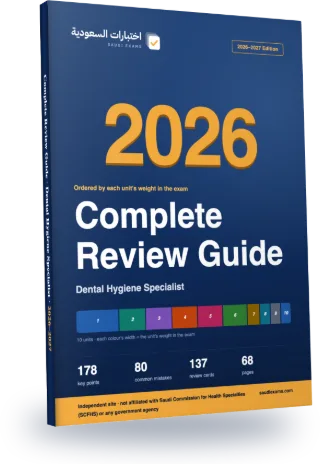
Try the questions in the test above first, then open each one here to see the correct answer and why every other option is wrong.
01A mother reports that her 5-year-old's permanent first molars erupted unusually early. The child has no systemic disease. Which statement about the rest of the dentition is best supported by population eruption data?
Practice question Unit: Basic Sciences: Dental Anatomy, Biology, Physiology and Oral Pathology
AIncisors will also erupt early because all permanent teeth follow one shared eruption timetable in each child.
A single shared timetable is not supported; molar eruption times were not correlated with those of nonmolars.
BEruption of every tooth group will be delayed later to compensate for the early start.
Nothing in the data shows compensation; eruption timing in one group does not trigger delays in another group.
CChronological age predicts the eruption time of each permanent tooth closely.
The correlation between chronological age and eruption time for an individual tooth is weak, so age is a poor predictor.
DSecond molars are likely to erupt early too, but incisor timing cannot be predicted from them. ✓ Correct answer
Eruption times correlate within a tooth group, so early first molars suggest early second molars, but not incisors.
Reference: Mechanism of Human Tooth Eruption, Scientifica 2014 (PMC3944225), section "Correlation between Eruption of Different Teeth"; SCFHS Dental Hygiene Specialist Content Guideline V1.220901, Section 1 Basic Sciences, p. 2
Ask a friend
02A 52-year-old with type 1 diabetes for 28 years uses insulin and says, "I never feel lows anymore, so I don't check before appointments." Treatment is scheduled for 90 minutes. Which response is best?
Practice question Unit: Medical and Dental Histories
AAccept the statement, since the absence of symptoms means glucose is normal, and begin as planned today
Warning symptoms can fade or vanish with insulin therapy, so no symptoms does not mean normal glucose.
BCancel all treatment permanently, since a patient who cannot feel lows can never safely be treated in the office
Impaired awareness calls for care and testing; it does not justify permanent refusal of treatment.
CExplain that long-term insulin use can blunt warning symptoms, ask about recent lows, and check glucose first ✓ Correct answer
Impaired awareness of hypoglycemia follows insulin treatment and is commoner in long-standing type 1 diabetes, so history and a glucometer check are essential.
DGive 15 to 20 g of carbohydrate to every patient with diabetes at arrival so that no meter is needed
Routine carbohydrate for everyone is unnecessary and may cause hyperglycemia; the meter reading guides action.
Reference: British Dental Journal 2020, "Medical emergencies in the dental practice poster: revised and updated", section "Hypoglycaemia"; American Dental Association, Diabetes (web page accessed 2026), section "Hypoglycemia", subsection "Treatment"; SCFHS Dental Hygiene Specialist Content Guideline V1.220901, Section 2 Medical and Dental Histories, p. 2
Ask a friend
03A 19-year-old has fever, sore throat, marked fatigue, and tender enlarged nodes on both sides of the posterior neck. Which extra-oral finding best supports Epstein-Barr infectious mononucleosis rather than a local dental infection?
Practice question Unit: Extra and Intra Oral Examination
ABilateral posterior cervical nodes, with possible spread to other groups ✓ Correct answer
Mononucleosis typically involves the bilateral posterior cervical nodes and may extend to axillary and inguinal groups, unlike most causes of pharyngitis.
BAn enlarged node confined to the ipsilateral submandibular area under the jaw
A one-sided submandibular node drains a nearby odontogenic or oral source and does not suggest a systemic viral illness.
CA single hard node in the submental region of one side
A single hard submental node suggests a localised or neoplastic process, not a diffuse viral illness.
DAn isolated preauricular node on the same side as a carious molar
An isolated node on one side near a carious tooth indicates a local source rather than a generalised lymphoid response.
Reference: Peripheral lymphadenopathy: approach and diagnostic tools, Iran J Med Sci 2014 (PMC full text), section "Generalized Adenopathy"; SCFHS Dental Hygiene Specialist Content Guideline V1.220901, Section 3 Extra and Intra Oral Examination, p. 2
Ask a friend
04A practice moves from film to photostimulable phosphor plates. Retakes fall, but nobody reviews exposure settings and the timer values slowly increase. Why is this a radiation protection concern?
Practice question Unit: Radiology
ADigital images darken visibly with overexposure, so every timer error is obvious to the operator
Overexposed digital images often still look acceptable, so the excess dose is not obvious the way a dark film would be.
BDigital receptors need higher doses than film, so slowly rising settings are an expected change
Digital imaging can reduce dose by 40 to 60 percent compared with film, so rising settings are not expected.
CDigital images forgive overexposure, so extra dose can go unnoticed ✓ Correct answer
Filmless technology forgives overexposure, so images still look acceptable; the timer should be set to the lowest setting giving a diagnostic image.
DPlates fog from room light, so longer timer settings are needed to compensate for this loss
Room light affects film handling, but it does not explain gradual increases in timer values after switching to plates.
Reference: ADA/FDA, Dental Radiographic Examinations: Recommendations for Patient Selection and Limiting Radiation Exposure, 2012 revision, section "Operating Potential and Exposure Time" and "Receptor Selection"; SCFHS Dental Hygiene Specialist Content Guideline V1.220901, Section 4 Radiology, p. 2
Ask a friend
05Per the 2018 case definition for periodontitis, which patient meets the criteria for a periodontitis diagnosis?
Practice question Unit: Non-Surgical Periodontal Therapy
ABuccal attachment loss of 3 mm with 4 mm probing depths at two teeth, with no non-periodontal cause found ✓ Correct answer
This meets the buccal criterion: loss of 3 mm or more with probing depth over 3 mm at two teeth, no other cause.
BInterdental attachment loss of 3 mm at one molar only, with no attachment loss on any other tooth
Interdental loss must be found at two or more non-adjacent teeth, so one affected molar does not meet the definition.
CBuccal recession of 4 mm at two teeth with 2 mm probing depths, caused by long-standing forceful brushing
Recession with shallow 2 mm pockets from brushing trauma has a non-periodontal cause, and probing depth does not exceed 3 mm.
DInterdental attachment loss of 2 mm on two adjacent central incisors after recent orthodontic tooth movement
Adjacent teeth do not count as separate sites, and orthodontic tooth movement is a recognized non-periodontal explanation for the loss.
Reference: Journal of Periodontal & Implant Science 2023, "Determination of the stage and grade of periodontitis according to the current classification of periodontal and peri-implant diseases and conditions (2018) using machine learning algorithms", section "Materials and Methods"; SCFHS Dental Hygiene Specialist Content Guideline V1.220901, Section 5 Non-Surgical Periodontal Therapy, p. 2
Ask a friend
06An 82-year-old with advanced dementia cannot cooperate with drilling. The hygienist finds a soft cavitated root lesion that has not reached the pulp. Which approach fits the available evidence for this patient?
Practice question Unit: Preventive Therapy
AApply silver diamine fluoride as an interim measure and reapply at recall visits ✓ Correct answer
Silver diamine fluoride has shown efficacy for root caries in older adults and as an interim approach when involved treatment is not tolerated.
BDefer all care until the patient can cooperate with a complete restorative appointment under routine conditions
Waiting lets an active lesion keep progressing toward the pulp, and the evidence supports a nonrestorative option for patients who cannot tolerate treatment.
CApply 5% sodium fluoride varnish once and expect the soft lesion to harden for good
A single varnish application is not documented to arrest a cavitated lesion, and varnish arrests dentine caries less effectively than silver diamine fluoride.
DExcavate the soft tissue with hand instruments and leave the cavity open unrestored
Leaving an open, unsealed cavity keeps a non-cleansable niche where plaque stays, so the lesion would remain active and likely progress.
Reference: ADA, Fluoride: Topical and Systemic Supplements, ADA oral health topics page, section "Silver Diamine Fluoride"; SCFHS Dental Hygiene Specialist Content Guideline V1.220901, Section 6 Preventive Therapy, p. 2
Ask a friend
07A hygienist treats a patient who fainted in the chair, woke within a minute, and now says he feels fine. Which additional finding, according to MedlinePlus guidance on fainting, most clearly means emergency services should be called?
Practice question Unit: Management of Medical Emergencies and Medically Compromised Patients
AHe recalls feeling warm and sweaty a moment before collapsing
Feeling warm and sweaty before fainting is a typical warning sign of a simple faint, not an emergency criterion.
BHe admits he skipped breakfast on the morning of the visit
Skipping a meal may contribute to a faint but is not listed as a criterion for calling emergency services.
CHe reports a pounding or irregular heartbeat after waking ✓ Correct answer
A pounding or irregular heartbeat may signal a heart rhythm problem; MedlinePlus lists it among reasons to call emergency services.
DHe says the room felt crowded just before he went pale
Feeling crowded or stuffy before fainting is a common trigger, not a listed warning sign needing emergency care.
Reference: MedlinePlus Medical Encyclopedia, Fainting (review date 5/19/2025), section "When to Contact a Medical Professional"; SCFHS Dental Hygiene Specialist Content Guideline V1.220901, Section 7 Management of Medical Emergencies and Medically Compromised Patients, p. 2
Ask a friend
08During a recall visit a patient says, "My gums bleed every morning and it worries me, but evenings are chaotic and I can't see myself flossing." Which hygienist reply best follows the motivational interviewing principle of listening for and eliciting change talk?
Practice question Unit: Communication Skills
ASay that many parents manage a two-minute routine and ask which evening task could be dropped to make room
Comparing her with other parents and telling her what to drop imposes advice instead of eliciting her own reasons for change.
BAgree that evenings are hard, then recommend moving interdental cleaning to a quieter point in the day
This accepts the difficulty and moves straight to advice, so her own reasons for change are never elicited or explored.
CReflect the worry about morning bleeding, then ask what would be different if the bleeding stopped ✓ Correct answer
Reflecting the worry picks up her change talk, and the follow-up question lets her voice her own reasons and the benefits of change.
DReflect the evening chaos and reassure the patient that flossing is optional if brushing is thorough
Reflecting only the chaos and calling flossing optional ignores her stated worry and gives up support for a needed behavior change.
Reference: Gillam DG, Yusuf H, Brief Motivational Interviewing in Dental Practice, Dentistry Journal (MDPI) 2019, section "Evoking" (listening for and eliciting change talk; reflective listening); SCFHS Dental Hygiene Specialist Content Guideline V1.220901, Section 8 Communication Skills, p. 2
Ask a friend
09A clinic acquires an older low-speed handpiece that cannot be heat sterilized. The manufacturer cannot supply documentation of FDA clearance or validated reprocessing instructions. Per the CDC statement summarized by the ADA, what should the clinic do?
Practice question Unit: Patient Safety
ACover it with a barrier sleeve and wipe it between patients
A sleeve and wiping do not make a device that lacks validated reprocessing instructions safe to use between patients.
BReprocess it by high-level disinfectant immersion between patients
Immersion is not a validated reprocessing method for this device, so it does not solve the missing-documentation problem.
CStop using that handpiece in patient care ✓ Correct answer
The CDC statement says a handpiece that cannot be heat sterilized and has no FDA-cleared validated instructions should not be used.
DReserve it for patients who report no bloodborne infections
Patient self-report cannot identify all infections, and standard precautions apply to every patient regardless of reported history.
Reference: American Dental Association, Infection Control and Sterilization (web page, summarizing CDC 2003 guidelines and 2016 summary), section "Instrument and Equipment Sterilization"; SCFHS Dental Hygiene Specialist Content Guideline V1.220901, Section 9 Patient Safety, p. 2
Ask a friend
10A patient who has capacity attends with her adult daughter, who manages her home care. The patient says, 'You can explain things to her.' Which basis lets the hygienist discuss the home-care plan with the daughter?
Practice question Unit: Professionalism and Ethics
AA dedicated written authorization, because no family disclosure is allowed without one.
Providers may share care-related information with someone involved in care when the patient agrees, so no separate authorization form is required.
BThe daughter's family relationship, which gives her access to the entire patient record.
Relationship alone does not open the whole record; disclosure is limited to what is directly relevant to the person's involvement in the patient's care.
CThe patient's agreement, limited to information relevant to the daughter's role in care. ✓ Correct answer
With a present patient who has capacity, a provider may share information directly relevant to the family member's involvement once she agrees.
DThe daughter's payment of the bill, which entitles her to every chart entry.
Paying a bill does not entitle someone to the full chart; permitted sharing is tied to the patient's agreement and relevance to care.
Reference: US Department of Health and Human Services, HIPAA Privacy Rule, 45 CFR Part 164, eCFR, § 164.510(b) Uses and disclosures for involvement in the individual's care, (b)(1)-(2); SCFHS Dental Hygiene Specialist Content Guideline V1.220901, Section 10 Professionalism and Ethics, p. 2
Ask a friend