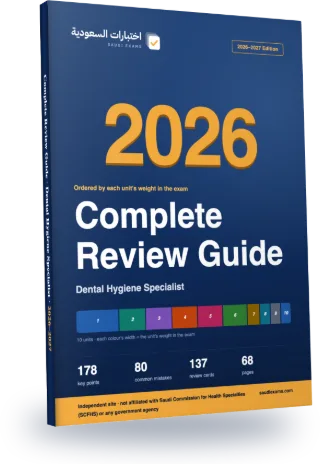
Dental Hygiene Specialist Complete Review Guide 2026–2027
Every exam topic in a 68-page Arabic PDF, ordered from the heaviest unit to the lightest. The first three chapters alone cover about 43% of the exam questions.
- 68Pages
- 178Key points
- 80Common mistakes
- 137Flashcards
Guide map
Each chapter is one exam unit, ordered by its weight in the real exam.
| Chapter | Unit | Weight | Exam questions | Key points |
|---|---|---|---|---|
| 1 | Non-Surgical Periodontal Therapy | 19% | 29 | 18 |
| 2 | Basic Sciences: Dental Anatomy, Biology, Physiology and Oral Pathology | 12% | 18 | 18 |
| 3 | Medical and Dental Histories | 12% | 18 | 18 |
| 4 | Extra and Intra Oral Examination | 12% | 18 | 17 |
| 5 | Preventive Therapy | 12% | 18 | 17 |
| 6 | Management of Medical Emergencies and Medically Compromised Patients | 12% | 18 | 18 |
| 7 | Radiology | 6% | 9 | 18 |
| 8 | Communication Skills | 5% | 8 | 18 |
| 9 | Patient Safety | 5% | 7 | 18 |
| 10 | Professionalism and Ethics | 5% | 7 | 18 |
Chapter 1 in full: Non-Surgical Periodontal Therapy
19% of the exam, about 29 questions. These are its key points, as in the guide.
- (Periodontal classification, etiology and risk factors) Periodontal health and gingivitis have no clinical attachment loss from periodontitis; gingivitis is bleeding on probing with plaque as the cause and is reversible once the biofilm is controlled.
- (Periodontal classification, etiology and risk factors) Under the 2018 classification, periodontitis is staged I to IV using clinical attachment loss, radiographic bone loss, probing depth, tooth loss from periodontitis and complexity such as furcation involvement; grades A, B and C describe slow, moderate and rapid progression.
- (Periodontal classification, etiology and risk factors) Clinical attachment loss is the distance from the cementoenamel junction to the base of the pocket; probing depth is measured from the gingival margin to the base of the pocket.
The rest of chapter 1, on this page
- (Periodontal classification, etiology and risk factors) Bacterial biofilm is the primary etiologic factor; calculus, overhanging restorations, crowding and open contacts are plaque-retentive local factors, and host response determines disease severity.
- (Periodontal classification, etiology and risk factors) Smoking and poorly controlled diabetes are major modifiable risk factors; smoking also masks bleeding and weakens healing after therapy.
- (Periodontal instruments, grasp, fulcrum and ergonomics) A sickle scaler has a triangular cross section and a pointed tip and is used for supragingival calculus; a curette has a rounded toe and is used subgingivally.
- (Periodontal instruments, grasp, fulcrum and ergonomics) A universal curette has two cutting edges and a blade face at 90 degrees to the lower shank; a Gracey curette is area-specific, has one cutting edge, and its offset face is angled about 60 to 70 degrees to the lower shank.
- (Periodontal instruments, grasp, fulcrum and ergonomics) A Gracey curette is used with its lower (outer) cutting edge, the one on the convex side of the offset blade; Gracey 11/12 are for mesial and 13/14 for distal surfaces of posterior teeth.
- (Periodontal instruments, grasp, fulcrum and ergonomics) The modified pen grasp with an intraoral finger rest (fulcrum) near the working area, usually the ring finger on a stable tooth in the same arch, gives control and reduces fatigue.
- (Scaling, root planing, ultrasonic instrumentation and polishing) Insert a curette with the blade nearly parallel to the root (about 0 degrees), then use an angle of about 45 to 90 degrees against the tooth with short, controlled pull strokes.
- (Scaling, root planing, ultrasonic instrumentation and polishing) Scaling removes plaque and calculus; root planing removes remaining deposits and roughened cementum to leave a smooth, hard root surface that supports healing.
- (Scaling, root planing, ultrasonic instrumentation and polishing) Magnetostrictive inserts vibrate in an elliptical pattern with all sides active, while piezoelectric tips move in a linear pattern with the lateral sides active; use light pressure, constant motion and adequate water.
- (Scaling, root planing, ultrasonic instrumentation and polishing) Ultrasonic scaling is generally avoided or modified for patients at risk from aerosols, such as those with uncontrolled respiratory disease or difficulty swallowing; patients with cardiac pacemakers need guidance from their physician and the device manufacturer.
- (Scaling, root planing, ultrasonic instrumentation and polishing) Polishing is selective, not routine: a rubber cup with low speed and light, intermittent pressure removes extrinsic stain, and abrasives are used from coarse to fine only as needed.
- (Care planning, local antimicrobials, re-evaluation, maintenance and implants) Phase I non-surgical therapy comes first (oral hygiene instruction, scaling and root planing, risk factor control), followed by re-evaluation several weeks later to decide whether surgery or further therapy is needed.
- (Care planning, local antimicrobials, re-evaluation, maintenance and implants) Locally delivered antimicrobials, such as a chlorhexidine chip or doxycycline or minocycline products, are adjuncts for persistent localized pockets, not a replacement for mechanical debridement.
- (Care planning, local antimicrobials, re-evaluation, maintenance and implants) Supportive periodontal maintenance after active therapy is commonly scheduled about every 3 months and adjusted to the patient's risk and response.
- (Care planning, local antimicrobials, re-evaluation, maintenance and implants) Peri-implant mucositis is reversible inflammation without bone loss; peri-implantitis includes inflammation with progressive bone loss; use plastic, titanium or carbon-fiber instruments and gentle probing around implants.
Common mistakes in this chapter
- Mixing up stage and grade: stage describes severity and extent now, grade describes risk of future progression
- Saying calculus is the primary cause of periodontitis; the primary cause is the bacterial biofilm
- Measuring clinical attachment loss from the gingival margin; it is measured from the cementoenamel junction
- Choosing a Gracey curette number for the wrong tooth surface, or using the upper cutting edge instead of the lower one
- Using a sickle scaler subgingivally; its pointed tip and triangular shape are for supragingival work
- Using an ultrasonic scaler with a stationary tip, with no water, or with the tip point on the tooth
- Using a metal curette or metal ultrasonic tip on an implant surface instead of plastic, titanium or carbon-fiber instruments
- Treating re-evaluation as the end of care; patients with periodontitis still need ongoing maintenance visits
The other chapters are in the full guide
One purchase · lifetime access · review guide included
7-day review plan
The chapters are spread over 6 days by weight so each day carries a similar load. Day 7 is a full exam.
Day 1 · 19% of the exam
Chapter 1: Non-Surgical Periodontal Therapy
Day 2 · 18% of the exam
Chapter 2: Basic Sciences: Dental Anatomy, Biology, Physiology and Oral Pathology
Chapter 7: RadiologyDay 3 · 17% of the exam
Chapter 3: Medical and Dental Histories
Chapter 8: Communication SkillsDay 4 · 17% of the exam
Chapter 4: Extra and Intra Oral Examination
Chapter 9: Patient SafetyDay 5 · 17% of the exam
Chapter 5: Preventive Therapy
Chapter 10: Professionalism and EthicsDay 6 · 12% of the exam
Chapter 6: Management of Medical Emergencies and Medically Compromised Patients
Day 7
Full mock exam: 150 questions in 180 minutes, then review the common mistakes in the units where you lost marks.
How many correct answers do you need?
- Pass mark 60%90 correct out of 150
Before you read: see your score today
10 free questions from the main units, no sign-up. Then you know which chapter to start with.
Try 10 free questions and see your levelA look at each chapter
The first three key points of each chapter, as they appear in the guide (in Arabic in the PDF).
Chapter 1: Non-Surgical Periodontal Therapy
- (Periodontal classification, etiology and risk factors) Periodontal health and gingivitis have no clinical attachment…
- (Periodontal classification, etiology and risk factors) Under the 2018 classification, periodontitis is staged I…
- (Periodontal classification, etiology and risk factors) Clinical attachment loss is the distance from the…
Chapter 2: Basic Sciences: Dental Anatomy, Biology, Physiology and Oral Pathology
- (Dental anatomy, tooth morphology, dental tissues and eruption) Adults have 32 permanent teeth and…
- (Dental anatomy, tooth morphology, dental tissues and eruption) In the FDI system the first…
- (Dental anatomy, tooth morphology, dental tissues and eruption) Enamel is the hardest tissue in…
Chapter 3: Medical and Dental Histories
- (Health history interview, vital signs and ASA classification) The health history should be reviewed…
- (Health history interview, vital signs and ASA classification) A positive answer on the questionnaire…
- (Health history interview, vital signs and ASA classification) Normal adult resting pulse is about…
Chapter 4: Extra and Intra Oral Examination
- (Head and neck examination and lymph nodes) The extra-oral examination starts with general observation…
- (Head and neck examination and lymph nodes) Lymph nodes are palpated bilaterally with the…
- (Head and neck examination and lymph nodes) Main nodes examined: preauricular, postauricular, occipital, submental…
Chapter 5: Preventive Therapy
- (Fluoride and caries prevention) Fluoride works mainly topically: it reduces demineralization, promotes remineralization of…
- (Fluoride and caries prevention) Community water fluoridation is considered a safe, cost-effective and equitable…
- (Fluoride and caries prevention) Excess fluoride intake while enamel is forming (in early childhood)…
Chapter 6: Management of Medical Emergencies and Medically Compromised Patients
- (Medical emergencies in the dental office and CPR) Prevention is the best emergency management…
- (Medical emergencies in the dental office and CPR) Normal adult resting values are approximately…
- (Medical emergencies in the dental office and CPR) The first steps in any emergency…
Chapter 7: Radiology
- (Radiation physics, biology and radiation protection) Dental X-rays are produced when electrons from the…
- (Radiation physics, biology and radiation protection) Increasing kVp increases the energy and penetrating power…
- (Radiation physics, biology and radiation protection) Filtration with aluminum removes low-energy X-rays that would…
Chapter 8: Communication Skills
- (Patient communication, education and motivational interviewing) Effective communication builds rapport and trust, and improves…
- (Patient communication, education and motivational interviewing) Active listening includes attentive posture, appropriate eye contact…
- (Patient communication, education and motivational interviewing) Open-ended questions invite a descriptive answer and encourage…
Chapter 9: Patient Safety
- (Infection control, sterilization and personal protective equipment) Standard precautions apply to every patient regardless…
- (Infection control, sterilization and personal protective equipment) Hand hygiene is required before and after…
- (Infection control, sterilization and personal protective equipment) A common donning order is gown, mask…
Chapter 10: Professionalism and Ethics
- (Ethical principles, confidentiality and documentation) Autonomy is respect for the patient's right to make…
- (Ethical principles, confidentiality and documentation) Beneficence means acting for the patient's benefit; nonmaleficence means…
- (Ethical principles, confidentiality and documentation) Justice means fairness and equitable treatment of patients; veracity…
The full guide comes with lifetime access
The full guide (68 pages) is included with lifetime access to this exam, together with every question and full mock exam. Chapter 1 is free for everyone.
Questions about the guide
Is the guide free?
Chapter 1 is free to read on the guide page. The full guide comes with lifetime access to this exam; 7-day access does not include it.
Is it up to date for 2026–2027?
Yes. Unit weights and exam facts follow what the exam body last published, and the last check date is printed in the guide. If the standards change we update the file and buyers download the new version.
Does the guide have questions?
No. The guide covers key points and common mistakes; scoring, weak-area practice and full mock exams are on the site.
Can I read it on my phone?
Yes. A5 pages in a single column, with chapters linked from the contents.
- Pages
- 68
- Edition
- 1448 AH · 2026–2027
- Language
- Arabic
- Last updated
Full prep for this exam
All of this in one purchase.
- Full mock exam, same as the real one150 questions in 180 minutes. You get a total score and a score for every unit.
- Practice unit by unit550 questions, every option explained with its source. Starts with your weakest units.
- Complete Review Guide 2026–2027 (PDF)Ordered by each unit's weight in the exam. With lifetime access only.
Choose your access
Continue with your Google account and you go straight to the payment page.