Dental Hygiene Specialist Syllabus: 10 Sections and Their Weights
The ten Dental Hygiene Specialist exam sections with official weights, what each covers, how our 150-question mock exam splits them, and the reference books.
- Questions and time
- 150 questions · 3 hours
- Pass mark
- 60%
- correct answers to pass (60%)
- 90 of 150
- Exam fee
- Paid to SCFHS online when you apply through Mumaris Plus; the amount is shown in your application
Start with 10 free questions to find what needs more work. No sign-up, with answer explanations.
Try 10 free questions and see your levelPut what you just read into practice
Start with 10 free questions to find what needs more work. No sign-up, with answer explanations.
Try 10 free questions and see your levelLast verified: 17 November 2026. Weights and content can change at any time, so check the classification exams page on the SCFHS website and the Dental Hygiene Specialist content guideline (PDF) before you start studying. This is an independent website, not affiliated with the Saudi Commission for Health Specialties, Prometric or Pearson VUE.
The SCFHS Dental Hygiene Specialist exam is a single exam with ten sections. Non-surgical periodontal therapy alone carries 19%, and the five sections at 12% each (basic sciences, medical and dental histories, extra and intra oral examination, preventive therapy, and medical emergencies) add another 60%, so these six sections decide most of your score. Use this page to decide where to start.
Exam format at a glance
| Item | Details |
|---|---|
| Questions | 150 multiple-choice questions |
| Time | 3 hours |
| Pass mark | 60% (Passing Score Specialist, as stated in the guideline) |
| Distribution | The real distribution can differ from the published weights by up to 5% (plus or minus) in each section |
| Exam language | English |
The ten sections and their weights
SCFHS publishes one percentage per section. The last column is the split we use in our full mock exams (150 questions): the official percentage times 150, rounded to a whole number so the total is 150.
| Section | Official weight | Questions in our mock exam |
|---|---|---|
| 1. Basic Sciences: Dental Anatomy, Biology, Physiology and Oral Pathology | 12% | 18 |
| 2. Medical and Dental Histories | 12% | 18 |
| 3. Extra and Intra Oral Examination | 12% | 18 |
| 4. Radiology | 6% | 9 |
| 5. Non-Surgical Periodontal Therapy | 19% | 29 |
| 6. Preventive Therapy | 12% | 18 |
| 7. Management of Medical Emergencies and Medically Compromised Patients | 12% | 18 |
| 8. Communication Skills | 5% | 8 |
| 9. Patient Safety | 5% | 7 |
| 10. Professionalism and Ethics | 5% | 7 |
| Total | 100% | 150 |
A note on detail: the SCFHS guideline names the ten sections and their weights but has no detailed topic list. The topic lists below are our own breakdown, built from the section names and the chapters of the reference books SCFHS names, and are not an official outline.
Section 1: Basic Sciences: Dental Anatomy, Biology, Physiology and Oral Pathology (12%, 18 questions)
- Dental anatomy, tooth morphology, dental tissues and eruption
- Head and neck anatomy, TMJ, muscles, nerves and blood supply
- Oral microbiology, physiology and oral pathology
How to prepare: Learn tooth numbering systems and eruption dates first, then the layers of enamel, dentin, cementum and pulp. Treat nerves and muscles as a short table. It carries 18 questions (12%), so give it a solid block of sessions rather than a quick skim.
Section 2: Medical and Dental Histories (12%, 18 questions)
- Health history interview, vital signs and ASA classification
- Systemic diseases and medications and their effect on dental hygiene care
- Dental history, risk assessment and documentation
How to prepare: Practise reading a health history like a case: for each condition or drug, ask what changes in the appointment (position, medication, antibiotic, bleeding, blood pressure). Know the ASA classes and normal vital signs by heart.
Section 3: Extra and Intra Oral Examination (12%, 18 questions)
- Head and neck examination and lymph nodes
- Intra-oral soft tissue examination and lesions
- Dental charting, caries, occlusion and periodontal examination
How to prepare: Learn the order of the extra-oral and intra-oral examination, how a normal finding looks, and which findings need referral. Practise matching lesion descriptions to the likely diagnosis.
Section 4: Radiology (6%, 9 questions)
- Radiation physics, biology and radiation protection
- Imaging techniques, film processing and digital imaging
- Radiographic interpretation and common errors
How to prepare: Learn radiation protection principles, exposure factors and the typical errors (cone cut, elongation, foreshortening, overlap) with the fix for each. It is a small section, so one or two sessions are enough.
Section 5: Non-Surgical Periodontal Therapy (19%, 29 questions)
- Periodontal classification, etiology and risk factors
- Periodontal instruments, grasp, fulcrum and ergonomics
- Scaling, root planing, ultrasonic instrumentation and polishing
- Care planning, local antimicrobials, re-evaluation, maintenance and implants
How to prepare: This is the largest section (19%). Learn the staging and grading system, then the instruments (which curette for which surface, grasp and fulcrum), then scaling and ultrasonic technique. Finish with re-evaluation, maintenance and implants. Practise case questions that ask what to do next.
Section 6: Preventive Therapy (12%, 18 questions)
- Fluoride and caries prevention
- Pit and fissure sealants
- Oral hygiene instruction, plaque control and nutrition
- Dentin hypersensitivity, whitening and tobacco cessation
How to prepare: Know fluoride forms, concentrations and toxicity, sealant steps and retention, and the toothbrushing methods with their indications. Link each product to the patient risk level in a case.
Section 7: Management of Medical Emergencies and Medically Compromised Patients (12%, 18 questions)
- Medical emergencies in the dental office and CPR
- Patients with cardiac disease, diabetes, pregnancy and other conditions
How to prepare: Learn the first response for each emergency in a fixed order (stop treatment, position, call for help, oxygen or drug, monitor) and the basic life support sequence. Then review how common conditions change the plan for a medically compromised patient.
Section 8: Communication Skills (5%, 8 questions)
- Patient communication, education and motivational interviewing
- Communicating with special populations and informed consent
How to prepare: Practise scenario questions: pick the answer that listens first, uses plain words and checks understanding. Know informed consent and the needs of special populations.
Section 9: Patient Safety (5%, 7 questions)
- Infection control, sterilization and personal protective equipment
- Occupational hazards, errors and a safe work environment
How to prepare: Memorise the infection control sequence (hand hygiene, PPE order, instrument processing, sterilization monitoring) and the sharps injury steps. These are rule-based and quick to learn.
Section 10: Professionalism and Ethics (5%, 7 questions)
- Ethical principles, confidentiality and documentation
- Scope of practice, legal liability and professional conduct
How to prepare: Learn the ethical principles with one example each, plus confidentiality, documentation and scope of practice. In dilemma questions the safest, most honest, patient-centred answer is usually correct.
Official reference list
SCFHS lists these books as a study aid only. It states that the list does not imply endorsement of these references, and that exam questions are not necessarily taken from them. The list means the latest edition of each book.
- E. M. Wilkins, Clinical Practice of the Dental Hygienist
- J. S. Nield-Gehring, Fundamentals of Periodontal Instrumentation
- Darby and Walsh, Dental Hygiene: Theory and Practice
- Danial, Harest and Wilder, Competence Cases in Dental Hygiene
- M. L. Darby, Comprehensive Review of Dental Hygiene (Mosby's)
- J. S. Nield-Gehring, Patient Assessment Tutorials
How it differs from the technician exam
This is the specialist exam with a 60% pass mark. The Dental Hygiene Technician exam is a separate exam in the same SCFHS list, with a 55% pass mark and its own weights (for example non-surgical periodontal therapy 22% instead of 19%). A separate technician exam page exists on this site. We built this page and our questions on the specialist sections and weights only.
How our practice follows this syllabus
Our questions are in English; SCFHS does not state the exam language, and we infer English because the guideline and its reference books are English only. The section split in our full mock exam is the one in the table above, and every practice set ends with your result in each section so you know where to start.
Finished reading? Try a set of questions
Start with 10 free questions to find your weakest units. Keep practising with the full question bank and mock exams from SAR 26.
Put the plan to work here
SAR 34 $9
One purchase · lifetime access · review guide included
- 550 questions, every option explained with its source
- Full mock exams: 150 questions in 180 minutes, like the real one
- Practice that starts with your weakest units, plus a review of your mistakes
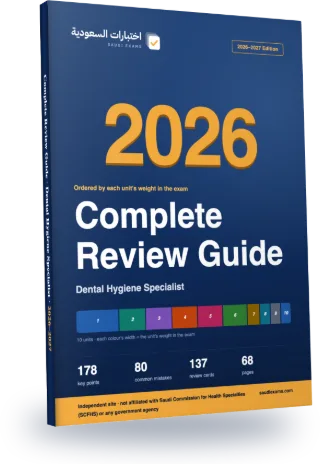 Complete Review Guide 2026–2027 included (PDF)Ordered by the weight of each unit in the examBuy now · SAR 34or 7 days for SAR 26
See everything included
Full mock exams like the real one and 550 explained questions that find your weak spots and train them
- Unlimited full mock exams to practise your pace and check your performance across the whole exam
- Practise 10 weak-area questions, starting where you lose the most marks
- 550 questions explaining why every option is right or wrong
- Arabic and English with one pass
- Unit notes and flashcards, then questions to check your understanding
This exam is part of professional classification as a dental hygiene specialist, and you cannot get a practice licence without classification. If you do not pass you get further attempts under SCFHS rules and pay the evaluation fee. Source Last verified: 2026-11-17