Dental Lab Technician Syllabus: 11 Sections and Their Weights
The eleven Dental Lab Technician exam sections with official weights, what each covers, how our mock exam splits 150 questions, and the SCFHS reference books.
- Questions and time
- 150 questions · 3 hours
- Pass mark
- 55%
- correct answers to pass (55%)
- 83 of 150
- Exam fee
- Paid to SCFHS online when you apply through Mumaris Plus; the amount is shown in your application
Start with 10 free questions to find what needs more work. No sign-up, with answer explanations.
Try 10 free questions and see your levelPut what you just read into practice
Start with 10 free questions to find what needs more work. No sign-up, with answer explanations.
Try 10 free questions and see your levelLast checked: 17 November 2026. Weights and content can change at any time, so check the classification exams page on the SCFHS website and the Dental Laboratory Technician content guideline (PDF) before you start studying. This is an independent website, not affiliated with the Saudi Commission for Health Specialties, Prometric or Pearson VUE.
The SCFHS Dental Laboratory Technician exam is a single exam with eleven sections. Fixed restorations carry 20%, and dental anatomy and occlusion and dental materials carry 15% each, so these three sections decide half of your score. Use this page to decide where to start.
Exam format at a glance
| Item | Details |
|---|---|
| Questions | 150 multiple-choice questions |
| Time | 3 hours |
| Pass mark | 55% |
| Distribution | The real distribution can differ from the published weights by up to 5% (plus or minus) in each section |
| Exam language | Not stated by SCFHS; its guideline and reference books are in English, so our questions are in English |
The eleven sections and their weights
SCFHS publishes one percentage per section. The last column is the split we use in our full mock exams (150 questions): the official percentage times 150, rounded to a whole number so the total is 150.
| Section | Official weight | Questions in our mock exam |
|---|---|---|
| 1. Dental Anatomy and Occlusion | 15% | 23 |
| 2. Dental Materials | 15% | 22 |
| 3. Removable Complete Prosthesis | 10% | 15 |
| 4. Fixed Restorations | 20% | 30 |
| 5. Removable Partial Prosthesis | 10% | 15 |
| 6. Dental Implant Prosthesis | 5% | 8 |
| 7. Orthodontic Appliances | 5% | 8 |
| 8. Maxillofacial Prosthesis | 5% | 8 |
| 9. Infection Control | 5% | 7 |
| 10. Health and Safety | 5% | 7 |
| 11. CAD-CAM Restorations | 5% | 7 |
| Total | 100% | 150 |
A note on detail: the SCFHS guideline names the eleven sections and their weights but has no detailed topic list. The topic lists below are our own breakdown, built from the section names and the reference books SCFHS names, and are not an official outline.
Section 1: Dental Anatomy and Occlusion (15%, 23 questions)
- Tooth morphology, numbering systems and dental tissues
- Primary and permanent dentition, eruption and arch form
- Occlusion, Angle classification and mandibular movements
- Articulators, occlusal schemes and occlusal carving
How to prepare: Learn tooth morphology and numbering first, then eruption dates and arch form, then Angle classes and mandibular movements. Finish with articulators and occlusal schemes, since carving questions combine all of them.
Section 2: Dental Materials (15%, 22 questions)
- Physical and mechanical properties of dental materials
- Impression materials and gypsum products
- Waxes, investments and casting alloys
- Acrylic resins, ceramics and composite resins
How to prepare: Start with properties (strength, elasticity, thermal behaviour), then gypsum, impression materials, waxes, investments and alloys, and finish with resins, ceramics and composites. Link each material to its typical lab fault and fix.
Section 3: Removable Complete Prosthesis (10%, 15 questions)
- Impressions, casts, temporary bases and occlusion rims
- Tooth selection, arrangement and try-in
- Processing, finishing, repairs and relining
How to prepare: Follow the denture in the order it travels through the lab: casts and bases, occlusion rims, set-up, processing, finishing and repairs. Practise reading a defect and naming the cause.
Section 4: Fixed Restorations (20%, 30 questions)
- Working casts, dies and margin definition
- Wax patterns, spruing, investing and casting
- Metal-ceramic crowns and porcelain application
- All-ceramic crowns, bridges, pontics, inlays and onlays
- Soldering, finishing and polishing of fixed restorations
How to prepare: This is the biggest section (20%). Work in lab order: dies and margins, wax-up, spruing and investing, casting, porcelain, all-ceramic work, soldering and finishing. For every defect (porosity, poor fit, bubbling) learn the likely causes and the cure.
Section 5: Removable Partial Prosthesis (10%, 15 questions)
- Kennedy classification, surveying and design
- Framework components: clasps, rests and connectors
- Framework fabrication, finishing, tooth set-up and processing
How to prepare: Learn the Kennedy classes and Applegate rules, then surveying and path of insertion, then each framework component and its job. Practise matching a clinical situation to a clasp or connector.
Section 6: Dental Implant Prosthesis (5%, 8 questions)
- Implant components and impression techniques
- Abutments, cement- and screw-retained restorations and implant overdentures
How to prepare: Know the components (implant, abutment, screw, analog, impression coping) and the two impression techniques. Then compare cement-retained and screw-retained work and implant overdentures.
Section 7: Orthodontic Appliances (5%, 8 questions)
- Removable appliances and wire bending
- Retainers, functional, fixed and clear aligner appliances
How to prepare: Learn the parts of a removable appliance and the wire gauges and springs commonly used, then retainers, functional appliances and clear aligners. A small section: one or two sessions are enough.
Section 8: Maxillofacial Prosthesis (5%, 8 questions)
- Intra-oral prostheses: obturators, radiation stents and carriers
- Extra-oral prostheses: ocular, auricular, nasal and silicone materials
How to prepare: Understand the purpose of each prosthesis (obturator, radiation stent, ocular, auricular, nasal) and the materials used, with silicone handling and colouring. Rule-based and quick to learn.
Section 9: Infection Control (5%, 7 questions)
- Sterilization, disinfection and handling of incoming impressions and prostheses
- Hand hygiene, protective equipment and sharps and infectious waste
How to prepare: Memorise the sequence for incoming work: disinfect, handle, process, disinfect again before dispatch. Know the hand-hygiene, glove and sharps rules; they are the same everywhere.
Section 10: Health and Safety (5%, 7 questions)
- Chemical hazards, dust, fumes and ventilation
- Machine, fire and noise safety and ergonomics
How to prepare: Link each lab hazard (monomer vapour, silica and metal dust, acids, heat, noise) to its control: ventilation, extraction, PPE, guarding. Know the fire-safety and ergonomic basics.
Section 11: CAD-CAM Restorations (5%, 7 questions)
- Scanning, design software and the digital workflow
- Milling, millable materials, sintering and finishing
How to prepare: Follow the digital chain: scan, design, mill or print, sinter, finish. Learn which materials are milled in which state and why sintered zirconia shrinks.
Official reference list
SCFHS lists these books as a study aid only. It states that the list does not imply endorsement of these references, and that exam questions are not necessarily taken from them. The list means the latest edition of each book.
- Hobo, Whitsett, Jacobi, Brackett and Shillingburg, Fundamentals of Fixed Prosthodontics
- McGivney, Carr and McCracken, McCracken's Removable Partial Prosthodontics
- Anusavice, Phillips' Science of Dental Materials
- Woelfel and Scheid, Dental Anatomy: Its Relevance to Dentistry
- Allen and McCarthy, Complete Dentures: From Planning to Problem Solving
- Graber and Vanarsdall, Orthodontics: Current Principles and Techniques
- Kennamer, Basic Infection Control for Healthcare Providers
- Rosenstiel, Land and Fujimoto, Contemporary Fixed Prosthodontics (5th edition)
- Drago and Peterson, Implant Laboratory Procedures: A Step-by-Step Guide
- McKinstry, Fundamentals of Facial Prosthetics
- Johnson and Wood, Techniques in Complete Denture Technology
- Johnson, Patrick, Stokes, Wildgoose and Wood, Basics of Dental Technology: A Step by Step Approach (2nd edition)
- Van Noort, Introduction to Dental Materials (4th edition)
How it differs from the specialist exam
This is the technician exam, with 11 sections and a 55% pass mark. The Dental Laboratory Specialist exam is a separate exam in the same SCFHS list: it has 12 sections (it adds 3D printing technology), different weights and a 60% pass mark. We built this page and our questions on the technician sections and weights only.
How our practice follows this syllabus
Our questions are in English, as the reference books are. The section split in our full mock exam is the one in the table above, and every practice set ends with your result in each section so you know where to start.
Finished reading? Try a set of questions
Start with 10 free questions to find your weakest units. Keep practising with the full question bank and mock exams from SAR 26.
Put the plan to work here
SAR 34 $9
One purchase · lifetime access · review guide included
- 591 questions, every option explained with its source
- Full mock exams: 150 questions in 180 minutes, like the real one
- Practice that starts with your weakest units, plus a review of your mistakes
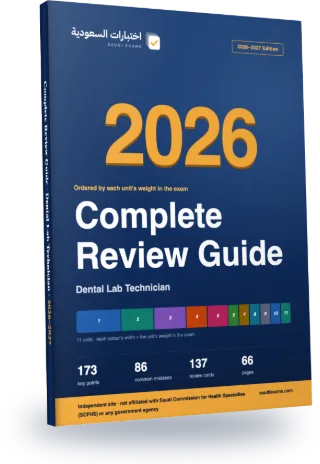 Complete Review Guide 2026–2027 included (PDF)Ordered by the weight of each unit in the examBuy now · SAR 34or 7 days for SAR 26
See everything included
Full mock exams like the real one and 591 explained questions that find your weak spots and train them
- Unlimited full mock exams to practise your pace and check your performance across the whole exam
- Practise 10 weak-area questions, starting where you lose the most marks
- 591 questions explaining why every option is right or wrong
- Arabic and English with one pass
- Unit notes and flashcards, then questions to check your understanding
This exam is part of professional classification as a dental laboratory technician, and you cannot get a practice licence without classification. If you do not pass you get further attempts under SCFHS rules and pay the evaluation fee. Source Last verified: 2026-11-17