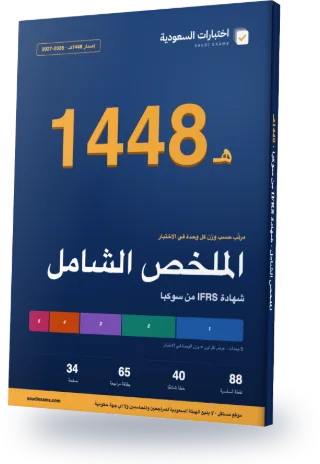
SOCPA IFRS Certificate Complete Review Guide 2026–2027
Every exam topic in a 34-page Arabic PDF, ordered from the heaviest unit to the lightest. The first three chapters alone cover about 75% of the exam questions.
- 34Pages
- 88Key points
- 40Common mistakes
- 65Flashcards
Guide map
Each chapter is one exam unit, ordered by its weight in the real exam.
| Chapter | Unit | Weight | Exam questions | Key points |
|---|---|---|---|---|
| 1 | Level 1: Conceptual Framework and core financial statements | 30% | 18 | 16 |
| 2 | Level 2: Long-term assets and provisions | 25% | 15 | 18 |
| 3 | Level 3: Groups and investments in other entities | 20% | 12 | 18 |
| 4 | Level 4: Financial instruments, leases and foreign currency | 15% | 9 | 18 |
| 5 | Level 5: Revenue, taxes and specialised topics | 10% | 6 | 18 |
Chapter 1 in full: Level 1: Conceptual Framework and core financial statements
30% of the exam, about 18 questions. These are its key points, as in the guide.
- (Framework) The objective of general purpose financial reporting is to give useful information to existing and potential investors, lenders and other creditors for decisions about providing resources to the entity.
- (Framework) Elements: asset, liability and equity in financial position, income and expenses in performance; equity is the residual interest in assets after deducting liabilities.
- (IAS 1) A complete set: statement of financial position, statement of profit or loss and OCI, statement of changes in equity, statement of cash flows, and notes, with comparative information.
The rest of chapter 1, on this page
- (IAS 1) A liability is current if expected to be settled in the normal operating cycle, held for trading, due within 12 months after the reporting period, or there is no right to defer settlement for at least 12 months.
- (IAS 1) Assets and liabilities, and income and expenses, are not offset unless a standard requires or permits it; materiality means aggregating similar items and separating dissimilar material ones.
- (IAS 7) Cash equivalents are short-term, highly liquid investments convertible to known amounts of cash with an insignificant risk of change in value, for example maturity of three months or less from acquisition.
- (IAS 7) Flows are classified as operating, investing or financing; operating flows may be shown by the direct or indirect method, and the indirect method starts from profit or loss adjusted for non-cash items.
- (IAS 8) A change in accounting policy is applied retrospectively unless impracticable; a material prior period error is corrected by restating comparatives.
- (IAS 8) A change in accounting estimate is recognised prospectively in the current and affected future periods and is not an error correction.
- (IAS 24) A related party includes those with control, joint control or significant influence over the entity, key management personnel, entities in the same group, and associates and joint ventures.
- (IFRS 5) An asset is held for sale when its carrying amount will be recovered mainly through sale, it is available for immediate sale in its present condition, the sale is highly probable, and normally expected within one year of classification.
- (IFRS 5) A held-for-sale asset is measured at the lower of carrying amount and fair value less costs to sell, is not depreciated, and is presented separately in the statement of financial position.
- (IFRS 13) Fair value is the price received to sell an asset or paid to transfer a liability in an orderly transaction between market participants at the measurement date, an exit price.
- (IFRS 13) Hierarchy: Level 1 quoted prices in active markets for identical items, Level 2 observable inputs, Level 3 unobservable inputs; the measurement is classified by the lowest level input significant to it.
- (IAS 2) Inventories are measured at the lower of cost and net realisable value, which is the estimated selling price less estimated costs of completion and costs necessary to make the sale.
- (IAS 2) Cost includes purchase, conversion and other costs of bringing inventory to its location and condition; abnormal waste, storage, administrative overheads and selling costs are excluded, and trade discounts are deducted.
Common mistakes in this chapter
- Mixing fundamental characteristics with enhancing ones: comparability is not a fundamental characteristic.
- Treating legal ownership as required for an asset: the definition rests on an economic resource and control, not legal title alone.
- Treating a liability as non-current because management intends to defer payment: IAS 1 looks at the right to defer settlement for at least 12 months after the reporting period.
- Always putting interest paid in investing: it may be operating or financing, applied consistently.
- Applying a change in estimate retrospectively or restating comparatives for it: an estimate affects the current and future periods only.
- Deciding two entities are related only because they share a director: a common director alone does not make them related parties.
- Depreciating an asset held for sale, or including selling costs in fair value: IFRS 13 fair value excludes transaction costs, while IFRS 5 deducts selling costs when measuring.
- Using last-in first-out for inventory: LIFO is prohibited; FIFO or weighted average cost is allowed.
The other chapters are in the full guide
One purchase · lifetime access · review guide included
7-day review plan
The chapters are spread over 6 days by weight so each day carries a similar load. Day 7 is a full exam.
Day 1 · 30% of the exam
Chapter 1: Level 1: Conceptual Framework and core financial statements
Day 2 · 25% of the exam
Chapter 2: Level 2: Long-term assets and provisions
Day 3 · 20% of the exam
Chapter 3: Level 3: Groups and investments in other entities
Day 4 · 15% of the exam
Chapter 4: Level 4: Financial instruments, leases and foreign currency
Day 5 · 10% of the exam
Chapter 5: Level 5: Revenue, taxes and specialised topics
Day 6
Full mock exam: 60 questions in 120 minutes, then review the common mistakes in the units where you lost marks.
How many correct answers do you need?
- Pass mark 60%36 correct out of 60
Before you read: see your score today
10 free questions from the main units, no sign-up. Then you know which chapter to start with.
Try 10 free questions and see your levelA look at each chapter
The first three key points of each chapter, as they appear in the guide (in Arabic in the PDF).
Chapter 1: Level 1: Conceptual Framework and core financial statements
- (Framework) The objective of general purpose financial reporting is to give useful information to…
- (Framework) Elements
- (IAS 1) A complete set
Chapter 2: Level 2: Long-term assets and provisions
- (IAS 16) Cost includes what is directly attributable to getting the asset ready for…
- (IAS 16) Components
- (IAS 16) The gain or loss on derecognition is the difference between net disposal…
Chapter 3: Level 3: Groups and investments in other entities
- (IFRS 10) An investor controls an investee when it is exposed, or has rights…
- (IFRS 10) An entity reassesses control if facts and circumstances indicate a change in…
- (IFRS 10) The parent prepares consolidated statements using uniform accounting policies; if reporting dates…
Chapter 4: Level 4: Financial instruments, leases and foreign currency
- (IFRS 9) A financial asset is measured at amortised cost if both conditions are…
- (IFRS 9) A "collect and sell" business model with the payments test means FVOCI;…
- (IFRS 9) An equity investment not held for trading may be irrevocably elected at…
Chapter 5: Level 5: Revenue, taxes and specialised topics
- (IFRS 15) A contract is in scope when the parties have approved it and…
- (IFRS 15) A performance obligation is a promise to transfer a distinct good or…
- (IFRS 15) The transaction price includes variable consideration, estimated by the expected value or…
The full guide comes with lifetime access
The full guide (34 pages) is included with lifetime access to this exam, together with every question and full mock exam. Chapter 1 is free for everyone.
Questions about the guide
Is the guide free?
Chapter 1 is free to read on the guide page. The full guide comes with lifetime access to this exam; 7-day access does not include it.
Is it up to date for 2026–2027?
Yes. Unit weights and exam facts follow what the exam body last published, and the last check date is printed in the guide. If the standards change we update the file and buyers download the new version.
Does the guide have questions?
No. The guide covers key points and common mistakes; scoring, weak-area practice and full mock exams are on the site.
Can I read it on my phone?
Yes. A5 pages in a single column, with chapters linked from the contents.
- Pages
- 34
- Edition
- 1448 AH · 2026–2027
- Language
- Arabic
- Last updated
Full prep for this exam
All of this in one purchase.
- Full mock exam, same as the real one60 questions in 120 minutes. You get a total score and a score for every unit.
- Practice unit by unit539 questions, every option explained with its source. Starts with your weakest units.
- Complete Review Guide 2026–2027 (PDF)Ordered by each unit's weight in the exam. With lifetime access only.
Choose your access
Continue with your Google account and you go straight to the payment page.