Try the questions in the test above first, then open each one here to see the correct answer and why every other option is wrong.
01The integers a, b, c and d satisfy ab = 2cd. Which of the following numbers could not be the value of the product abcd?
Past exam question Unit: Number and operations
A50
50 is possible: abcd = 2(cd)² means abcd/2 must be a perfect square, and 50/2 = 25 = 5² works.
B200
200 is possible: 200/2 = 100 = 10², so cd = 10 works, for example with ab = 20.
C450
450 is possible: 450/2 = 225 = 15², so cd = 15 works, for example with ab = 30.
D100 ✓ Correct answer
Correct. Multiplying ab = 2cd by cd gives abcd = 2(cd)², so half of abcd must be a perfect square. But 100/2 = 50 is not a perfect square.
E800
800 is possible: 800/2 = 400 = 20², so cd = 20 works, for example with ab = 40.
Reference: Kangaroo Mawhiba Mathematics Competition 2020, Grade 9–10 paper, Problem 12
Ask a friend
02Eight consecutive three-digit positive integers have the following property: each of them is divisible by its last digit. What is the sum of the digits of the smallest of the eight integers?
Past exam question Unit: Number and operations
A13 ✓ Correct answer
Correct. No number ends in 0, so the last digits are 1 to 8 (2 to 9 would need a multiple of 2520, too big), and the number ending in 0 just before them is a multiple of 840. The run is 841 to 848, and 8 + 4 + 1 = 13.
B10
A digit sum of 10 fits the start 721, but 727 is not divisible by 7, so that run of numbers fails.
C11
A digit sum of 11 fits the start 731, but 733 is not divisible by 3, so that run fails.
D12
A digit sum of 12 fits 840, but 840 ends in 0 and division by 0 is not allowed, so the run cannot start there.
E14
A digit sum of 14 fits a start of 842, but then 849 would need divisibility by 9, and it fails.
Reference: Kangaroo Mawhiba Mathematics Competition 2020, Grade 9–10 paper, Problem 30
Ask a friend
03A group of pirates divided 200 gold coins and 600 silver coins between them. Each officer received 5 gold and 10 silver coins. Each sailor received 3 gold and 8 silver coins. Each cabin boy received 1 gold and 6 silver coins. How many pirates are there in the group?
Past exam question Unit: Algebra and patterns
A50
50 pirates would give 5 × 50 = 250, but subtracting the gold equation from the silver one forces 5 × (number of pirates) = 600 − 200 = 400.
B60
60 pirates would give 5 × 60 = 300, not the 400 that the gold and silver equations require.
C72
72 pirates would give 5 × 72 = 360, while the coin equations require 400.
D80 ✓ Correct answer
Let x, y, z be the officers, sailors and cabin boys. Gold: 5x + 3y + z = 200; silver: 10x + 8y + 6z = 600. Subtracting gold from silver gives 5(x + y + z) = 400, so there are 80 pirates.
E90
90 pirates would give 5 × 90 = 450, but the coin equations force the value 400.
Reference: Kangaroo Mawhiba Mathematics Competition 2022, Grade 9–10 paper, Problem 23
Ask a friend
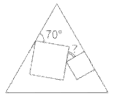
04Two squares of different size are drawn inside an equilateral triangle. One side of one of these squares lies on one of the sides of the triangle as shown. What is the size of the angle marked by the question mark?
Past exam question Unit: Geometry
A50° ✓ Correct answer
The pentagon formed by the triangle's apex, the 70° corner, the big square's top-right corner, the marked angle and the small square's corner on the triangle's side has angles totalling 540°: 60° at the apex, 90° at the small square's corner on the side, 270° outside the big square's corner (360° − 90°), and 70°. So the marked angle is 540° − 490° = 50°.
B25°
With 25° the pentagon's angles would total 60 + 90 + 270 + 70 + 25 = 515°, not the required 540°.
C30°
With 30° the pentagon's angles would total 60 + 90 + 270 + 70 + 30 = 520°, not the required 540°.
D35°
With 35° the pentagon's angles would total 60 + 90 + 270 + 70 + 35 = 525°, not the required 540°.
E45°
With 45° the pentagon's angles would total 60 + 90 + 270 + 70 + 45 = 535°, not the required 540°.
Reference: Kangaroo Mawhiba Mathematics Competition 2020, Grade 9–10 paper, Problem 17
05A foolish hare and a tortoise competed in a 5 km race along a straight line. The hare is five times faster than the tortoise. The hare mistakenly started perpendicular to the route. After a while he realized his mistake, then turned and ran straight to the finish point. He arrived at the same time as the tortoise. What is the distance between the hare's turning point and the finish point?
Past exam question Unit: Geometry
A11 km
If the return leg were 11 km, the outward leg would be 14 km and 5² + 14² = 221 would have to equal 11² = 121, which is false.
B13 km ✓ Correct answer
Correct. The hare runs 25 km in all. With return leg x, the outward leg is 25 − x, so 5² + (25 − x)² = x², giving x = 13.
C12 km
If the return leg were 12 km, the outward leg would be 13 km and 5² + 13² = 194 would have to equal 12² = 144, which is false.
D14 km
If the return leg were 14 km, the outward leg would be 11 km and 5² + 11² = 146 would have to equal 14² = 196, which is false.
E15 km
15 km would leave only 10 km for the outward leg, but 5² + 10² = 125 is not 15² = 225, so it cannot be.
Reference: Kangaroo Mawhiba Mathematics Competition 2020, Grade 9–10 paper, Problem 22
Ask a friend
06A large cube is built using 64 smaller identical cubes. Three of the faces of the large cube are painted. What is the maximum possible number of small cubes that have exactly one face painted?
Past exam question Unit: Geometry
A27
27 is what three faces meeting at a corner give (3 × 3 per face, 9 × 3), but another choice of faces does better.
B28
28 is not the maximum: choosing two opposite faces and one adjacent face gives 32, which is more.
C34
34 cannot be reached: the best arrangement gives 12 + 12 + 8 = 32, because cubes on shared edges are painted twice.
D32 ✓ Correct answer
Correct. Paint two opposite faces and one face between them: each opposite face has 16 − 4 = 12 cubes with only one painted face, and the third face has 16 − 8 = 8. Total 32.
E40
40 is impossible: no choice of three faces gets that high, since cubes along shared edges have two painted faces and are not counted.
Reference: Kangaroo Mawhiba Mathematics Competition 2020, Grade 9–10 paper, Problem 26
Ask a friend
07Ahmed labelled the vertices of the square-based pyramid using 1, 2, 3, 4 and 5 once each. For each face Ahmed calculated the sum of the numbers on its vertices. Four of these sums equalled 7, 8, 9 and 10. What is the sum of the fifth face?
Past exam question Unit: Logic and combinatorics

A13 ✓ Correct answer
Correct. Base vertices lie on 3 faces and the apex a on 4, so all sums total 45 + a and the fifth is 11 + a. If it is the base, 15 − a = 11 + a, so a = 2: sum 13.
B11
11 would need the apex number to be 0, since the five face sums add up to 45 plus the apex number and the four known sums total 34.
C12
12 would need apex 1, making the base sum 14, which is not among the given sums 7, 8, 9, 10.
D14
14 would need apex 3, making the base sum 12, which is not among 7, 8, 9, 10, so the data do not fit.
E15
15 would need apex 4, making the base sum 11, which is not among 7, 8, 9, 10, so the data do not fit.
Reference: Kangaroo Mawhiba Mathematics Competition 2020, Grade 9–10 paper, Problem 25
08Amal, Basma and Sahar had a table tennis contest. In each game two girls played, while the third rested. After each game, the winner played the next game against the girl who had rested. In total, Amal played 10 times, Basma played 15 times and Sahar played 17 times. Who lost the second game?
Past exam question Unit: Logic and combinatorics
AAmal ✓ Correct answer
Correct. There were 21 games, so Amal rested 11 times and never twice in a row: in games 1, 3, ..., 21. She played game 2, rested in game 3, so she lost game 2.
BBasma
Basma cannot be the loser of game 2: the loser rests in game 3, and Amal is the one who rests in every odd game, including game 3.
CSahar
Sahar cannot be the loser of game 2: the loser rests in game 3, which is Amal's rest, since Amal rested in all odd-numbered games.
Deither Amal or Basma
It cannot be Basma: the loser of game 2 rests in game 3, and that is Amal every time, so Amal alone lost.
Eeither Basma or Sahar
It cannot be Basma or Sahar: the girl resting in game 3 is Amal, and she is the loser of game 2.
Reference: Kangaroo Mawhiba Mathematics Competition 2020, Grade 9–10 paper, Problem 28
Ask a friend
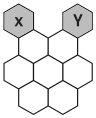
09A bee moves from hexagon x to hexagon y. She can only move from one hexagon to another if they have an edge in common. How many different routes are there from x to y that pass through each of the seven white hexagons exactly once?
Past exam question Unit: Logic and combinatorics
A2
Two is too few: going first to the left cell of the middle row already allows four different complete routes.
B3
Three misses routes: the start through the left cell of the middle row gives four, and the start through the centre cell gives one more, so five.
C4
Four counts only the routes that start by stepping into the left cell of the middle row; one more route starts from the centre cell, making five.
D5 ✓ Correct answer
From the cell below x, going to the left cell of the middle row gives 4 routes and going to the centre cell gives 1; in total 5.
E6
Six overcounts: any sixth attempt either leaves a white hexagon unvisited or gets stuck, so only five valid routes exist.
Reference: Kangaroo Mawhiba Mathematics Competition 2022, Grade 9–10 paper, Problem 12
10Khaled began a 520 km trip by car with 14 liters of fuel in the car tank. His car consumes 1 liter of fuel per 10 km. After driving 55 km, he reads a road sign showing the distances from that point to five petrol stations ahead on the road. These distances are 35 km, 45 km, 55 km, 75 km and 95 km. The capacity of the car's fuel tank is 40 liters and Khaled wants to stop just once to fill the tank. How far is the petrol station that he should stop at?
Past exam question Unit: Data and applied problems
A35 km
Stopping after 35 km leaves 520 − 55 − 35 = 430 km to go, more than a full tank (400 km) can cover.
B45 km
Stopping after 45 km leaves 420 km to go, which a full tank (400 km) cannot cover.
C55 km
Stopping after 55 km leaves 410 km to go, still 10 km more than a full tank (400 km) covers.
D75 km ✓ Correct answer
Correct. His 8.5 L last 85 km, so d ≤ 85; the rest of the trip, 465 − d, must be at most 400, so d ≥ 65. Only 75 km fits.
E95 km
The station 95 km ahead is out of reach: the remaining fuel lasts only 85 km, so the car would run dry before arriving.
Reference: Kangaroo Mawhiba Mathematics Competition 2020, Grade 9–10 paper, Problem 18
Ask a friend