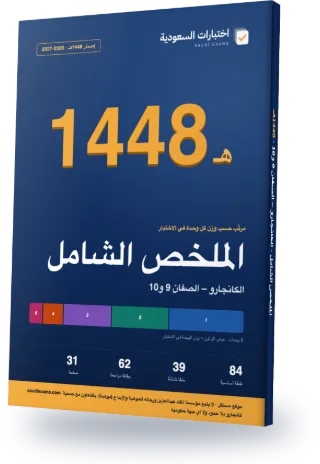
Kangaroo Grades 9–10 Complete Review Guide 2026–2027
Every exam topic in a 31-page Arabic PDF, ordered from the heaviest unit to the lightest. The first three chapters alone cover about 83% of the exam questions.
- 31Pages
- 84Key points
- 39Common mistakes
- 62Flashcards
Guide map
Each chapter is one exam unit, ordered by its weight in the real exam.
| Chapter | Unit | Weight | Exam questions | Key points |
|---|---|---|---|---|
| 1 | Geometry | 33% | 10 | 16 |
| 2 | Logic and combinatorics | 27% | 8 | 18 |
| 3 | Number and operations | 23% | 7 | 17 |
| 4 | Algebra and patterns | 10% | 3 | 16 |
| 5 | Data and applied problems | 7% | 2 | 17 |
Chapter 1 in full: Geometry
33% of the exam, about 10 questions. These are its key points, as in the guide.
- The angles of a triangle sum to 180°. An exterior angle equals the sum of the two remote interior angles, which saves many steps.
- In an isosceles triangle the base angles are equal, and in an equilateral triangle every angle is 60°. If two equal sides appear, start with the base angles.
- When a line crosses two parallel lines, alternate angles are equal and co-interior angles sum to 180°. Draw a helper line parallel to them to connect two distant angles.
The rest of chapter 1, on this page
- The angles of an n-sided polygon sum to (n−2)×180°: a pentagon 540° and a hexagon 720°. Each angle of a regular n-gon is that sum divided by n, so a regular hexagon has 120° angles.
- Pythagoras: in a right triangle a²+b²=c², where c is the hypotenuse. Common triples are 3-4-5, 5-12-13 and 8-15-17 and their multiples, such as 6-8-10.
- Triangle inequality: each side is less than the sum of the other two. Sides 2, 3 and 6 cannot form a triangle because 2+3 is less than 6.
- Triangle area is ½×base×height, parallelogram base×height, trapezium ½×(sum of the bases)×height. Triangles with the same base and height have equal areas, and a median splits a triangle into two triangles of equal area.
- For a shaded area: shaded = big figure − unshaded parts, or move the shaded pieces to form a familiar shape. Choose the shorter method before you calculate.
- The circle: circumference 2πr and area πr². A sector of angle θ has area (θ/360)×πr² and arc length (θ/360)×2πr. A semicircle means θ=180°.
- An inscribed angle is half the central angle on the same arc, and an angle in a semicircle is a right angle (90°). A tangent is perpendicular to the radius at the point of contact.
- Similarity: if the ratio of lengths is k, the ratio of areas is k² and of volumes is k³. Enlarging lengths 3 times gives 9 times the area and 27 times the volume.
- A cuboid: volume l×w×h and surface area 2(lw+lh+wh); a cube has 6 faces, 12 edges and 8 vertices. A cylinder has volume πr²h and a cone ⅓πr²h.
- A cube net has 6 squares. In a row of three squares the first and third are opposite, and in a row of four the first and third are opposite, as are the second and fourth. Find the opposite faces before you fold.
- Views: the top view shows which columns are occupied, and the front and side views give the maximum height in each row and column. The smallest or largest possible number of cubes comes from choosing the lowest or highest heights that agree with every view.
- Reflection in the x-axis maps (x,y) to (x,−y), in the y-axis to (−x,y), and in the line y=x the coordinates swap to (y,x). A 180° rotation about the origin gives (−x,−y), and a 90° anticlockwise rotation gives (−y,x).
- The distance between (x1,y1) and (x2,y2) is √((x2−x1)²+(y2−y1)²) from Pythagoras, and the midpoint is the average of the coordinates. A fold line is the perpendicular bisector of the segment joining a point and its image.
Common mistakes in this chapter
- Trusting how the figure looks: Kangaroo figures are not drawn to exact scale, so do not judge by eye or assume an angle that looks right-angled is one.
- Mixing up perimeter and area, or forgetting that perimeter is measured in length and area in square length.
- In a circle: using the diameter in place of the radius in πr². Diameter 10 means radius 5 and area 25π, not 100π.
- Multiplying area by k instead of k² when enlarging. Doubling the lengths makes the area 4 times and the volume 8 times.
- In a cube net: assuming two squares that touch in the net always touch on the cube. In a row of three squares, the first and third are opposite faces.
- In views: counting only the visible cubes and forgetting cubes hidden behind or under others.
- Reflection and rotation: mixing up coordinate signs. Reflection in the x-axis changes only the sign of y, and a 180° rotation changes the signs of both x and y.
- Folding: forgetting that every hole or cut in folded paper is doubled, and that the unfolded shape is symmetric about the fold line.
The other chapters are in the full guide
One purchase · lifetime access · review guide included
7-day review plan
The chapters are spread over 6 days by weight so each day carries a similar load. Day 7 is a full exam.
Day 1 · 33% of the exam
Chapter 1: Geometry
Day 2 · 27% of the exam
Chapter 2: Logic and combinatorics
Day 3 · 23% of the exam
Chapter 3: Number and operations
Day 4 · 10% of the exam
Chapter 4: Algebra and patterns
Day 5 · 7% of the exam
Chapter 5: Data and applied problems
Day 6
Full mock exam: 30 questions in 90 minutes, then review the common mistakes in the units where you lost marks.
Before you read: see your score today
10 free questions from the main units, no sign-up. Then you know which chapter to start with.
Try 10 free questions and see your levelA look at each chapter
The first three key points of each chapter, as they appear in the guide (in Arabic in the PDF).
Chapter 1: Geometry
- The angles of a triangle sum to 180°. An exterior angle equals the sum…
- In an isosceles triangle the base angles are equal, and in an equilateral triangle…
- When a line crosses two parallel lines, alternate angles are equal and co-interior angles…
Chapter 2: Logic and combinatorics
- (Logic and deduction) A truth-teller’s statement is always true, and a liar’s statement is…
- (Logic and deduction) Method of assumption
- (Logic and deduction) If A says “we are all liars”, A cannot be truthful…
Chapter 3: Number and operations
- (Integers, divisibility and primes) A number is divisible by 3 (or 9) if its…
- (Integers, divisibility and primes) A number is divisible by 4 if its last two…
- (Integers, divisibility and primes) A prime has exactly two divisors. The primes up to…
Chapter 4: Algebra and patterns
- (Equations and expressions) (a + b)² = a² + 2ab + b², (a −…
- (Equations and expressions) If x + y = s and x − y =…
- (Equations and expressions) Mean = sum ÷ count, so sum = mean × count…
Chapter 5: Data and applied problems
- 1 hour = 60 minutes = 3600 seconds, 1 day = 24 hours, 1…
- An ordinary year is 365 days = 52 weeks + 1 day, a leap…
- Month lengths
The full guide comes with lifetime access
The full guide (31 pages) is included with lifetime access to this exam, together with every question and full mock exam. Chapter 1 is free for everyone.
Questions about the guide
Is the guide free?
Chapter 1 is free to read on the guide page. The full guide comes with lifetime access to this exam; 7-day access does not include it.
Is it up to date for 2026–2027?
Yes. Unit weights and exam facts follow what the exam body last published, and the last check date is printed in the guide. If the standards change we update the file and buyers download the new version.
Does the guide have questions?
No. The guide covers key points and common mistakes; scoring, weak-area practice and full mock exams are on the site.
Can I read it on my phone?
Yes. A5 pages in a single column, with chapters linked from the contents.
- Pages
- 31
- Edition
- 1448 AH · 2026–2027
- Language
- Arabic
- Last updated
All School Student Exams review guides
Back to Kangaroo Mawhiba Mathematics Competition – Grades 9–10
Full prep for this exam
All of this in one purchase.
- Full mock exam, same as the real one30 questions in 90 minutes. You get a total score and a score for every unit.
- Practice unit by unit521 questions, every option explained with its source. Starts with your weakest units.
- Complete Review Guide 2026–2027 (PDF)Ordered by each unit's weight in the exam. With lifetime access only.
Choose your access
Continue with your Google account and you go straight to the payment page.