Kangaroo Grades 9–10: Score Structure and Question Types
How the Grade 9–10 Kangaroo scores: 30 questions worth 3, 4 and 5 marks, and five content areas from number and algebra to geometry, logic and data.
- Questions and time
- 30 questions · 90 minutes
- Pass mark
- No pass mark; the competition awards medals and the total score is 120
- Exam fee
- SAR 60 guardian contribution
Start with 10 free questions to find what needs more work. No sign-up, with answer explanations.
Try 10 free questions and see your levelPut what you just read into practice
Start with 10 free questions to find what needs more work. No sign-up, with answer explanations.
Try 10 free questions and see your levelInformation last checked: 16 November 2026. The question count and marks come from the About Kangaroo page and from the Grade 9–10 papers for 2020 to 2025 published on the Questions Samples page of the Kangaroo Mawhiba site. This is an independent website, not affiliated with Mawhiba, the Education and Training Evaluation Commission or any government body, and it promises no particular score.
The competition publishes no official syllabus and no topic weights. So we sorted the questions from the six papers (180 questions) into five content areas by what they ask. That grouping is ours, and the counts below are the papers' average spread, rounded.
Paper structure
- 30 questions in 90 minutes, each with five options from A to E.
- The first 10 questions are worth 3 marks, the middle 10 are worth 4 marks, and the last 10 are worth 5 marks.
- The total is 120 (30 + 40 + 50). There is no pass mark; your score appears when you finish, and top scorers receive gold, silver and bronze medals.
- Questions appear in Arabic and English on the same page.
In practice, the last 10 questions are worth 50 of the 120 marks, but they are usually harder and need more time. The first two blocks together are worth 70, so accuracy on them is the base of your score.
The five content areas
1. Number and operations (about 6 questions)
Usual topics: divisibility and primes, fractions and percentages, ratio and proportion, powers, roots and estimation. A common type: compare large numbers or estimate a result without full calculation. Marks are lost by calculating at length instead of simplifying or estimating.
2. Algebra and patterns (about 6 questions)
Usual topics: equations and expressions, sequences and patterns, functions, graphs and inequalities. A common type: find the required term of a repeating pattern instead of writing out every term. Marks are lost by trying the options at random instead of setting up an equation.
3. Geometry (about 7 questions)
Usual topics: angles and triangles, perimeter, area and circles, solids, nets and views, transformations, folding and coordinates. A common type: the area of a composite shape, found by cutting it into parts. Marks are lost by trusting a figure that is not drawn to scale.
4. Logic and combinatorics (about 7 questions)
Usual topics: deduction, counting and combinations, probability and strategy games, grids, arrangements and puzzles. A common type: arrange people or objects under conditions. Marks are lost by missing one case or counting a case twice.
5. Data and applied problems (about 4 questions)
Usual topics: time, calendar and measurement, tables, charts and averages, everyday word problems. A common type: an average that changes when a value is added. Marks are lost by reading the question only in part.
How to use this grouping
Do the free questions first and see where you lose marks. Geometry and logic together account for about 18 of the 30 questions, so start with them if your results there are lower. Our past questions come from the 2020 to 2025 papers, and every option has an explanation.
Read next: the study plan and registration. Then start with the free questions on the Kangaroo Grades 9–10 page, no sign-up needed.
Finished reading? Try a set of questions
Start with 10 free questions to find your weakest units. Keep practising with the full question bank and mock exams from SAR 26.
Put the plan to work here
SAR 34 $9
One purchase · lifetime access · review guide included
- 521 questions, every option explained with its source
- Full mock exams: 30 questions in 90 minutes, like the real one
- Practice that starts with your weakest units, plus a review of your mistakes
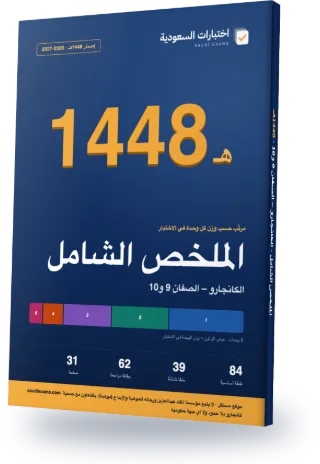 Complete Review Guide 2026–2027 included (PDF)Ordered by the weight of each unit in the examBuy now · SAR 34or 7 days for SAR 26
See everything included
Full mock exams like the real one and 521 explained questions that find your weak spots and train them
- Unlimited full mock exams to practise your pace and check your performance across the whole exam
- Practise 10 weak-area questions, starting where you lose the most marks
- 521 questions explaining why every option is right or wrong
- Arabic and English with one pass
- Unit notes and flashcards, then questions to check your understanding
There is no pass mark; your score out of 120 ranks you among the entrants, and top scorers receive gold, silver and bronze medals. Source Last verified: 2026-11-16
Sources and references
- Kangaroo Mawhiba: About Kangaroo kangarooksa.org
- Kangaroo Mawhiba: Questions Samples (2020–2025 papers) kangarooksa.org