Try the questions in the test above first, then open each one here to see the correct answer and why every other option is wrong.
01How many four-digit numbers A are there, such that half of the number A is divisible by 2, its third is divisible by 3, and the fifth is divisible by 5?
Past exam question Unit: Numbers and Operations
A1
There is more than one such number; for example 1800 and 2700 are both multiples of 900 and satisfy the conditions.
B7
7 would stop at 7200 and miss 8100, 9000 and 9900, which are also four-digit multiples of 900.
C9
9 would stop at 9000 and miss 9900, which is also a four-digit multiple of 900.
D10 ✓ Correct answer
Half divisible by 2, a third by 3 and a fifth by 5 means A is divisible by 4, 9 and 25, so A is a multiple of 900: 900 × 2 to 900 × 11, which is 10 numbers.
E11
11 would include 900 × 1 = 900, which has only three digits; the valid multiples run from 900 × 2 to 900 × 11, which is 10.
Reference: Kangaroo Mawhiba Mathematics Competition 2020, Grade 7–8, Question 23 (official solution)
Ask a friend
02Osama, Bader and Saad ran a race. They started at the same time, and their speeds were constant. When Osama finished, Bader had 15 m to run and Saad had 35 m to run. When Bader finished, Saad had 22 m to run. What is the distance in meters they ran?
Past exam question Unit: Numbers and Operations
A135
If the race were 135 m, when Bader finishes Saad would have run 135 × 100 ÷ 120 = 112.5 m, leaving 22.5 m, not 22.
B140
If the race were 140 m, when Bader finishes Saad would have run 140 × 105 ÷ 125 = 117.6 m, leaving 22.4 m, not 22.
C150
If the race were 150 m, when Bader finishes Saad would have run 150 × 115 ÷ 135 ≈ 127.8 m, leaving about 22.2 m, not 22.
D165 ✓ Correct answer
Bader's and Saad's speed ratio is fixed: (x − 15) ÷ (x − 35) = x ÷ (x − 22), so x² − 37x + 330 = x² − 35x and x = 165.
E175
If the race were 175 m, when Bader finishes Saad would have run 175 × 140 ÷ 160 ≈ 153.1 m, leaving about 21.9 m, not 22.
Reference: Kangaroo Mawhiba Mathematics Competition 2020, Grade 7–8, Question 29 (official solution)
Ask a friend
03In a particular fraction the numerator and denominator are both positive. The numerator of this fraction is increased by 40%. By what percentage should its denominator be decreased so that the new fraction is double the original fraction?
Past exam question Unit: Numbers and Operations
A10%
Decreasing the denominator by 10% gives 1.4 ÷ 0.9 ≈ 1.56 times the original fraction, not double.
B20%
Decreasing the denominator by 20% gives 1.4 ÷ 0.8 = 1.75 times the original, which is less than double.
C30% ✓ Correct answer
The new numerator is 140% of the original, and to double the fraction the denominator must become 70% of the original since 1.4 ÷ 0.7 = 2; that is a 30% decrease.
D40%
Decreasing the denominator by 40% gives 1.4 ÷ 0.6 ≈ 2.33 times the original, which is more than double.
E50%
Decreasing the denominator by 50% gives 1.4 ÷ 0.5 = 2.8 times the original, far more than double.
Reference: Kangaroo Mawhiba Mathematics Competition 2021, Grade 7–8, Question 21 (official solution)
Ask a friend
04Sana writes a positive integer on each edge of a square. She also writes at each vertex the product of the numbers on the two edges that meet at that vertex. The sum of the numbers at the vertices is 15. What is the sum of the numbers on the edges of the square?
Past exam question Unit: Algebra and Word Problems
A6
If the edge sum were 6, the factors (a + c) and (b + d) would add to 6, and their product could be at most 3 × 3 = 9, not 15.
B7
If the sum were 7, the two factors would add to 7 and multiply to 10 (2 and 5) or 12 (3 and 4), never 15.
C8 ✓ Correct answer
With edges a, b, c, d in order the vertex sum is ab + bc + cd + da = (a + c)(b + d) = 15; both factors exceed 1, so they are 3 and 5, giving 8.
D10
If the sum were 10, the two factors would add to 10 with each above 1, so their product would be 16, 21, 24 or 25, never 15.
E15
15 is the vertex sum, not the edge sum; edges adding to 15 would need two factors adding to 15 with product 15, impossible because each factor is more than 1.
Reference: Kangaroo Mawhiba Mathematics Competition 2020, Grade 7–8, Question 25 (official solution)
Ask a friend
05Abdallah is standing in a queue. The number of people in the queue is a multiple of 3. He notices that he has as many people in front of him as behind him. He sees two friends, both standing behind him in the queue, one in 19th place and the other in 28th place. In which position in the queue is Abdallah?
Past exam question Unit: Algebra and Word Problems
A14
Position 14 means 13 people in front and 13 behind, so the queue has 27 people, and the friend in 28th place would not exist.
B15
Position 15 means the queue has 29 people, which is not a multiple of 3.
C16
Position 16 means the queue has 31 people, which is not a multiple of 3.
D17 ✓ Correct answer
With n people in front, he is in place n+1 and the queue has 2n+1 people. Friends behind him give n+1 < 19 and 2n+1 ≥ 28, so 2n+1 is 29, 31, 33 or 35; only 33 is a multiple of 3, so n = 16 and he is 17th.
E18
Position 18 gives a queue of 35 people, which is not a multiple of 3.
Reference: Kangaroo Mawhiba Mathematics Competition 2023, Grade 7–8, Question 25 (official solution)
Ask a friend
06Anas buys 27 identical small cubes, each with two adjacent faces painted red. He then uses all of these cubes to build a large cube. What is the largest number of completely red faces of the large cube he can make?
Past exam question Unit: Geometry and Measurement
A2
More than two faces can be done: the four side faces can all be made red without any conflict, so 2 is not the largest.
B3
More than 3 is possible: all four side faces of the large cube can be red, so 3 is not the largest.
C4 ✓ Correct answer
Three fully red faces cannot meet at one corner, since the corner cube has only two red faces, so the maximum is 4, reached with the four side faces.
D5
Five faces must include three that meet at a corner, so that corner cube would need three red faces but has only two.
E6
Six faces would mean three red faces at every corner, which is impossible because a corner cube has only two red faces.
Reference: Kangaroo Mawhiba Mathematics Competition 2020, Grade 7–8, Question 16 (official solution)
Ask a friend
07Four children are in the four corners of a 10 m × 25 m pool. Their trainer is standing somewhere on one side of the pool. When he calls them, three children get out and walk as short a distance as possible round the pool to meet him. They walk 50 m in total. The fourth child stays in his corner. What is the shortest distance, in metres, that the trainer needs to walk round the pool to get to the fourth child?
Past exam question Unit: Geometry and Measurement
A10
The four children's shortest walks always total 70 m, the pool's perimeter; with 10 m for the fourth the total would be 60 m, not 70.
B12
The four children's shortest walks always total 70 m; with 12 m for the fourth the total would be 62 m, not 70.
C15
The four children's shortest walks always total 70 m; with 15 m for the fourth the total would be 65 m, not 70.
D20 ✓ Correct answer
With the trainer on a 25 m side, x from a corner, the four walks are x, 25 − x, 35 − x and 10 + x, totalling 70 m, so the fourth walks 70 − 50 = 20 m.
E25
The four children's shortest walks always total 70 m; with 25 m for the fourth the total would be 75 m, not 70.
Reference: Kangaroo Mawhiba Mathematics Competition 2020, Grade 7–8, Question 28 (official solution)
Ask a friend
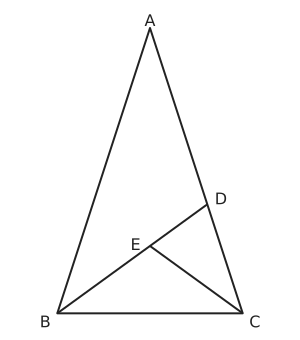
08An isosceles triangle ABC, with AB = AC, is split into three smaller isosceles triangles, as shown, so that AD = BD, CE = CD and EB = EC. Note that the diagram is not drawn to scale. What is the size of angle BAC?
Past exam question Unit: Geometry and Measurement
A24°
If angle BAC were 24°, the angle sum x + 2x + 2x = 5x would be 120°, not 180°.
B28°
If angle BAC were 28°, the angle sum 5x would be 140°, not 180°.
C30°
If angle BAC were 30°, the angle sum 5x would be 150°, not 180°.
D35°
If angle BAC were 35°, the angle sum 5x would be 175°, not 180°.
E36° ✓ Correct answer
Let angle BAC = x. Then angle ABD = x, angle BDC = 2x, angle CED = 2x, and angles EBC and ECB are x each, so ABC = ACB = 2x. Hence x + 2x + 2x = 180° and x = 36°.
Reference: Kangaroo Mawhiba Mathematics Competition 2022, Grade 7–8, Question 29 (official solution)
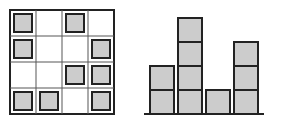
09Ameena made a "city" with identical wooden cubes. One of the diagrams shows the view from above the "city" and the other the view from one of the sides. However, it is not known from which side the side view was taken. What is the largest number of cubes that Ameena could have used?
Past exam question Unit: Logic, Counting and Reasoning
A25
No side allows 25 cubes; the largest total over the four possible viewing sides is 24.
B24 ✓ Correct answer
From the side whose lines of the top view hold 3, 1, 2 and 3 squares, heights 3, 1, 4, 2 give 3 × 3 + 1 × 1 + 2 × 4 + 3 × 2 = 24 cubes, the best of the four sides.
C23
23 is the maximum for just one of the four sides, but another side allows 24 cubes, so it is not the largest.
D22
22 is the maximum for just one side, but another side allows 24 cubes, so it is not the largest.
E21
21 is the maximum when the view is taken from one particular side, but another side allows 24 cubes, so it is not the largest.
Reference: Kangaroo Mawhiba Mathematics Competition 2020, Grade 7–8, Question 19 (official solution)
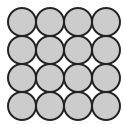
10Omar builds a pyramid with metal spheres. The square base consists of 4 × 4 spheres as shown in the figure. The floors consist of 3 × 3 spheres, 2 × 2 spheres and a final sphere at the top. At each point of contact between two spheres, a blob of glue is placed. How many blobs of glue will Omar place?
Past exam question Unit: Logic, Counting and Reasoning
A72
72 is 24 short of the true count, exactly the number of contacts inside the bottom layer, so it leaves those out.
B85
85 does not come from any consistent way of counting the contacts; the careful count gives 96.
C88
88 is 8 short of the true count, as if it omits the 4 contacts inside the 2 × 2 layer and the 4 contacts of the top sphere.
D92
92 is 4 short of the true count, as if it forgets the 4 contacts of the top sphere with the layer below.
E96 ✓ Correct answer
Within layers: 24 + 12 + 4 = 40; between layers each sphere rests on 4 spheres, giving 9 × 4 + 4 × 4 + 4 = 56; the total is 40 + 56 = 96.
Reference: Kangaroo Mawhiba Mathematics Competition 2020, Grade 7–8, Question 27 (official solution)