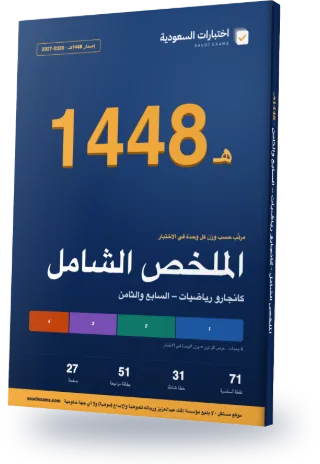
Kangaroo Math 7–8 Complete Review Guide 2026–2027
Every exam topic in a 27-page Arabic PDF, ordered from the heaviest unit to the lightest. The first three chapters alone cover about 80% of the exam questions.
- 27Pages
- 71Key points
- 31Common mistakes
- 51Flashcards
Guide map
Each chapter is one exam unit, ordered by its weight in the real exam.
| Chapter | Unit | Weight | Exam questions | Key points |
|---|---|---|---|---|
| 1 | Geometry and Measurement | 30% | 9 | 18 |
| 2 | Numbers and Operations | 27% | 8 | 18 |
| 3 | Logic, Counting and Reasoning | 23% | 7 | 18 |
| 4 | Algebra and Word Problems | 20% | 6 | 17 |
Chapter 1 in full: Geometry and Measurement
30% of the exam, about 9 questions. These are its key points, as in the guide.
- (Angles, triangles and circles) The angles of a triangle add up to 180°. If a triangle has angles 50° and 60°, the third is 180 − 110 = 70°.
- (Angles, triangles and circles) In an isosceles triangle the two base angles are equal. If the apex angle is 40°, each base angle is (180 − 40) ÷ 2 = 70°.
- (Angles, triangles and circles) The angle of a regular polygon with n sides is (n − 2) × 180 ÷ n. For a hexagon it is (6 − 2) × 180 ÷ 6 = 120°, and for a square 90°. The angle grows as the number of sides grows.
The rest of chapter 1, on this page
- (Angles, triangles and circles) In a circle the circumference is 2πr and the area is πr². With radius 3 cm the area is 9π cm² and the circumference is 6π cm; it is usually fine to leave π in the answer.
- (Perimeter and area) The perimeter of a rectangle is 2 × (length + width) and its area is length × width. For an 8 × 5 rectangle the perimeter is 26 and the area is 40.
- (Perimeter and area) The area of a triangle is half the base times the height. With base 6 and height 4 the area is 12. Two triangles on the same base with the same height have equal areas.
- (Perimeter and area) The area of a rhombus is half the product of its diagonals, and the area of a trapezium is half the sum of the parallel sides times the height. Diagonals 6 and 8 give 24; parallel sides 3 and 7 with height 4 give 20.
- (Perimeter and area) If a square has area 49 cm², its side is 7 cm, and a diagonal d gives the area d² ÷ 2. A diagonal of 10 gives a square of area 50.
- (Perimeter and area) For overlapping areas, add and then subtract the shared part. For two circles of area 8 sharing an area of 1: 8 + 8 − 1 = 15.
- (Solids, cubes, volume and nets) The volume of a cuboid is length × width × height, and its total surface area is 2 × (lw + lh + wh). For a 3×4×5 cuboid the volume is 60 and the surface area is 2 × (12 + 15 + 20) = 94.
- (Solids, cubes, volume and nets) In a 3×3×3 cube made of 27 small cubes: 8 corner cubes show three faces, 12 edge cubes show two, 6 face-centre cubes show one, and 1 inside cube shows none.
- (Solids, cubes, volume and nets) A cube has 8 vertices, 12 edges and 6 faces, and a convex solid satisfies vertices − edges + faces = 2. A tetrahedron has 4 vertices, 6 edges and 4 faces.
- (Solids, cubes, volume and nets) On a standard dice opposite faces add to 7. When dice are glued, the joined faces are hidden, so work out the visible total after identifying the hidden faces.
- (Solids, cubes, volume and nets) If the height of a cuboid with a square base is reduced by h, the surface area falls by 4 × side × h. A height cut of 2 with an area drop of 32 means the base side is 4, so the original is 4×4×6 and the volume is 96.
- (Symmetry, transformations and folding) An axis of symmetry is a line that splits a shape into two mirror images. A square has 4, an equilateral triangle 3, a non-square rectangle 2, and a regular hexagon 6.
- (Symmetry, transformations and folding) The turn that brings a regular polygon back onto itself is 360 ÷ n. For a hexagon it is 360 ÷ 6 = 60°, and for a square 90°.
- (Symmetry, transformations and folding) A half turn (180°) turns a shape upside down. The digits 0, 1 and 8 look the same after a half turn, and 6 becomes 9 and the reverse.
- (Symmetry, transformations and folding) When paper is folded, the crease is an axis of symmetry, so each point lands at the same distance from the line on the other side. Cut a folded sheet once, open it, and you get the hole and its mirror partner.
Common mistakes in this chapter
- Treating the diagram as drawn to scale. Competition diagrams are often not to scale, so do not measure by eye; use the numbers given.
- Mixing up perimeter and area. Perimeter is a length in cm, area is in cm², and volume is in cm³.
- Forgetting that doubling a side length multiplies the area by 4 and the volume by 8, not by 2.
- Using the triangle area formula without the perpendicular height. The height is perpendicular to the base, not the slanted side.
- Mixing up radius and diameter in a circle. Area is πr² and circumference is 2πr, and if the diameter is 10 the radius is 5.
- Counting hidden faces or cubes twice, or forgetting them. Draw each layer separately.
- Assuming a shape is symmetric because it looks so. Check that every point has its partner, and that a rotation is not a reflection.
- Adding two overlapping areas without subtracting the shared area once.
The other chapters are in the full guide
One purchase · lifetime access · review guide included
7-day review plan
The chapters are spread over 6 days by weight so each day carries a similar load. Day 7 is a full exam.
Day 1 · 30% of the exam
Chapter 1: Geometry and Measurement
Day 2 · 27% of the exam
Chapter 2: Numbers and Operations
Day 3 · 23% of the exam
Chapter 3: Logic, Counting and Reasoning
Day 4 · 20% of the exam
Chapter 4: Algebra and Word Problems
Day 5
Full mock exam: 30 questions in 90 minutes, then review the common mistakes in the units where you lost marks.
Before you read: see your score today
10 free questions from the main units, no sign-up. Then you know which chapter to start with.
Try 10 free questions and see your levelA look at each chapter
The first three key points of each chapter, as they appear in the guide (in Arabic in the PDF).
Chapter 1: Geometry and Measurement
- (Angles, triangles and circles) The angles of a triangle add up to 180°. If…
- (Angles, triangles and circles) In an isosceles triangle the two base angles are equal…
- (Angles, triangles and circles) The angle of a regular polygon with n sides is…
Chapter 2: Numbers and Operations
- (Arithmetic and estimation) Brackets, then powers, then × and ÷ from the left, then…
- (Arithmetic and estimation) For the smallest product from a set with negatives, aim for…
- (Arithmetic and estimation) In an expression like a − b + c − d…
Chapter 3: Logic, Counting and Reasoning
- (Logic puzzles and truth-tellers) A truth-teller says only true statements and a liar only…
- (Logic puzzles and truth-tellers) When one person describes another: "he is a truth-teller" means…
- (Logic puzzles and truth-tellers) Case method
Chapter 4: Algebra and Word Problems
- (Equations and expressions) Name the unknown with a letter, then write an equation that…
- (Equations and expressions) The sum of an odd number of consecutive integers equals their…
- (Equations and expressions) In grids and circles where each number is the sum of…
The full guide comes with lifetime access
The full guide (27 pages) is included with lifetime access to this exam, together with every question and full mock exam. Chapter 1 is free for everyone.
Questions about the guide
Is the guide free?
Chapter 1 is free to read on the guide page. The full guide comes with lifetime access to this exam; 7-day access does not include it.
Is it up to date for 2026–2027?
Yes. Unit weights and exam facts follow what the exam body last published, and the last check date is printed in the guide. If the standards change we update the file and buyers download the new version.
Does the guide have questions?
No. The guide covers key points and common mistakes; scoring, weak-area practice and full mock exams are on the site.
Can I read it on my phone?
Yes. A5 pages in a single column, with chapters linked from the contents.
- Pages
- 27
- Edition
- 1448 AH · 2026–2027
- Language
- Arabic
- Last updated
All School Student Exams review guides
Back to Kangaroo Mawhiba Mathematics Competition – Grades 7–8
Full prep for this exam
All of this in one purchase.
- Full mock exam, same as the real one30 questions in 90 minutes. You get a total score and a score for every unit.
- Practice unit by unit501 questions, every option explained with its source. Starts with your weakest units.
- Complete Review Guide 2026–2027 (PDF)Ordered by each unit's weight in the exam. With lifetime access only.
Choose your access
Continue with your Google account and you go straight to the payment page.