What Kangaroo Math 7–8 Covers: 30 Questions, 4 Units
30 questions in 90 minutes, five choices each. No syllabus is published, so here is our grouping of the 2020–2025 questions into four units.
- Questions and time
- 30 questions · 90 minutes
- Pass mark
- No pass mark; the score is out of 120 and gold, silver and bronze medals are awarded
- Exam fee
- SAR 60 guardian contribution
Start with 10 free questions to find what needs more work. No sign-up, with answer explanations.
Try 10 free questions and see your levelPut what you just read into practice
Start with 10 free questions to find what needs more work. No sign-up, with answer explanations.
Try 10 free questions and see your levelLast verified: 16 November 2026. The question count, duration and scoring come from the competition page and the registration and FAQ page. This is an independent guide, not affiliated with Mawhiba, the organisers of the Kangaroo competition or any government body.
The Kangaroo Mawhiba Mathematics Competition for Grades 7–8 has 30 questions in 90 minutes, each with five choices from A to E. Ten questions are worth 3 points, ten are worth 4 and ten are worth 5, so the total is 120 points. The questions appear in Arabic and English together.
There is no published syllabus
The competition has not published units or weights. What it publishes is the number of questions, the point bands and each year's papers on the sample questions page. So we sorted the Grade 7–8 questions from 2020 to 2025 (the 172 we collected) into four units by what each question asks, and took the average number of questions per unit in a single paper. This is our own grouping for practice, not an official syllabus.
The four units
- Unit 1, Numbers and Operations (about 8 questions per paper): arithmetic and estimation; fractions, ratios and percentages; divisibility, primes and digits; time, units and rates. Typical patterns: a percentage of a group, writing a number as a sum of numbers made from one digit, speeds that change along the sides of a shape.
- Unit 2, Algebra and Word Problems (about 6): equations and expressions; word problems; sequences and patterns; averages and data. Typical patterns: filling boxes with numbers so the sums match, the sum of consecutive integers, the average of scores over several games.
- Unit 3, Geometry and Measurement (about 9, the most): angles, triangles and circles; perimeter and area; solids, cubes, volume and nets; symmetry, transformations and folding. Typical patterns: angles in an isosceles triangle, an area inside a rectangle or regular hexagon, colouring the edges of a cube, folding a transparent sheet.
- Unit 4, Logic, Counting and Reasoning (about 7): logic puzzles and truth-tellers; counting, arrangements and probability; grids, paths and games; spatial reasoning, cutting and covering. Typical patterns: a tournament where everyone plays everyone, stacking discs into a tower, tiling a floor, choosing the missing part of a figure.
The averages add up to 30 questions (8, 6, 9 and 7). The number per unit changes from year to year, so do not rely on the exact figure.
How to read this breakdown
- The first questions in a paper (3 points) are shorter and closer to familiar skills; the last ones (5 points) need an idea or a way to organise the solution.
- Many questions rely on a figure, so get used to reading the figure before the text.
- Unit 3 has the most questions, but Unit 4 is usually where many points are lost because its questions are less familiar.
To practise, start with the free questions on the competition page, then read the study plan and the registration guide.
Finished reading? Try a set of questions
Start with 10 free questions to find your weakest units. Keep practising with the full question bank and mock exams from SAR 26.
Put the plan to work here
SAR 34 $9
One purchase · lifetime access · review guide included
- 501 questions, every option explained with its source
- Full mock exams: 30 questions in 90 minutes, like the real one
- Practice that starts with your weakest units, plus a review of your mistakes
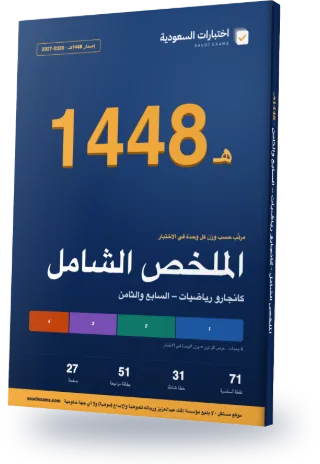 Complete Review Guide 2026–2027 included (PDF)Ordered by the weight of each unit in the examBuy now · SAR 34or 7 days for SAR 26
See everything included
Full mock exams like the real one and 501 explained questions that find your weak spots and train them
- Unlimited full mock exams to practise your pace and check your performance across the whole exam
- Practise 10 weak-area questions, starting where you lose the most marks
- 501 questions explaining why every option is right or wrong
- Arabic and English with one pass
- Unit notes and flashcards, then questions to check your understanding
Sources and references
- كانجارو موهبة: عن المسابقة kangarooksa.org
- كانجارو موهبة: التسجيل والأسئلة الشائعة kangarooksa.org
- كانجارو موهبة: الجدول الزمني kangarooksa.org
- كانجارو موهبة: نماذج الأسئلة kangarooksa.org