CDPNE

Aramco College Degree Program (CDPNE) Screening Test: free practice test

Start with 10 free questions to see what needs more practice. Finish to see your score, weakest units and every option explained.

Back to Aramco College Degree Program (CDPNE) Screening Test

Practice test questions with answers and explanations

Try the questions in the test above first, then open each one here to see the correct answer and why every other option is wrong.

01By the time you read this email, I ___ over the Atlantic for three hours.

Practice question Unit: Grammar

  1. Awill have been flying ✓ Correct answer

    A future reference point (by the time) with a duration (for three hours) takes the future perfect continuous.

  2. Bwill be flying

    Future continuous shows an action in progress at that moment but cannot count a duration back from it.

  3. Cwill fly

    Simple future gives no sense of an action already under way before that point.

  4. Dhave flown

    Present perfect refers to the present moment, not to a future reference point.

Reference: Aramco CDPNE screening test preparation booklet (sample items, 20 Feb 2025), Paper 1 English placement test — Grammar; skill: future perfect continuous with by the time + for-duration

02It would be ____ to save part of your allowance each month in case an unexpected expense arises.

Practice question Unit: Vocabulary

  1. Aimpulsive

    Means acting suddenly without thinking ahead, whereas saving every month in case of an unexpected expense is careful planning, not impulse.

  2. Bstingy

    Means unwilling to spend, with a negative tone, and it describes people rather than advisable actions.

  3. Cprudent ✓ Correct answer

    Means wise and careful about the future; 'It would be prudent to' is the standard way to recommend an action.

  4. Doptimistic

    Means expecting good outcomes; saving in case of an expense is a cautious act, not an optimistic one.

Reference: Aramco CDPNE screening test preparation booklet (sample items, 20 Feb 2025), Paper 1 English placement test — Vocabulary in context; skill: prudent in 'It would be prudent to ...'

03I can't **spare** an hour today because the deadline is tomorrow.

Practice question Unit: Vocabulary in context

  1. Aafford to give up ✓ Correct answer

    Spare an hour means have it free to give; the deadline leaves no free time.

  2. Bsave from harm

    Spare can mean not harm someone, but an hour of time cannot be protected from harm.

  3. Ckeep in reserve

    Keeping in reserve is saving for later, whereas the speaker is refusing to give it now.

  4. Dmeasure exactly

    Measuring exactly is not a sense of spare; the speaker is talking about not having an hour free to give, not about timing it.

Reference: Aramco CDPNE screening test preparation booklet (sample items, 20 Feb 2025), Paper 1 English placement test — Vocabulary in context; skill: verb 'spare' meaning afford to give

04What can be inferred about a polluted reef that suffers a short heatwave?

Practice question Unit: Reading comprehension

(1) Coral reefs cover less than one percent of the ocean floor, yet they shelter about a quarter of all marine species. Reef-building corals are animals, but most of their energy comes from microscopic algae that live inside their tissue. The algae use sunlight to make sugars, and in return the coral gives them shelter and the compounds they need to grow. This arrangement also supplies the bright colours of a healthy reef. (2) When the water stays a degree or two above the usual summer maximum for several weeks, the partnership begins to fail. The algae produce harmful molecules instead of sugars, and the coral expels them. Without its algae the coral turns pale, and the white calcium skeleton shows through the transparent tissue. This is what is called bleaching. A bleached coral is not dead, but it is starving, and it can survive only a few weeks unless conditions improve. (3) Recovery depends on timing. If the water cools quickly, surviving algae can recolonise the coral within months. If the heat lasts, the coral dies and fast-growing seaweed often covers the bare skeleton, which makes it harder for young corals to settle. Reefs that are also stressed by pollution or overfishing tend to recover more slowly than those that are not. (4) Some reefs have surprised researchers. Corals in parts of the Red Sea have tolerated temperatures that would bleach reefs elsewhere, and scientists are studying whether this tolerance can be passed on. Still, most researchers caution that such resilience has limits, and that reducing the underlying warming matters more than protecting a few hardy reefs.

  1. AIt will certainly die, because pollution makes bleaching permanent

    The text says bleached coral can recover if the water cools; 'certainly' and 'permanent' go beyond it.

  2. BIt will probably recover more slowly than a clean reef in the same heat ✓ Correct answer

    The passage says reefs stressed by pollution tend to recover more slowly, so this follows from paragraph 3.

  3. CIt will recover faster, because pollution keeps seaweed from spreading

    The text links pollution to slower recovery, not to less seaweed; nothing suggests pollution helps.

  4. DIt will bleach less, because polluted water blocks sunlight from reaching the algae

    Nothing says polluted water reduces bleaching; the text gives pollution only as an extra stress on recovery.

Reference: Aramco CDPNE screening test preparation booklet (sample items, 20 Feb 2025), Paper 1 English placement test — Reading comprehension; skill: inference from a comparison between two reef conditions

05α and β are the roots of x² − 3x + 1 = 0. Which equation has roots α² and β²?

Practice question Unit: Algebra and functions

  1. Ax² − 7x + 1 = 0 ✓ Correct answer

    The new sum is α² + β² = 9 − 2 = 7 and the new product is (αβ)² = 1.

  2. Bx² − 9x + 1 = 0

    This takes (α + β)² = 9 as the new sum, forgetting to subtract 2αβ.

  3. Cx² − 7x + 9 = 0

    The sum 7 is right, but the product of the new roots is (αβ)² = 1, not 9.

  4. Dx² + 7x + 1 = 0

    The coefficients are right, but the middle term must be minus the sum of roots, −7x.

Reference: Aramco CDPNE screening test preparation booklet (sample items, 20 Feb 2025), Paper 2 mathematics placement test (scope: Saudi Ministry of Education intermediate and high-school curriculum); topic: forming a quadratic whose roots are the squares of the original roots

06Three numbers are inserted between 2 and 32 so that the five numbers form a geometric sequence whose terms alternate in sign. What is the sum of the three inserted numbers?

Practice question Unit: Sequences, counting, probability and statistics

  1. A−28

    This makes all three numbers negative, but in a geometric sequence with ratio −2 the middle term 8 is positive.

  2. B−12 ✓ Correct answer

    r⁴ = 16 and the signs alternate, so r = −2: the sequence is 2, −4, 8, −16, 32 and the inserted terms sum to −4 + 8 − 16 = −12.

  3. C12

    This has the signs the wrong way round (4 − 8 + 16); the first inserted term must be 2·(−2) = −4.

  4. D28

    This uses the positive ratio 2, giving 4 + 8 + 16, but then the terms do not alternate in sign.

Reference: Aramco CDPNE screening test preparation booklet (sample items, 20 Feb 2025), Paper 2 mathematics placement test (scope: Saudi Ministry of Education intermediate and high-school curriculum); topic: geometric means with a negative common ratio

07From an external point P, a tangent segment PT of length 12 cm is drawn to a circle. A secant from P meets the circle at A (nearer) and then at B, with PA = 8 cm. What is the length of the chord AB in cm?

Practice question Unit: Geometry, trigonometry and coordinate geometry

  1. A10 ✓ Correct answer

    PT² = PA × PB gives 144 = 8 × PB, so PB = 18. The chord is the part inside the circle: AB = 18 − 8 = 10.

  2. B18

    PB = 18 is the whole secant from P to B. The chord AB excludes the external part PA = 8.

  3. C20

    This adds PA and PT (8 + 12). The tangent-secant relation is a product, PT² = PA × PB, not a sum.

  4. D36

    This divides 144 by 4, taking 12 − 8 as the other factor. The second factor of the product is the whole secant PB.

Reference: Aramco CDPNE screening test preparation booklet (sample items, 20 Feb 2025), Paper 2 mathematics placement test (scope: Saudi Ministry of Education intermediate and high-school curriculum); topic: tangent-secant product theorem (PT² = PA·PB)

08What is lim(x→∞) (√(x² + 4x) − x)?

Practice question Unit: Limits and differentiation

  1. A0

    0 treats √(x² + 4x) as x, but the 4x term inside the root leaves a leftover that does not vanish.

  2. B1

    1 comes from halving the coefficient twice; the correct step is 4x/(2x) = 2.

  3. C2 ✓ Correct answer

    Multiply by the conjugate: 4x/(√(x² + 4x) + x). Dividing by x gives 4/(√(1 + 4/x) + 1) → 4/2 = 2.

  4. D∞

    ∞ − ∞ is an indeterminate form, not automatically infinite; after the conjugate step the limit is finite.

Reference: Aramco CDPNE screening test preparation booklet (sample items, 20 Feb 2025), Paper 2 mathematics placement test (scope: Saudi Ministry of Education intermediate and high-school curriculum); topic: limit at infinity of a difference of a square root and a linear term (conjugate)

09The platform was empty because, by the time we reached the station, the train ___.

Practice question Unit: Fluency

  1. Ahas already left

    Present perfect links to now and cannot follow a past-time clause like we reached.

  2. Bis already leaving

    Is already leaving is a present progressive and clashes with the past context set by by the time we reached.

  3. Cwould already leave

    Would leave expresses a future in the past, not an action already completed.

  4. Dhad already left ✓ Correct answer

    Leaving happened before the arrival, and both are in the past, so past perfect is needed.

Reference: Aramco CDPNE screening test preparation booklet (sample items, 20 Feb 2025), Paper 3 — Fluency / Vocabulary / Spelling; skill: past perfect with by the time + simple past

10having mixed or opposing feelings about something

Practice question Unit: Vocabulary (definition)

  1. Aambivalent ✓ Correct answer

    'ambivalent' means having mixed or opposing feelings about something, which matches the definition in the question.

  2. Bunequivocal

    'unequivocal' means clear and firm, leaving no doubt. That is a different idea from the definition given, so it does not fit.

  3. Capathetic

    'apathetic' means showing no interest or concern. That is a different idea from the definition given, so it does not fit.

  4. Dambiguous

    'ambiguous' means open to more than one interpretation. That is a different idea from the definition given, so it does not fit.

Reference: Aramco CDPNE screening test preparation booklet (sample items, 20 Feb 2025), Paper 3 — Fluency / Vocabulary / Spelling — Vocabulary; skill: matching the C1 word 'ambivalent' to its English definition

Aramco CDPNE Test

Full prep for this exam

All of this in one purchase.

  • Full mock exam, same as the real one166 questions in 280 minutes. You get a total score and a score for every unit.
  • Practice unit by unit563 questions, every option explained with its source. Starts with your weakest units.
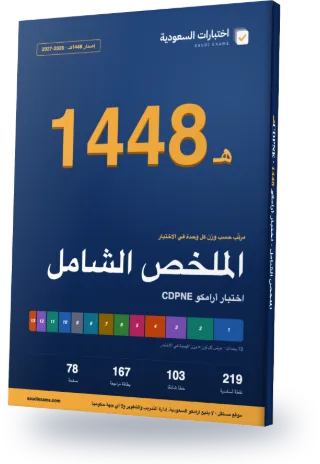
  • Complete Review Guide 2026–2027 (PDF)Ordered by each unit's weight in the exam. With lifetime access only.
Choose your access

One step before payment

Continue with your Google account and you go straight to the payment page.

Check my score freeFull prep