CDPNE
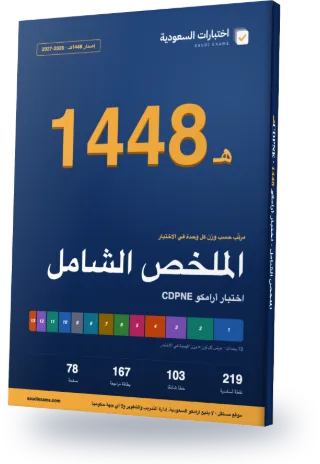
Aramco CDPNE Test Complete Review Guide 2026–2027
Every exam topic in a 78-page Arabic PDF, ordered from the heaviest unit to the lightest. The first three chapters alone cover about 35% of the exam questions.
- 78Pages
- 219Key points
- 103Common mistakes
- 167Flashcards
Guide map
Each chapter is one exam unit, ordered by its weight in the real exam.
| Chapter | Unit | Weight | Exam questions | Key points |
|---|---|---|---|---|
| 1 | Algebra and functions | 13% | 22 | 18 |
| 2 | Reading comprehension | 12% | 20 | 16 |
| 3 | Grammar | 10% | 16 | 18 |
| 4 | Geometry, trigonometry and coordinate geometry | 10% | 16 | 18 |
| 5 | Vocabulary | 7% | 12 | 16 |
| 6 | Vocabulary in context | 7% | 12 | 18 |
| 7 | Sequences, counting, probability and statistics | 7% | 12 | 18 |
| 8 | Fluency | 7% | 12 | 17 |
| 9 | Limits and differentiation | 6% | 10 | 18 |
| 10 | Vocabulary (definition) | 6% | 10 | 16 |
| 11 | Spelling | 6% | 10 | 17 |
| 12 | Inductive reasoning | 5% | 8 | 15 |
| 13 | Deductive logic | 4% | 6 | 14 |
Chapter 1 in full: Algebra and functions
13% of the exam, about 22 questions. These are its key points, as in the guide.
- (Equations and inequalities) The equation ax^2 + bx + c = 0 has roots x = (−b ± √(b^2 − 4ac))/(2a). The discriminant D = b^2 − 4ac: D > 0 gives two distinct real roots, D = 0 a repeated root, D < 0 no real roots. Example: x^2 − 6x + 9 = 0 has D = 0 and root x = 3.
- (Equations and inequalities) For a quadratic, the sum of the roots is x1 + x2 = −b/a and the product is x1·x2 = c/a. Example: in x^2 − 5x + 6 = 0 the sum is 5 and the product 6, so the roots are 2 and 3. Use this to build an equation from given roots without solving.
- (Equations and inequalities) Multiplying or dividing by a negative reverses the inequality: −2x > 6 gives x < −3. Solve a quadratic inequality by factoring and using a sign chart: (x − 1)(x − 4) < 0 gives 1 < x < 4, while (x − 1)(x − 4) > 0 gives x < 1 or x > 4.
The rest of chapter 1, on this page
- (Equations and inequalities) Absolute value: |x − a| < r means a − r < x < a + r, and |x − a| > r means x < a − r or x > a + r. The equation |2x − 1| = 5 gives 2x − 1 = 5 or 2x − 1 = −5, so x = 3 or x = −2. An equation |expr| = negative number has no solution.
- (Equations and inequalities) For a radical equation, isolate the root, square both sides, solve, then substitute each answer into the original equation. Example: √(x + 2) = x gives x^2 − x − 2 = 0, so x = 2 or x = −1, and substitution keeps only x = 2. The same applies to rational equations: a solution that makes a denominator zero is rejected. A system of two equations is solved by substitution or elimination.
- (Functions: composition, inverse and domain) Composition: (f∘g)(x) = f(g(x)), meaning g(x) is substituted inside f. Order matters: if f(x) = 2x + 1 and g(x) = x^2 then f(g(x)) = 2x^2 + 1 and g(f(x)) = (2x + 1)^2. For f(g(2)), compute g(2) first, then apply f to that value.
- (Functions: composition, inverse and domain) To find an inverse: write y = f(x), swap x and y, then solve for y. Example: f(x) = 2x + 3 has inverse f⁻¹(x) = (x − 3)/2. It satisfies f(f⁻¹(x)) = x, its graph is the reflection of f's graph in y = x, and the domain of f⁻¹ is the range of f.
- (Functions: composition, inverse and domain) A function has an inverse only if it is one-to-one (each y value comes from a single x). The function x^2 over all real numbers has no inverse, but restricting its domain to x ≥ 0 makes it invertible, with inverse √x.
- (Functions: composition, inverse and domain) Domain: exclude values that make a denominator zero, put a negative under an even root, or make a logarithm's argument non-positive. Example: f(x) = √(x − 3)/(x − 5) has domain x ≥ 3 and x ≠ 5. For f(g(x)), x must lie in the domain of g and g(x) in the domain of f.
- (Functions: composition, inverse and domain) Transformations: f(x − h) + k shifts the graph h right and k up, −f(x) reflects it in the x-axis, f(−x) reflects it in the y-axis. A function is even if f(−x) = f(x) (like x^2) and odd if f(−x) = −f(x) (like x^3). The vertex of the parabola y = ax^2 + bx + c is at x = −b/(2a).
- (Exponents and logarithms) Exponent laws: a^m · a^n = a^(m+n), a^m / a^n = a^(m−n), (a^m)^n = a^(mn), a^0 = 1, a^(−n) = 1/a^n, a^(m/n) = the nth root of a^m. Example: 8^(2/3) = (cube root of 8)^2 = 2^2 = 4.
- (Exponents and logarithms) Definition: log_a b = c means a^c = b, with a > 0, a ≠ 1 and b > 0. Examples: log₂8 = 3 because 2^3 = 8, log_a 1 = 0, log_a a = 1. A logarithm is an exponent, so you solve it by converting to exponential form.
- (Exponents and logarithms) Log laws: log(xy) = log x + log y, log(x/y) = log x − log y, log(x^k) = k·log x, and change of base log_a b = log_c b / log_c a. Example: log₂12 − log₂3 = log₂4 = 2. There is no law that simplifies log(x + y).
- (Exponents and logarithms) Solve an exponential equation by matching bases: 2^(x+1) = 32 gives x + 1 = 5, so x = 4. For a logarithmic equation, combine the logs, convert to exponential form, and check the domain: log₂x + log₂(x − 2) = 3 gives x(x − 2) = 8, so x^2 − 2x − 8 = 0, x = 4 or x = −2, and −2 is rejected because a log argument would be negative.
- (Polynomials and complex numbers) Remainder theorem: the remainder when P(x) is divided by (x − c) equals P(c). Factor theorem: (x − c) is a factor of P(x) if and only if P(c) = 0. Example: for P(x) = x^3 − 2x + 4, P(−2) = −8 + 4 + 4 = 0, so (x + 2) is a factor.
- (Polynomials and complex numbers) Rational root theorem: every rational root of a polynomial with integer coefficients has the form p/q, where p divides the constant term and q divides the leading coefficient. Example: for 2x^3 − 3x^2 − 3x + 2 the candidates are ±1, ±2, ±1/2, and x = 2 is a root because 16 − 12 − 6 + 2 = 0. A degree-n polynomial has at most n roots, and with real coefficients non-real roots come in conjugate pairs.
- (Polynomials and complex numbers) A complex number is a + bi with i^2 = −1. Multiplication: (a + bi)(c + di) = (ac − bd) + (ad + bc)i, so (3 + 2i)(1 − i) = 3 − 3i + 2i − 2i^2 = 5 − i. Divide by multiplying top and bottom by the conjugate of the denominator: (2 + i)/(1 − i) = (2 + i)(1 + i)/2 = (1 + 3i)/2.
- (Polynomials and complex numbers) Powers of i repeat every four: i^1 = i, i^2 = −1, i^3 = −i, i^4 = 1, so divide the exponent by 4 and use the remainder (i^27 = i^3 = −i). The modulus is |a + bi| = √(a^2 + b^2), so |3 + 4i| = 5. When D < 0 the roots are complex: x^2 + 2x + 5 = 0 gives x = −1 ± 2i.
Common mistakes in this chapter
- Dividing both sides by an expression containing x (as in x^2 = 3x, then dividing by x) loses the solution x = 0; move terms and factor instead: x(x − 3) = 0.
- Forgetting to flip the inequality when multiplying by a negative: −2x > 6 gives x < −3, not x > −3.
- Squaring a radical equation can introduce extraneous roots: in √(x + 2) = x, squaring gives x = 2 or x = −1, and only x = 2 works.
- Mixing up f∘g and g∘f: with f(x) = 2x + 1 and g(x) = x^2, f(g(x)) = 2x^2 + 1 but g(f(x)) = (2x + 1)^2.
- Treating the inverse as 1/f(x): f⁻¹ undoes the function rather than inverting its value, so the inverse of 2x + 3 is (x − 3)/2, not 1/(2x + 3).
- Simplifying log(x + y) to log x + log y; the sum law applies to products only: log(xy) = log x + log y.
- Accepting every solution of a logarithmic equation without checking the domain; a solution that makes a log argument zero or negative is rejected.
- Writing (a + b)^2 = a^2 + b^2 and dropping the middle term 2ab, one of the most common algebra errors in simplification questions.
The other chapters are in the full guide
One purchase · lifetime access · review guide included
7-day review plan
The chapters are spread over 6 days by weight so each day carries a similar load. Day 7 is a full exam.
Day 1 · 18% of the exam
Chapter 1: Algebra and functions
Chapter 12: Inductive reasoningDay 2 · 18% of the exam
Chapter 2: Reading comprehension
Chapter 11: SpellingDay 3 · 16% of the exam
Chapter 3: Grammar
Chapter 9: Limits and differentiationDay 4 · 16% of the exam
Chapter 4: Geometry, trigonometry and coordinate geometry
Chapter 10: Vocabulary (definition)Day 5 · 18% of the exam
Chapter 5: Vocabulary
Chapter 7: Sequences, counting, probability and statistics
Chapter 13: Deductive logicDay 6 · 14% of the exam
Chapter 6: Vocabulary in context
Chapter 8: FluencyDay 7
Full mock exam: 166 questions in 280 minutes, then review the common mistakes in the units where you lost marks.
Before you read: see your score today
10 free questions from the main units, no sign-up. Then you know which chapter to start with.
Try 10 free questions and see your levelA look at each chapter
The first three key points of each chapter, as they appear in the guide (in Arabic in the PDF).
Chapter 1: Algebra and functions
- (Equations and inequalities) The equation ax^2 + bx + c = 0 has roots…
- (Equations and inequalities) For a quadratic, the sum of the roots is x1 +…
- (Equations and inequalities) Multiplying or dividing by a negative reverses the inequality: −2x >…
Chapter 2: Reading comprehension
- (Details and stated information) In an "according to paragraph 2" question go back to…
- (Details and stated information) Watch cause-and-effect words: because, so, which is why, as a…
- (Details and stated information) An answer worded with synonyms (reduced / lowered) is often…
Chapter 3: Grammar
- (Tenses and verb forms) Use the past simple for an action finished at a…
- (Tenses and verb forms) Perfect continuous tenses stress duration: had been sheltering for two…
- (Tenses and verb forms) After when, until, before, as soon as and by the…
Chapter 4: Geometry, trigonometry and coordinate geometry
- (Plane and solid geometry and measurement) The angles of a triangle sum to 180°…
- (Plane and solid geometry and measurement) Pythagoras in a right triangle: a² + b²…
- (Plane and solid geometry and measurement) Triangle area is ½ × base × height…
Chapter 5: Vocabulary
- (Word meaning (choose the word that fits)) Clues come in three kinds: contrast (although…
- (Word meaning (choose the word that fits)) Words for reducing harm: mitigate, alleviate, curb…
- (Word meaning (choose the word that fits)) Charge
Chapter 6: Vocabulary in context
- (Word meaning from the sentence) Step one
- (Word meaning from the sentence) One word carries several senses: bear = support, tolerate…
- (Word meaning from the sentence) Stock as a verb means keep on sale in…
Chapter 7: Sequences, counting, probability and statistics
- (Arithmetic and geometric sequences) An arithmetic sequence has a constant difference: a_n = a₁…
- (Arithmetic and geometric sequences) Sum of the first n terms: S_n = n/2 ·…
- (Arithmetic and geometric sequences) A geometric sequence has a constant ratio: a_n = a₁·r^(n−1)…
Chapter 8: Fluency
- (Choose the option that completes the sentence) Read the whole sentence first, then decide…
- (Choose the option that completes the sentence) The past perfect (had + past participle)…
- (Choose the option that completes the sentence) In time clauses about the future (as…
Chapter 9: Limits and differentiation
- (Limits and continuity) Meaning of a limit
- (Limits and continuity) Start by direct substitution
- (Limits and continuity) With roots, multiply numerator and denominator by the conjugate: lim(x→0) (√(x…
Chapter 10: Vocabulary (definition)
- (Choose the word that matches the definition) Solving routine: (1) read the whole definition…
- (Choose the word that matches the definition) The wording of a definition gives away…
- (Choose the word that matches the definition) Ubiquitous
Chapter 11: Spelling
- (Choose the correct spelling) 'accommodate' has both cc and mm: ac-com-mo-date. Example: The hotel…
- (Choose the correct spelling) 'embarrass' has rr and ss, while 'harass' has one r…
- (Choose the correct spelling) 'occurrence' has cc and rr and ends in -ence. The…
Chapter 12: Inductive reasoning
- (Choose the object that does not fit the rule) Step one
- (Choose the object that does not fit the rule) Alternating fill: "black, white, black…
- (Choose the object that does not fit the rule) Shape cycle
Chapter 13: Deductive logic
- (Choose the correct code for the machine) The code rule
- (Choose the correct code for the machine) The identity code 1234 changes nothing. Any…
- (Choose the correct code for the machine) Method 1
The full guide comes with lifetime access
The full guide (78 pages) is included with lifetime access to this exam, together with every question and full mock exam. Chapter 1 is free for everyone.
Questions about the guide
Is the guide free?
Chapter 1 is free to read on the guide page. The full guide comes with lifetime access to this exam; 7-day access does not include it.
Is it up to date for 2026–2027?
Yes. Unit weights and exam facts follow what the exam body last published, and the last check date is printed in the guide. If the standards change we update the file and buyers download the new version.
Does the guide have questions?
No. The guide covers key points and common mistakes; scoring, weak-area practice and full mock exams are on the site.
Can I read it on my phone?
Yes. A5 pages in a single column, with chapters linked from the contents.
- Pages
- 78
- Edition
- 1448 AH · 2026–2027
- Language
- Arabic
- Last updated
All University & Graduate Exams review guides
Back to Aramco College Degree Program (CDPNE) Screening Test
Full prep for this exam
All of this in one purchase.
- Full mock exam, same as the real one166 questions in 280 minutes. You get a total score and a score for every unit.
- Practice unit by unit563 questions, every option explained with its source. Starts with your weakest units.
- Complete Review Guide 2026–2027 (PDF)Ordered by each unit's weight in the exam. With lifetime access only.
Choose your access
Continue with your Google account and you go straight to the payment page.