How to Prepare for the Earth Science Professional Licence Test: A Four-Week Plan and a One-Week Plan by Weight
A study plan for the Earth Science professional licence test by the weights of the six domains: four weeks starting with Crustal Materials (28%), a one-week plan if time is short, with full practice tests.
- Questions and time
- 75 questions · 120 minutes
- Pass mark
- 50%
- correct answers to pass (50%)
- 38 of 75
- Exam fee
- SAR 100 for the subject test
Start with 10 free questions to find what needs more work. No sign-up, with answer explanations.
Try 10 free questions and see your levelPut what you just read into practice
Teacher License – Earth Science
Start with 10 free questions to find what needs more work. No sign-up, with answer explanations.
Try 10 free questions and see your levelInformation last verified: 16 November 2026. The weights are from the applicant guide for Earth Science teachers (pp. 6-7), and the standards are from the Earth Science teacher standards document. This is an independent guide. It is not affiliated with the Education and Training Evaluation Commission (ETEC), the National Center for Assessment (Qiyas), the Ministry of Education or any government body.
In short: two plans based on the weights of the six domains: a four-week plan, and a one-week plan if time is short. In both we start with Crustal Materials (28%) because it is the largest domain, then crustal changes and Historical Geology, and we leave Scientific Foundations and Teaching Earth Science for the end along with the full tests. The next cycle is expected in late January 2027, so adjust the plan to finish before your date (dates).
How we split the time
| Domain | Weight | Questions out of 75 (estimate) | Its time in the four-week plan |
|---|---|---|---|
| Crustal Materials | 28% | 21 | Week 1 and Week 2 (oil and gas) |
| Earth and the Universe | 18.7% | 14 | Week 3 |
| Historical Geology | 18.6% | 14 | Week 2 and Week 3 |
| Scientific Foundations and Applications | 16% | 12 | Week 4 |
| Crustal Changes | 10.7% | 8 | Week 2 |
| Teaching Earth Science | 8% | 6 | Week 4, plus a short session every week |
The question counts based on an estimated 75 questions are an estimate we calculate from the weights, because ETEC has not announced the number of questions on the test. What matters here is the ratio between domains. If a domain is strong for you from your work, shorten its time and add it to the weakest one after the result of the first week's test.
Rules that apply to both plans
- Read the standard, then solve: each standard has indicators in the test content, and each question measures one indicator. Start each topic with its indicators, then solve its questions in practice mode.
- Read the explanation of every option: a wrong option tells you the common misconception, so write down for yourself what you got wrong.
- Link what you study to the Kingdom: the Arabian Shield, the Arabian Shelf, the Red Sea, the Kingdom's ores, its aquifers and its oil reservoirs come within standards of the scientific content, so give each topic a Saudi example.
- Calculation without a calculator: the test does not allow one, and few questions need calculation, but get used to reading numbers and ratios (such as silica content and age estimates) without a calculator.
- The teaching session: the Teaching Earth Science domain is 8% and its questions need an understanding of strategies more than memorisation (6.31.13 and 6.31.14), so set aside twenty minutes for it every week.
- Review your mistakes: at the start of each week, redo the questions from the previous week that you got wrong.
The four-week plan
Week 1: Diagnosis and Crustal Materials (minerals, rocks and water)
- Day one: the free questions to find out where you stand in all domains, and note your three weakest standards.
- 6.31.6 (10.7%): minerals, their physical and chemical properties and formation, igneous, sedimentary and metamorphic rocks and their textures, the rock cycle, and the Kingdom's ores. Give it more than half the week, as it is one of the heaviest standards on the test.
- 6.31.10 (8%): hydrogeology: the water cycle, aquifers and aquicludes, the saturated and aeration zones, wells and the artesian well, the main aquifers in the Kingdom, and protecting fresh water.
- End of the week: practice on the two standards.
Week 2: Oil and gas, crustal changes and Historical Geology (1)
- 6.31.11 (9.3%): theories of the origin of oil, reservoirs, reservoir rocks and traps, methods of discovery and extraction, and the locations of reservoirs in the world and in the Kingdom.
- 6.31.7 (10.7%): plate tectonics and continental drift, earthquakes and volcanoes and their relation to plate boundaries, folds, faults and joints, and weathering, erosion, transport and deposition.
- 6.31.8 (9.3%): fossils, their types and formation, the principles of historical geology, and the geological record and its divisions.
- End of the week: practice on the whole of Crustal Materials (6.31.6, 6.31.10 and 6.31.11), then on 6.31.7, and review the mistakes of the two weeks.
Week 3: The history of the Arabian Peninsula, and Earth and the Universe
- 6.31.9 (9.3%): the geological history of the Arabian Peninsula, the Arabian Shield and the Arabian Shelf, the origin of the Red Sea, and the boundaries of the Arabian Plate and the direction of its movement.
- 6.31.4 (6.7%): theories of the origin of the universe and its components, and the Earth's position in the solar system and its changes.
- 6.31.5 (8%): the Earth's spheres: the layers of the atmosphere, the layers of the lithosphere, their composition and the methods used to study them, and the hydrosphere and biosphere.
- 6.31.1 (4%): the history of Earth sciences, the contributions of Islamic civilisation, the nature of science, and the difference between fact, concept, law and theory.
- End of the week: practice on Historical Geology with its two standards, then on Earth and the Universe.
Week 4: Scientific foundations, teaching and the first full tests
- 6.31.2 (4%) and 6.31.3 (5.3%): the scientific method, hypothesis, theory and variables, and laboratory and field safety rules and handling geological samples.
- 6.31.12 (6.7%): the relation of Earth sciences to other sciences and their applications in mining, agriculture, engineering and industry.
- 6.31.13 and 6.31.14 (4% each): modern trends in teaching, misconceptions and how to detect them, teaching strategies, inquiry activities and field studies, and assessment methods.
- Midweek: the first full timed practice test in two hours with no phone and no calculator. Compare its result with the first week's diagnosis, domain by domain.
- End of the week: review its mistakes and go back to your two weakest domains, then take a second full practice test at least two days before the test, then a light review. Do not start a new topic on the last day.
- Test day: review the required ID and what is allowed, sleep early, and arrive early.
The one-week plan
If only a week is left, do not try to cover everything in depth. Start with the diagnosis, then arrange the days by weight:
| Day | What to do |
|---|---|
| 1 | The free questions for diagnosis, then 6.31.6: minerals, rocks and the rock cycle (10.7%) |
| 2 | 6.31.10 hydrogeology (8%), and 6.31.11 oil and gas (9.3%) |
| 3 | 6.31.7 crustal changes: plates, earthquakes, volcanoes, weathering and erosion (10.7%), and 6.31.8 Historical Geology (9.3%) |
| 4 | 6.31.9 the geological history of the Arabian Peninsula (9.3%), and 6.31.5 the Earth's spheres (8%) |
| 5 | 6.31.4 the origin of the universe and the solar system (6.7%), 6.31.12 the relation of Earth sciences to other sciences (6.7%), and 6.31.3 safety (5.3%) |
| 6 | 6.31.1 and 6.31.2 (4% each), and 6.31.13 and 6.31.14 teaching (4% each), then a full timed practice test |
| 7 | Review the mistakes of the full test and its two weakest standards, then rest. No new topic |
Each day, finish by solving that day's questions in practice mode, then read the explanation of the wrong options. If time is even shorter than that, start with Crustal Materials (28%), then crustal changes and Historical Geology, and reserve the last day for a full test and a review of its mistakes.
These plans are our suggestion for organising your time and do not guarantee any particular score, and the practice test result is an estimate of your readiness, not an official result. Start from unit training with Crustal Materials (28%), and leave the full practice test for the end of the plan.
Finished reading? Try a set of questions
Start with 10 free questions to find your weakest units. Keep practising with the full question bank and mock exams from SAR 26.
Put the plan to work here
SAR 34 $9
One purchase · lifetime access · review guide included
- 548 questions, every option explained with its source
- Full mock exams: 75 questions in 120 minutes, like the real one
- Practice that starts with your weakest units, plus a review of your mistakes
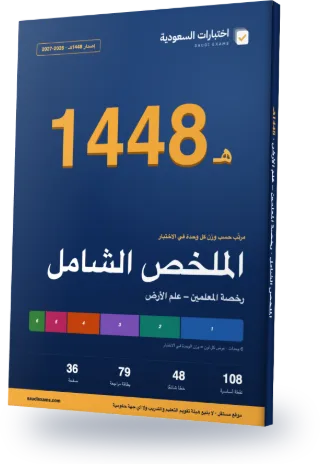 Complete Review Guide 2026–2027 included (PDF)Ordered by the weight of each unit in the examBuy now · SAR 34or 7 days for SAR 26
See everything included
Full mock exams like the real one and 548 explained questions that find your weak spots and train them
- Unlimited full mock exams to practise your pace and check your performance across the whole exam
- Practise 10 weak-area questions, starting where you lose the most marks
- 548 questions explaining why every option is right or wrong
- Arabic and English with one pass
- Unit notes and flashcards, then questions to check your understanding
Sources and references
- ETEC – Professional License Test for Educational Professions (dates, scoring, FAQ and e-services) etec.gov.sa
- ETEC – Candidate guide for Earth Science teachers (1441 AH / 2020 trial edition): domains, weights and sample questions media.etec.gov.sa
- ETEC – Subject standards for Earth Science teachers (1441 AH / 2020) media.etec.gov.sa