Kangaroo Mawhiba Mathematics Competition – Grades 3–4: free practice test
Start with 10 free questions to see what needs more practice. Finish to see your score, weakest units and every option explained.
Back to Kangaroo Mawhiba Mathematics Competition – Grades 3–4
Practice test questions with answers and explanations
Try the questions in the test above first, then open each one here to see the correct answer and why every other option is wrong.
01Several teams came to the summer Kangaroo camp. Each team has 5 or 6 members. There are 43 people in total. How many teams are at this camp?
Reference: Kangaroo Mawhiba Mathematics 2020, Grades 3–4 (Ecolier), question 22 with full solution
02Salma replaces letters in the calculation KAN − ROO + GA with numbers from 1 to 9 and then calculates the result. The same letters are replaced by the same numbers and different letters by different numbers. What is the largest possible result she could get?
Reference: Kangaroo Mawhiba Mathematics 2020, Grades 3–4 (Ecolier), question 24 with full solution
03Five balls start moving at the same time, each in the direction of its arrow. From left to right, the balls 10 and 9 move right, and the balls 3, 7 and 20 move left. When two balls moving in opposite directions collide, the bigger ball swallows the smaller one and increases its value by the value of the smaller ball. The bigger ball keeps moving in its original direction (for example, an 11 moving right and a 4 moving left give a 15 moving right). What is the final result of the collisions of the 5 balls?
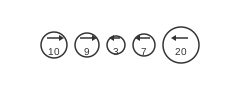
Reference: Kangaroo Mawhiba Mathematics 2021, Grades 3–4 (Ecolier), question 12 with full solution
04A standard die has 7 as the sum of the dots on opposite faces. It starts on the first square of a row of 6 squares, with 1 on top, 3 on its right face and 2 on its front face. It is rolled to the right 5 times in a row, each time over its right edge, until it lands on the last square. What is the total number of dots on the top, front and right faces then?
Reference: Kangaroo Mawhiba Mathematics 2020, Grades 3–4 (Ecolier), question 17 with full solution
05Each key below is made of 15 shaded squares. Which key would it be impossible to cut into three different figures of five shaded squares each? (Two figures that match after turning or flipping count as the same figure.)
A
 Figure 1
It can be cut into three different pieces: a T-shape, a big corner (V-shape) and a zigzag (N-shape).
B
 Figure 2
It can be cut into three different pieces: an F-shape, a big corner (V-shape) and a staircase (W-shape).
C
 Figure 3
It can be cut into three different pieces: a plus sign (X-shape), a Y-shape and a zigzag (N-shape).
D
 Figure 4 ✓ Correct answer
Correct, it is impossible: if we start with the five squares at the bottom, the other 10 squares can only be split into two identical figures, which breaks the rule.
E
 Figure 5
It can be cut into three different pieces: a U-shape, a Y-shape and an F-shape.
Reference: Kangaroo Mawhiba Mathematics 2020, Grades 3–4 (Ecolier), question 23 with full solution
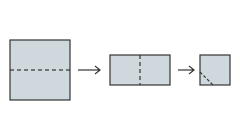
06Rana folds a square piece of paper twice, as shown: first she folds the bottom half up onto the top half, then she folds the left half over onto the right half. Then she cuts off the bottom-left corner of the small folded square, as shown. What does the paper look like once it is unfolded?
A
 Figure 1
A slanted cut makes slanted edges. This hole has straight edges parallel to the sides of the paper, but the cut edges are diagonal, so the real hole is a diamond, not an upright square.
B
 Figure 2 ✓ Correct answer
The corner cut off from the folded paper is the centre of the original sheet, and the cut triangle repeats in all four quarters, making one diamond-shaped hole in the middle.
C
 Figure 3
This figure comes from cutting the four outer corners, but the corner that was cut is the centre one.
D
 Figure 4
This figure comes from cutting squares out of the outer corners, not a triangle at the centre.
E
 Figure 5
This figure combines a centre hole with cut outer corners, but only one cut was made.
Reference: Kangaroo Mawhiba Mathematics 2023, Grades 3–4 (Ecolier), question 18 with full solution
07Khalid throws darts at balloons worth 3, 9, 13, 14 and 18 points. A balloon bursts when it is hit, so each balloon can be hit only once. He scores 30 points in total. Which balloon does Khalid definitely hit?
Reference: Kangaroo Mawhiba Mathematics 2021, Grades 3–4 (Ecolier), question 20 with full solution
086 camels and 2 kangaroos stand in a line (8 animals numbered 1 to 8). Among any 3 animals with consecutive numbers, exactly 1 is a kangaroo. Which numbered animal is a kangaroo?
Reference: Kangaroo Mawhiba Mathematics 2023, Grades 3–4 (Ecolier), question 17 with full solution
096 people each order one scoop of ice cream: 3 scoops of vanilla, 2 scoops of chocolate and 1 scoop of lemon. They top the ice creams with 3 cherries, 2 wafers and 1 chocolate chip, one topping on each scoop, so that no two ice creams are alike. Which of the following combinations is NOT possible?
Reference: Kangaroo Mawhiba Mathematics 2020, Grades 3–4 (Ecolier), question 18 with full solution
10Five children ate some plums. Lara ate two plums more than Sara. Soaad ate three plums fewer than Lara. Fatemah ate one plum more than Soaad and three plums fewer than Reem. Which two girls ate the same number of plums?
Reference: Kangaroo Mawhiba Mathematics 2022, Grades 3–4 (Ecolier), question 22 with full solution
Full prep for this exam
All of this in one purchase.
- Full mock exam, same as the real one24 questions in 75 minutes. You get a total score and a score for every unit.
- Practice unit by unit558 questions, every option explained with its source. Starts with your weakest units.
- Complete Review Guide 2026–2027 (PDF)Ordered by each unit's weight in the exam. With lifetime access only.
Choose your access
Continue with your Google account and you go straight to the payment page.