Kangaroo Mawhiba 11–12 Syllabus: 30 Questions, Examples
30 questions in 90 minutes, scored out of 120: the five units with a worked example each, the 3, 4 and 5 mark ladder, and where marks are lost.
- Questions and time
- 30 questions · 90 minutes
- Pass mark
- No pass mark; the score is out of 120, and gold, silver and bronze medals go by cut-offs Mawhiba announces each year
- Exam fee
- SAR 60 (guardian contribution)
Start with 10 free questions to find what needs more work. No sign-up, with answer explanations.
Try 10 free questions and see your levelPut what you just read into practice
Start with 10 free questions to find what needs more work. No sign-up, with answer explanations.
Try 10 free questions and see your levelLast verified: 16 November 2026. The question count, duration and full score come from the About Kangaroo page on the Kangaroo Mawhiba site, and the spread of questions across units from the question samples page. They may change, so check before the test. This is an independent guide, not affiliated with Mawhiba, the Education and Training Evaluation Commission (ETEC) or any government body, and it does not promise any score.
Kangaroo Mawhiba for grades 11 and 12 is a maths competition of 30 questions in 90 minutes, with a full score of 120. The competition does not publish a list of topics, so this guide is built on the past papers from 2020 to 2025: we sorted their questions into five units and wrote one example of our own, with its solution, for each unit. The units and their shares are our own grouping of those papers, not an official list, and this year's paper may be spread a little differently. For a day-by-day plan see the study plan guide, and for sign-up steps see the registration guide.
The key numbers
| Item | Details | What it means for you |
|---|---|---|
| Questions | 30 multiple-choice questions (A–E) | Five options for every question |
| Duration | 90 minutes | 90 ÷ 30 = 3 minutes per question on average |
| Full score | 120 | 10 questions × 3 + 10 questions × 4 + 10 questions × 5 = 120 |
| Question language | Arabic and English together | Read each question in whichever language you prefer |
| Pass mark | None | The score is out of 120, and medals go by cut-offs Mawhiba announces after the test |
The ladder: 3, 4 and 5 marks
The paper has three equal sections. The first is ten questions worth 3 marks each, the second ten worth 4 marks, and the third ten worth 5 marks. So the last section alone carries 50 of the 120 marks, more than a third. Even so, a 3-mark question is worth as much as any other to someone who loses it to a small slip in arithmetic: it is a mark that a little care can save. In the past papers, 3-mark questions usually take one or two steps, 4-mark questions need one clear idea, and 5-mark questions combine two ideas, need a special case or call for a sketch.
| Section | Questions | Marks each | Total |
|---|---|---|---|
| First | 10 | 3 | 30 |
| Second | 10 | 4 | 40 |
| Third | 10 | 5 | 50 |
The cut-offs Mawhiba announced for the 2026 medals are on the cut-offs and scores page. They change every year with how students perform, so do not build a fixed target on them. It is more useful to know what you would score today and which kind of question you lose marks in.
The five units and their questions
| Unit | Questions (about) | Share | Topics |
|---|---|---|---|
| Numbers and Arithmetic | 6 | 20% | Divisibility and primes; fractions, ratios, speed and work; digits, powers, roots and estimation |
| Algebra and Functions | 7 | 23% | Equations, inequalities and systems; functions, graphs and sequences; algebraic expressions, logarithms and polynomials |
| Geometry | 8 | 27% | Triangles, circles and angles; areas, perimeters and similarity; coordinate geometry, solids, transformations and trigonometry |
| Counting and Probability | 5 | 17% | Counting, permutations and combinations; probability; statistics, averages and tables |
| Logic and Problem Solving | 4 | 13% | Logic puzzles and knights and knaves; patterns, games and operations; extreme cases, estimation and reasoning |
1. Numbers and Arithmetic
These questions need no calculator, and they are usually solved by a short idea instead of long arithmetic: the cycle of last digits, factorising a number, or simplifying fractions before multiplying. Many 3-mark questions come from here, so they deserve to be solved quickly and carefully.
Example: What is the units digit of 7^{2026}?
Solution: The units digits of the powers of 7 repeat every four steps: 7, 9, 3, 1. The remainder of 2026 divided by 4 is 2, so the units digit is the second one in the cycle, which is 9.
2. Algebra and Functions
The questions run from a simple equation to inequalities, functions and graphs. Often you are not asked for the unknown itself but for the value of an expression linked to it, and an algebraic trick works better than solving directly.
Example: If x + \frac{1}{x} = 3, what is x^2 + \frac{1}{x^2}?
Solution: Square both sides: \left(x + \frac{1}{x}\right)^2 = x^2 + 2 + \frac{1}{x^2} = 9. So x^2 + \frac{1}{x^2} = 9 - 2 = 7. There is no need to find x.
3. Geometry
This is the largest unit in the past papers. Draw the figure yourself and write the lengths and angles on it, because the sketch solves half the problem. The same ideas come back often: the right triangle, the circle inscribed in a triangle, similarity, and areas found by cutting a shape into pieces.
Example: A right triangle has legs 6 and 8. What is the radius of the circle inscribed in it?
Solution: The hypotenuse is \sqrt{6^2 + 8^2} = 10. In a right triangle the inradius is r = \frac{a + b - c}{2} = \frac{6 + 8 - 10}{2} = 2. To check: the area 24 = r \times the semi-perimeter = r \times 12, so r = 2.
4. Counting and Probability
Counting questions test how you think more than what you have memorised. The usual mistake is counting a case twice or forgetting one. It is better to split into clear cases, or to count the opposite cases and subtract them from the total.
Example: In how many ways can five friends stand in a line if Ahmad and Salem must stand next to each other?
Solution: Treat Ahmad and Salem as one block, so there are 4 items to arrange in 4! = 24 ways. Inside the block the two can swap in 2 ways, so the total is 24 \times 2 = 48 ways.
5. Logic and Problem Solving
This unit has the fewest questions but costs the most time, because there is no ready-made rule for it. It brings knights and knaves puzzles, patterns, games where the first player wins, and "greatest possible value" questions. Start by trying small examples, and do not hesitate to cross out possibilities one by one.
Example: On an island a knight always tells the truth and a knave always lies. One islander says, speaking about himself and his friend: "At least one of us is a knave." Who is the knight and who is the knave?
Solution: If the speaker were a knave, his statement would be true, which is a contradiction because a knave never tells the truth. So the speaker is a knight, his statement is true, and his friend is the knave.
Where students lose marks
- Reading the question too fast: it asks for the "smallest" value and the largest is chosen, or it asks for the shaded area and the unshaded one is found.
- Long arithmetic instead of a short idea: if a solution runs past three minutes there is usually a shorter route, as in the algebra example above.
- Geometry without a sketch: students who draw and label the figure make fewer mistakes.
- Double counting in counting questions: check your cases after solving: did you count one twice?
- Neglecting the easy questions: a student may spend the time on a 5-mark question and leave the 3-mark questions unchecked.
Try the questions yourself
To find your weakest unit, solve the free questions on the practice test page with no sign-up, and you will see roughly your score out of 120 and the kind of question where you lose marks. Questions marked past questions come from the papers Mawhiba published for 2020 to 2025, and the rest are practice questions in the same style.
Finished reading? Try a set of questions
Start with 10 free questions to find your weakest units. Keep practising with the full question bank and mock exams from SAR 26.
Put the plan to work here
SAR 34 $9
One purchase · lifetime access · review guide included
- 524 questions, every option explained with its source
- Full mock exams: 30 questions in 90 minutes, like the real one
- Practice that starts with your weakest units, plus a review of your mistakes
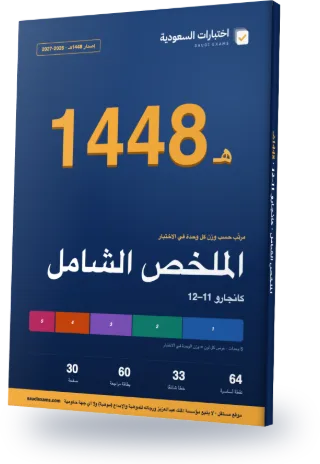 Complete Review Guide 2026–2027 included (PDF)Ordered by the weight of each unit in the examBuy now · SAR 34or 7 days for SAR 26
See everything included
Full mock exams like the real one and 524 explained questions that find your weak spots and train them
- Unlimited full mock exams to practise your pace and check your performance across the whole exam
- Practise 10 weak-area questions, starting where you lose the most marks
- 524 questions explaining why every option is right or wrong
- Arabic and English with one pass
- Unit notes and flashcards, then questions to check your understanding
This is a competition, not an entry requirement: the score is out of 120, and gold, silver and bronze medals go to students who reach cut-offs Mawhiba announces after the test, delivered through the gifted education departments of the education offices. Source Last verified: 2026-11-16
Sources and references
- كانجارو موهبة: عن كانجارو kangarooksa.org
- كانجارو موهبة: نماذج الأسئلة kangarooksa.org
- كانجارو موهبة: الحدود والدرجات kangarooksa.org