Kangaroo Mawhiba 11–12 Study Plan by Days Left
A plan for Kangaroo Mawhiba 11–12: 30 questions in 90 minutes, 3 minutes each. Start with free questions, then train your weakest units.
- Questions and time
- 30 questions · 90 minutes
- Pass mark
- No pass mark; the score is out of 120, and gold, silver and bronze medals go by cut-offs Mawhiba announces each year
- Exam fee
- SAR 60 (guardian contribution)
Start with 10 free questions to find what needs more work. No sign-up, with answer explanations.
Try 10 free questions and see your levelPut what you just read into practice
Start with 10 free questions to find what needs more work. No sign-up, with answer explanations.
Try 10 free questions and see your levelLast verified: 16 November 2026. The question count, duration and score come from the About Kangaroo page, and the 2026 edition dates from the timeline. They may change, so check before the test. This is an independent guide, not affiliated with Mawhiba, the Education and Training Evaluation Commission (ETEC) or any government body, and it does not promise any score.
This is a plan for a grade 11 or grade 12 student who wants to prepare for Kangaroo Mawhiba in the time that remains. The test is 30 questions in 90 minutes, which is 3 minutes per question on average, and the score is out of 120 with no pass mark. So the plan is not built around a minimum. It is built around knowing roughly what you would score today, seeing where you lose marks, and arriving having already tried the timing and format. For the units and their examples see the syllabus guide, and for registration and the test environment see the registration guide. Mawhiba has not yet announced the next edition's date, so build your plan on the days you have left once it is announced.
One practice session (45 minutes)
- 5 minutes: go over two mistakes from your mistakes notebook, and explain the right method to yourself without looking at the solution.
- 25 minutes: solve 8 questions from the day's unit with a timer running on screen.
- 15 minutes: go over every question you got wrong and ask: was it the idea, the arithmetic, or reading the question? Write the reason in the notebook.
The three kinds of mistake need different fixes: an idea mistake needs a lesson review, an arithmetic mistake needs slower work with the steps written out, and a reading mistake needs you to underline the key word in the question ("smallest", "not", "at least").
Time strategy on test day
90 minutes for 30 questions gives 3 minutes per question on average. But the questions are not equal: the early ones are easier than the last ones. Try this split in your practice:
| Stage | Questions | Suggested time | Aim |
|---|---|---|---|
| Round 1: the easier questions | The 3-mark and 4-mark questions (1–20) | About 45 minutes (2.5 minutes each) | Solve what looks clear and do not stay stuck on one |
| Round 2: the 5-mark questions | 21–30 | About 35 minutes | Start with the ones whose idea you know, then the rest |
| Review | The questions you flagged | About 10 minutes | Redo the arithmetic and reread the question text |
- Finish the clear questions first: 3-mark questions usually take one or two steps, so bank those marks before you move on.
- Flag what you are stuck on and move: if 3 minutes pass with no idea, flag the question, go to the next one and come back in round 2.
- Come back to the 5-mark questions late: they carry the most marks but take the longest, so leave enough time for them rather than using it all at the start of the paper.
- Choose an answer before you move on: since the questions are multiple choice with five options, ruling out two or three quickly raises your chance of landing the right one. Check the test rules on the competition page before you rely on guessing.
This is a strategy we suggest trying in practice, not an official rule. What matters is that you know which split of time suits you before test day.
The plan by time left
4 weeks or more
- Week 1: solve the free questions on the practice test page with no sign-up to see roughly what you would score today out of 120 and your weakest unit. Start a mistakes notebook.
- Weeks 2 and 3: one unit every day or two, weakest first. Eight questions per session, then review the mistakes. Spread the days by unit size: geometry (about 27%) and algebra (about 23%) take the most days.
- Week 4: one full test of 30 questions in 90 minutes, then a whole day to review its mistakes.
2 to 3 weeks
- Days 1–2: the free questions to measure where you stand and pick your two weakest units.
- Days 3–10: alternate the two weak units, with one session from another unit every three days so you do not forget it.
- Days 11–13: a full test in real time, then go through the notebook.
- The last day before the final week: a second test, and compare your score with the first.
The last week
| Day | What to do |
|---|---|
| 1 | A full test in real time, on the device you will sit the test on |
| 2 | Review the test's mistakes and write the reasons |
| 3 | The weakest unit: 10 questions against a timer |
| 4 | The second weakest unit: 10 questions against a timer |
| 5 | The notebook only: redo every question you got wrong |
| 6 | A light session: 6 easy questions from different units |
| 7 | Rest day, or the day before the test (see below) |
The day before and test day
- Do not sit a full test the day before. Review the mistakes notebook and about 20 minutes of easy questions only.
- Check your device: the desktop or laptop, audio and video, the internet, and find the message with the login details in your email.
- Prepare paper, scrap paper and a pen, and a quiet place free of interruptions, because the test is monitored with audio and video.
- On test day log in a few minutes early (the 2026 slot for grades 11–12 was 5:00 pm) and start with the questions that look clear.
How to practise each unit
| Unit | How to practise |
|---|---|
| Numbers and Arithmetic (about 6 questions) | Practise digit cycles, divisibility and factorising, and try each question with a short idea before long arithmetic. Redo ratio and speed questions in two ways. |
| Algebra and Functions (about 7 questions) | Write every step, and practise squaring and substitution tricks that give the value of an expression instead of finding the unknown. Sketch the function for any graph question. |
| Geometry (about 8 questions) | Draw the figure in every question and write the values on it. Review the right triangle, the inscribed circle, similarity and splitting an area. |
| Counting and Probability (about 5 questions) | Split into clear cases, or count the opposite cases. Check every solution by asking: did I count a case twice? |
| Logic and Problem Solving (about 4 questions) | Start with small examples and cross out possibilities. Practise knights and knaves puzzles because they come back. |
Find your level and practise
Start with the free questions on the practice test page, then continue with practice by unit and the full mock exams, which have the same number of questions and time. After each session you will see roughly your score out of 120 and the unit where you lost the most, so you know where to spend your time.
Finished reading? Try a set of questions
Start with 10 free questions to find your weakest units. Keep practising with the full question bank and mock exams from SAR 26.
Put the plan to work here
SAR 34 $9
One purchase · lifetime access · review guide included
- 524 questions, every option explained with its source
- Full mock exams: 30 questions in 90 minutes, like the real one
- Practice that starts with your weakest units, plus a review of your mistakes
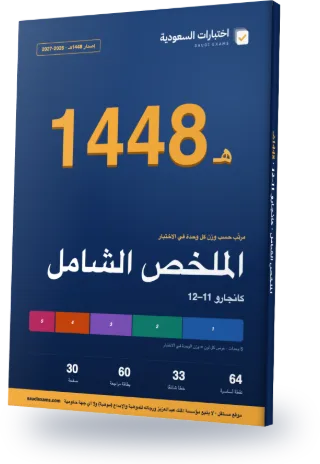 Complete Review Guide 2026–2027 included (PDF)Ordered by the weight of each unit in the examBuy now · SAR 34or 7 days for SAR 26
See everything included
Full mock exams like the real one and 524 explained questions that find your weak spots and train them
- Unlimited full mock exams to practise your pace and check your performance across the whole exam
- Practise 10 weak-area questions, starting where you lose the most marks
- 524 questions explaining why every option is right or wrong
- Arabic and English with one pass
- Unit notes and flashcards, then questions to check your understanding
This is a competition, not an entry requirement: the score is out of 120, and gold, silver and bronze medals go to students who reach cut-offs Mawhiba announces after the test, delivered through the gifted education departments of the education offices. Source Last verified: 2026-11-16
Sources and references
- كانجارو موهبة: عن كانجارو kangarooksa.org
- كانجارو موهبة: الجدول الزمني kangarooksa.org
- كانجارو موهبة: نماذج الأسئلة kangarooksa.org