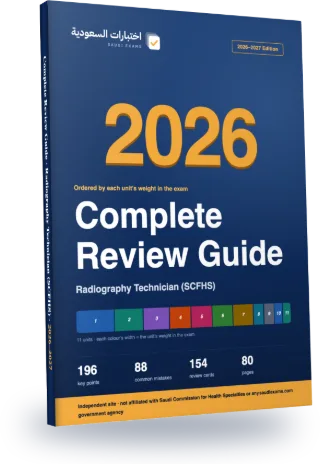
Radiography Technician (SCFHS) Complete Review Guide 2026–2027
Every exam topic in a 80-page Arabic PDF, ordered from the heaviest unit to the lightest. The first three chapters alone cover about 42% of the exam questions.
- 80Pages
- 196Key points
- 88Common mistakes
- 154Flashcards
Guide map
Each chapter is one exam unit, ordered by its weight in the real exam.
| Chapter | Unit | Weight | Exam questions | Key points |
|---|---|---|---|---|
| 1 | General Anatomy | 17% | 25 | 18 |
| 2 | X-ray | 13% | 20 | 18 |
| 3 | Radiation Protection | 12% | 18 | 18 |
| 4 | CT | 10% | 15 | 16 |
| 5 | MRI | 10% | 15 | 18 |
| 6 | Ultrasound | 10% | 15 | 18 |
| 7 | Nuclear Medicine | 10% | 15 | 18 |
| 8 | Patient Safety | 5% | 8 | 18 |
| 9 | Professionalism and Ethics | 5% | 7 | 18 |
| 10 | Angiography | 4% | 6 | 18 |
| 11 | Fluoroscopy | 4% | 6 | 18 |
Chapter 1 in full: General Anatomy
17% of the exam, about 25 questions. These are its key points, as in the guide.
- (Skull) The pterion is a small H-shaped region about two finger widths above the zygomatic arch where the frontal, parietal, temporal and sphenoid bones meet; it is the weakest part of the lateral skull and an artery runs deep to it, so a fracture can cause a hematoma between the brain and the inner skull.
- (Skull) The sella turcica lies in the sphenoid bone; its rounded floor is the hypophyseal (pituitary) fossa. The sphenoid sinus lies in the body of the sphenoid, just anterior and inferior to the sella.
- (Skull) The cranial floor has anterior, middle and posterior cranial fossae. The foramen ovale (sensory nerve to the cheek, chin and lower teeth) is in the middle fossa; the internal acoustic meatus on the medial wall of the petrous ridge is in the posterior fossa.
The rest of chapter 1, on this page
- (Vertebral column) Seven cervical (C1-C7), 12 thoracic (T1-T12) and five lumbar (L1-L5) vertebrae. The dens (odontoid process) projects upward from C2; thoracic vertebrae carry articular facets for rib heads.
- (Vertebral column) Running a finger down the posterior midline of the neck, the first prominent spinous process you reach is C7. An intervertebral foramen, formed by adjacent vertebrae, lets a spinal nerve leave the column.
- (Pelvis) The sacroiliac joint is between the auricular surfaces of the sacrum and ilium. The pelvic brim runs from the pubic symphysis along the pectineal and arcuate lines to the sacral promontory; the outlet is bounded by the ischial tuberosity and coccyx tip.
- (Thoracic cage) The sternal angle is the junction of manubrium and sternal body, at the second rib. Ribs 3-7 attach to the sternal body. The sternal angle also marks the end of the ascending aorta, which rises about 5 cm from the aortic valve.
- (Limb bones) The scaphoid is the most commonly fractured carpal bone; deep lateral wrist pain with a normal first film calls for a repeat radiograph weeks later. A Colles fracture of the distal radius gives a dinner-fork deformity with the hand displaced posteriorly.
- (Joints) The posterior cruciate ligament stops the femur sliding forward off the tibia when the knee is flexed and bearing weight; the anterior cruciate ligament tightens in extension and resists hyperextension.
- (Joints) The shoulder has a loose capsule and shallow socket; the rotator cuff muscles give it its main stability.
- (Heart) Coronary arteries arise from the aortic sinuses just above the aortic valve. The anterior interventricular (left anterior descending) artery supplies the left ventricle and septum; the posterior interventricular artery normally comes from the right coronary artery; the coronary sinus empties into the right atrium.
- (Heart) Tetralogy of Fallot: ventricular septal defect, aorta shifted over both ventricles, pulmonary valve stenosis, right ventricular hypertrophy. Patent ductus arteriosus shunts blood from the aorta into the pulmonary trunk. As little as 100 mL of fluid in the pericardial space can cause tamponade.
- (Lungs) The visceral pleura covers the lung and lines the fissures. The bronchial arteries arise from the thoracic aorta and carry systemic blood to bronchi and visceral pleura.
- (Great vessels) The aortic arch gives off the brachiocephalic, left common carotid and left subclavian arteries; the right subclavian arises from the brachiocephalic artery. The subclavian vein joins the internal and external jugular veins to form the brachiocephalic vein.
- (Abdominal vessels) The hepatic portal vein begins at L2 where the superior mesenteric and splenic veins meet. The inferior mesenteric vein drains the descending colon, sigmoid colon and rectum. The superior mesenteric artery arises from the aorta separately from the celiac trunk.
- (Urinary tract) The ureters pass obliquely through the bladder wall, which helps prevent reflux. In women the bladder lies anterior to the uterus, with peritoneum over its dome only. The suspensory ligament of the ovary carries the ovarian vessels.
- (Ventricles and CSF) CSF flows from the lateral ventricles to the third ventricle, through the cerebral aqueduct to the fourth ventricle, and is returned to venous blood through arachnoid granulations into the dural sinuses.
- (Venous sinuses) Blood from the superior sagittal sinus drains through the confluence of sinuses, the transverse sinus and the sigmoid sinus to the internal jugular vein.
Common mistakes in this chapter
- Pterion versus asterion: the pterion is on the lateral skull above the zygomatic arch; the asterion is a posterior junction and does not overlie that artery.
- Dens and C7: the dens belongs to C2 (the axis). The long prominent spine you feel at the base of the neck is C7, not C1 or C2.
- First rib versus second rib: the first rib is hidden behind the clavicle. The second rib attaches at the sternal angle and is the highest rib you can palpate.
- Inlet versus outlet of the pelvis: the sacral promontory ends the brim posteriorly; the coccyx tip and ischial tuberosity bound the outlet.
- Right versus left lung: the right lung has three lobes (including a middle lobe); the left lung has a cardiac notch. Do not give the left lung a middle lobe.
- Aortic sinuses: the left posterior and anterior sinuses give rise to the coronary arteries; the right posterior sinus normally gives off no vessel.
- Pulmonary veins carry oxygenated blood into the left atrium, so contrast injected into an arm vein reaches them only after passing through the lungs.
- Peritoneal and retroperitoneal organs: the ascending colon and the kidneys lie behind the peritoneum; the liver does not make the right kidney higher, it pushes it lower.
The other chapters are in the full guide
One purchase · lifetime access · review guide included
7-day review plan
The chapters are spread over 6 days by weight so each day carries a similar load. Day 7 is a full exam.
Day 1 · 17% of the exam
Chapter 1: General Anatomy
Day 2 · 17% of the exam
Chapter 2: X-ray
Chapter 11: FluoroscopyDay 3 · 16% of the exam
Chapter 3: Radiation Protection
Chapter 10: AngiographyDay 4 · 20% of the exam
Chapter 4: CT
Chapter 7: Nuclear MedicineDay 5 · 15% of the exam
Chapter 5: MRI
Chapter 8: Patient SafetyDay 6 · 15% of the exam
Chapter 6: Ultrasound
Chapter 9: Professionalism and EthicsDay 7
Full mock exam: 150 questions in 180 minutes, then review the common mistakes in the units where you lost marks.
How many correct answers do you need?
- Pass mark 55%83 correct out of 150
Before you read: see your score today
10 free questions from the main units, no sign-up. Then you know which chapter to start with.
Try 10 free questions and see your levelA look at each chapter
The first three key points of each chapter, as they appear in the guide (in Arabic in the PDF).
Chapter 1: General Anatomy
- (Skull) The pterion is a small H-shaped region about two finger widths above the…
- (Skull) The sella turcica lies in the sphenoid bone; its rounded floor is the…
- (Skull) The cranial floor has anterior, middle and posterior cranial fossae. The foramen ovale…
Chapter 2: X-ray
- (Tube production) Bremsstrahlung
- (Tube production) Characteristic K lines of tungsten appear only when the tube voltage exceeds…
- (Focal spot) Anode angles in diagnostic tubes range from 6 to 22 degrees (10…
Chapter 3: Radiation Protection
- (Effects) Stochastic effects (cancer, hereditary effects) have no threshold; probability rises with dose and…
- (Effects) Deterministic effects have a threshold dose and their severity rises with dose; examples…
- (Radiobiology) For low-LET radiation such as X-rays, indirect action through radicals formed in water…
Chapter 4: CT
- (Scanner design) The gantry carries the tube, high voltage generator, collimator, beam shaping filters…
- (Detectors) Solid state scintillator detectors have a detection efficiency close to 100%, against about…
- (Detectors) To resolve an object of size d the detector arc needs about 2…
Chapter 5: MRI
- (Larmor) Larmor frequency = gyromagnetic ratio x B0; for hydrogen about 42.58 MHz/T, so…
- (Net magnetization) With no RF applied, a small excess of spins lie parallel to…
- (Relaxation) T1 is the longitudinal recovery time constant (energy to the lattice); T2 is…
Chapter 6: Ultrasound
- (Basics) Ultrasound is sound with frequency above 20 kHz; diagnostic imaging uses roughly 2…
- (Basics) Wavelength = speed / frequency; at 5 MHz in soft tissue (1540 m/s)…
- (Impedance) Acoustic impedance Z = density x sound speed (unit Rayl); soft tissue is…
Chapter 7: Nuclear Medicine
- (Half-life) After n half-lives the activity is the starting activity ÷ 2ⁿ. For example…
- (Mean life) Mean life τ = T½ ÷ 0.693, about 1.44 × T½. For…
- (Specific activity) Activity per atom equals the decay constant λ, so a short-lived nuclide…
Chapter 8: Patient Safety
- (Patient identification) An effective system uses at least two, preferably three, forms of verification…
- (Nuclear medicine interview) Before a radiopharmaceutical is given, ask about pregnancy, small children at…
- (Safety barriers) Place safety barriers with specific quality control checks at critical points. Checks…
Chapter 9: Professionalism and Ethics
- (Valid consent) Four conditions
- (Valid consent) The patient's consent must be sought before any medical or surgical intervention;…
- (Incompetent patients) Unconscious patients, children and the mentally incapacitated need consent from the legal…
Chapter 10: Angiography
- (DSA) Fill images that include contrast are subtracted from a mask image that contains…
- (DSA) Mask and fill images both undergo a log transform before subtraction, so the…
- (DSA noise) Quantum noise sums in quadrature, so the subtracted image is noisier by…
Chapter 11: Fluoroscopy
- (Definition) Fluoroscopy uses an X-ray beam and an image receptor to view processes or…
- (Intensifier) The image intensifier converts the low X-ray fluence leaving the patient into a…
- (Intensifier) Input phosphor
The full guide comes with lifetime access
The full guide (80 pages) is included with lifetime access to this exam, together with every question and full mock exam. Chapter 1 is free for everyone.
Questions about the guide
Is the guide free?
Chapter 1 is free to read on the guide page. The full guide comes with lifetime access to this exam; 7-day access does not include it.
Is it up to date for 2026–2027?
Yes. Unit weights and exam facts follow what the exam body last published, and the last check date is printed in the guide. If the standards change we update the file and buyers download the new version.
Does the guide have questions?
No. The guide covers key points and common mistakes; scoring, weak-area practice and full mock exams are on the site.
Can I read it on my phone?
Yes. A5 pages in a single column, with chapters linked from the contents.
- Pages
- 80
- Edition
- 1448 AH · 2026–2027
- Language
- Arabic
- Last updated
All Health Exams review guides
Back to Saudi Classification Examination: Radiography Technician
Full prep for this exam
All of this in one purchase.
- Full mock exam, same as the real one150 questions in 180 minutes. You get a total score and a score for every unit.
- Practice unit by unit581 questions, every option explained with its source. Starts with your weakest units.
- Complete Review Guide 2026–2027 (PDF)Ordered by each unit's weight in the exam. With lifetime access only.
Choose your access
Continue with your Google account and you go straight to the payment page.
You pay on the Waffo Pancake checkout page (in English). The amount is in US dollars and your bank converts it to riyals. One payment with no automatic renewal, by Visa, Mastercard (a mada card with either logo works too), Apple Pay or Google Pay. Your statement shows "WAFFO". Purchases are not refundable.