Radiography Technician Study Plan: 6 Weeks, or 2
A study plan for the SCFHS Radiography Technician exam by the weight of its 11 sections: anatomy first, then X-ray and protection, then modalities, and a full mock two days before.
- Questions and time
- 150 questions · 180 minutes
- Pass mark
- 55%
- correct answers to pass (55%)
- 83 of 150
- Exam fee
- Check the current fee when you apply for eligibility and book through the approved channels.
Start with 10 free questions to find what needs more work. No sign-up, with answer explanations.
Try 10 free questions and see your levelPut what you just read into practice
Radiography Technician (SCFHS)
Start with 10 free questions to find what needs more work. No sign-up, with answer explanations.
Try 10 free questions and see your levelLast verified: 15 November 2026. Check the SCFHS website and the Radiography Technician content guideline (PDF) before you start, because weights and rules can change. This is an independent guide with no link to SCFHS, Prometric or any government body.
The exam has 150 questions across 11 sections. Anatomy, X-ray and Radiation Protection together are 42% of it, and the four modality sections (CT, MRI, Ultrasound, Nuclear Medicine) are 10% each. This plan starts with anatomy because every other section assumes it, gives each big block its own days, and keeps the last week for gaps and a full mock. The detail of each section is in the exam content guide, and the application steps are in the registration guide.
Numbers to build your plan on
| Item | What it means for your study |
|---|---|
| 150 multiple-choice questions | Per the SCFHS content guideline. The guideline does not state the number of options; our questions use four. |
| 3 hours | 180 minutes for 150 questions is 72 seconds a question. Practise sitting the full time in one go. |
| Pass mark 55% (technician level) | Your result on this site shows your percentage in each section, so you can compare sections and track progress. |
| Shares can move by up to 5 percentage points | Do not skip a small section. Even the smallest sections are worth 6 to 8 questions each. |
| Language | The guideline does not state it. We assume English (our inference), so revise terms in English from the start. Our questions and explanations are in English. |
| Calculator | Not mentioned in the guideline, so practise any calculation by hand with simple numbers. |
Split your time by section
The percentages are the official weights. The question counts are the split in our 150-question full mock exam (the percentage times 150, rounded to a total of 150):
| Section | Official weight | Questions | Your time in the plan |
|---|---|---|---|
| General Anatomy | 17% | 25 | Week 1 |
| X-ray | 13% | 20 | Week 2 |
| Radiation Protection | 12% | 18 | Week 2 |
| CT | 10% | 15 | Week 3 |
| MRI | 10% | 15 | Week 3 |
| Ultrasound | 10% | 15 | Week 4 |
| Nuclear Medicine | 10% | 15 | Week 4 |
| Angiography | 4% | 6 | Week 5 |
| Fluoroscopy | 4% | 6 | Week 5 |
| Patient Safety | 5% | 8 | Week 5 |
| Professionalism and Ethics | 5% | 7 | Week 5 |
General Anatomy alone is 25 questions, the largest section, so it gets the whole first week alongside your baseline. X-ray and Radiation Protection share week 2, the four modalities take weeks 3 and 4 in pairs, and the four small sections (Angiography, Fluoroscopy, Patient Safety, Professionalism and Ethics) are 27 questions together and share week 5.
The 6-week plan
The plan assumes one to two hours a day. Count back six weeks from your booking date once your scheduling permit shows the booking period. Each week has the same rhythm: five days of reading and practice, one day to redo the week's mistakes, and one light day.
Week 1: Baseline and General Anatomy
- Day 1: take the free practice test (10 free questions, no sign-up). Note your percentage in each section and your three weakest.
- Day 2: skeletal system and joints. Day 3: thorax, cardiovascular and respiratory systems. Day 4: abdomen, pelvis, digestive and urinary systems.
- Day 5: head, neck and nervous system. Day 6: cross-sectional and surface anatomy. Cross-sectional questions reward practice with images, so spend time on them.
Week 2: X-ray and Radiation Protection
- Day 1: X-ray production, the tube and the generator. Day 2: interaction, contrast and exposure factors. Day 3: digital receptors and image quality.
- Day 4: positioning and projection technique.
- Day 5: radiation biology and dose quantities, then the principles of justification, optimization and dose limits.
- Day 6: shielding, distance and time, personnel monitoring, and protecting the patient and a pregnant patient.
- Drill: the inverse square law (intensity falls with the square of distance) for the time, distance, shielding questions.
Week 3: CT and MRI
- Day 1: CT scanner design and acquisition. Day 2: image reconstruction, Hounsfield units and display. Day 3: CT dose and artefacts, then contrast media and protocols.
- Day 4: MR physics and relaxation. Day 5: pulse sequences and contrast weighting. Day 6: MRI image quality and artefacts, MR safety and contrast.
Week 4: Ultrasound and Nuclear Medicine
- Day 1: sound physics and transducers. Day 2: instrumentation and image formation. Day 3: Doppler. Day 4: artefacts, safety and clinical use.
- Day 5: radioactivity and decay (practise half-life calculations), then radiopharmaceuticals.
- Day 6: the gamma camera, SPECT and PET, radiation safety and quality control.
Week 5: The four small sections and a first sweep
- Day 1: angiographic equipment and DSA, then procedures, contrast and patient care.
- Day 2: fluoroscopic equipment and image intensification, then fluoroscopy dose and protection.
- Day 3: patient safety: identification, infection control, falls, then contrast reactions, emergencies and error reporting.
- Day 4: professionalism and ethics: ethical duties, confidentiality and consent, then conduct and communication. These questions are text-based and are won by reading.
- Day 5: open the practice area, pick your two weakest sections and do 10 questions from each topic.
Week 6: Close the gaps and sit the full mock
- Days 1–3: redo every question in your error notebook, then practise your weakest topics 10 questions at a time.
- Day 4: a light day. Skim your notes on anatomy, X-ray and radiation protection.
- Day 5 (two days before the exam): sit one full mock exam (next section).
- Day 6: review only the mistakes from the mock. Do not open a new topic.
The full mock exam, two days before the real one
- 150 questions in 180 minutes, in one sitting. The content guideline does not mention a break, so do not plan one.
- No phone and no notes. Calculate by hand.
- If a question stalls you, flag it and move on; at 72 seconds each, one slow question costs the next one.
- Afterwards, open the result for each section. The section with the lowest percentage is what you review on your last study day.
The 2-week plan if you are short of time
Build it on the sections with the most questions:
| Day | Task |
|---|---|
| 1 | Free practice test (10 questions) and pick out your weakest sections |
| 2–3 | General Anatomy |
| 4 | X-ray |
| 5 | Radiation Protection |
| 6 | CT |
| 7 | MRI |
| 8 | Ultrasound |
| 9 | Nuclear Medicine |
| 10 | Angiography, Fluoroscopy, Patient Safety, Professionalism and Ethics |
| 11–12 | Error notebook and weakest topics (10 questions each) |
| 13 | Full mock exam: 150 questions in 180 minutes |
| 14 | Review only the mock's mistakes, then an early night |
How to handle your mistakes
- Read the explanation of every option, not just the correct answer. A wrong option today can be the right answer tomorrow.
- Write the cause of each mistake in one phrase: missing fact, mixed up two terms, calculation slip, or rushed reading. One cause usually repeats.
- Redo missed questions after two days, then after a week. When you answer one correctly twice in a row, take it out of your notebook.
What this site adds to your plan
- The free practice test: 10 free questions from the exam's sections, with the answer, its explanation and your percentage in each section, no sign-up.
- The practice area: practise section by section, with an error notebook and practice on your weakest topics. The remaining questions need a paid pass.
- The full mock exam of 150 questions in 180 minutes, the same question count and total time as the guideline. It also needs a paid pass.
This is an independent exam preparation website with no link to SCFHS, Prometric or any government body.
Finished reading? Try a set of questions
Start with 10 free questions to find your weakest units. Keep practising with the full question bank and mock exams from SAR 26.
Put the plan to work here
SAR 34 $9
One purchase · lifetime access · review guide included
- 581 questions, every option explained with its source
- Full mock exams: 150 questions in 180 minutes, like the real one
- Practice that starts with your weakest units, plus a review of your mistakes
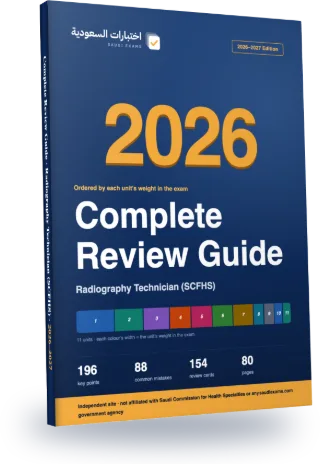 Complete Review Guide 2026–2027 included (PDF)Ordered by the weight of each unit in the examBuy now · SAR 34or 7 days for SAR 26
See everything included
Full mock exams like the real one and 581 explained questions that find your weak spots and train them
- Unlimited full mock exams to practise your pace and check your performance across the whole exam
- Practise 10 weak-area questions, starting where you lose the most marks
- 581 questions explaining why every option is right or wrong
- Arabic and English with one pass
- Unit notes and flashcards, then questions to check your understanding