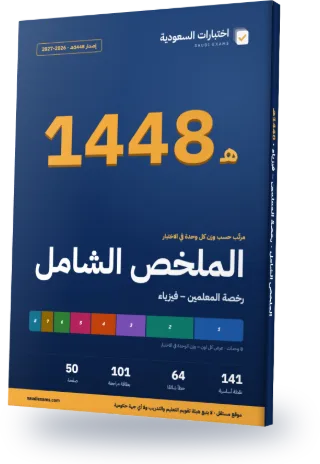
Teacher License – Physics Complete Review Guide 2026–2027
Every exam topic in a 50-page Arabic PDF, ordered from the heaviest unit to the lightest. The first three chapters alone cover about 58% of the exam questions.
- 50Pages
- 141Key points
- 64Common mistakes
- 101Flashcards
Guide map
Each chapter is one exam unit, ordered by its weight in the real exam.
| Chapter | Unit | Weight | Exam questions | Key points |
|---|---|---|---|---|
| 1 | Mechanics and Fluids | 22% | 20 | 16 |
| 2 | Electrostatics, Current Electricity and Magnetism | 22% | 19 | 18 |
| 3 | Modern and Nuclear Physics | 14% | 12 | 18 |
| 4 | Waves and Light | 12% | 11 | 17 |
| 5 | Heat, Properties of Matter and Thermodynamics | 10% | 9 | 18 |
| 6 | Physics Teaching Strategies, Skills and Assessment | 8% | 7 | 18 |
| 7 | Nature and History of Physics, Links to Other Sciences and the Scientific Method | 6% | 5 | 18 |
| 8 | Practical Work, Mathematical and Statistical Skills | 6% | 5 | 18 |
Chapter 1 in full: Mechanics and Fluids
22% of the exam, about 20 questions. These are its key points, as in the guide.
- Constant acceleration in one dimension: \(v = v_0 + at\), \(\Delta x = v_0 t + \tfrac{1}{2}at^2\), \(v^2 = v_0^2 + 2a\Delta x\). The slope of x-t is velocity, the slope of v-t is acceleration, and the area under v-t is displacement (6.6.5, 1).
- Free fall (air resistance neglected): \(a = g \approx 9.8\ \text{m/s}^2\) downward for rising and falling bodies alike, and in a vacuum heavy and light objects fall together. From rest: \(v = gt\) and \(h = \tfrac{1}{2}gt^2\) (6.6.5, 1).
- A projectile launched at speed \(v_0\) and angle \(\theta\): \(v_x = v_0\cos\theta\) is constant and \(v_y = v_0\sin\theta - gt\). On level ground the range is \(R = v_0^2\sin 2\theta / g\), greatest at \(45^\circ\), and two complementary angles give the same range (6.6.5, 2).
The rest of chapter 1, on this page
- Newton's second law: \(\sum F = ma\), with acceleration along the net force. First law: a body at rest or at constant velocity has zero net force. Third law: two forces equal in size and opposite in direction acting on two different bodies (6.6.5, 3).
- Kinetic friction \(f_k = \mu_k N\) and maximum static friction \(f_s \le \mu_s N\). On an incline at angle \(\theta\), the weight component along the plane is \(mg\sin\theta\) and perpendicular to it is \(mg\cos\theta\) (6.6.5, 3).
- Momentum \(p = mv\) and impulse \(F\Delta t = \Delta p\). Total momentum is conserved when the net external force is zero. In an elastic collision kinetic energy is also conserved, in an inelastic one it is not, and in a perfectly inelastic one the bodies stick together at a common speed \(v = (m_1v_1 + m_2v_2)/(m_1 + m_2)\) (6.6.5, 4).
- Uniform circular motion: constant speed but changing direction, centripetal acceleration \(a_c = v^2/r\) toward the centre, centripetal force \(F_c = mv^2/r\), and \(v = \omega r = 2\pi r/T\) (6.6.5, 5).
- Torque \(\tau = rF\sin\theta\) (unit N·m), where \(r\sin\theta\) is the perpendicular lever arm. Equilibrium of a rigid body needs both \(\sum F = 0\) and \(\sum \tau = 0\), and a net torque produces angular acceleration \(\sum\tau = I\alpha\) (6.6.5, 6).
- Universal gravitation: \(F = Gm_1m_2/r^2\) with \(G = 6.67\times10^{-11}\ \text{N}\cdot\text{m}^2/\text{kg}^2\). The force is inversely proportional to the square of the distance between centres, and surface gravity is \(g = GM/R^2\) (6.6.5, 7).
- Work \(W = Fd\cos\theta\), kinetic energy \(KE = \tfrac{1}{2}mv^2\), gravitational potential energy \(PE = mgh\), power \(P = W/t\). Work-energy theorem: \(W_{net} = \Delta KE\) (6.6.5, 8).
- Mechanical energy \(KE + PE\) is conserved when only conservative forces act (gravity, springs). Friction removes some of it as heat, yet total energy stays conserved. Spring energy is \(\tfrac{1}{2}kx^2\) (6.6.5, 8).
- Relative motion: \(\vec v_{A/B} = \vec v_A - \vec v_B\), and measured velocity changes with the reference frame. A boat crossing a river at 4 m/s perpendicular to a 3 m/s current moves at 5 m/s relative to the bank (3-4-5 triangle) (6.6.5, 9).
- Archimedes' principle: the buoyant force on a fully or partly submerged body equals the weight of fluid displaced, \(F_b = \rho_f V_{sub} g\). For a cylinder submerged to height \(h\), \(F_b = \pi r^2 \rho g h\). A body floats if its density is less than the fluid's, and at rest while floating \(F_b = W\) (6.6.6, 1).
- Continuity for an incompressible fluid: \(A_1 v_1 = A_2 v_2\) (volume flow rate is constant), so speed rises where the cross-section narrows. Bernoulli along a streamline: \(P + \tfrac{1}{2}\rho v^2 + \rho g h = \text{constant}\), so pressure drops where speed rises at the same height (6.6.6, 2 and 3).
- Pascal's principle: pressure applied to a confined fluid is transmitted undiminished to every point, so a hydraulic press obeys \(F_1/A_1 = F_2/A_2\). Pressure is \(P = F/A\) in pascals (\(\text{Pa} = \text{N/m}^2\)), and at depth \(h\) it is \(P = P_0 + \rho g h\) (6.6.6, 4 and 5).
- Viscosity is a fluid's resistance to flow (internal friction), in Pa·s. Liquid viscosity falls as temperature rises while gas viscosity rises. Cohesion is attraction between molecules of the same substance, adhesion between molecules of different substances (6.6.6, 5 and 6).
Common mistakes in this chapter
- Mass versus weight: mass is the same everywhere (kg), while weight \(W = mg\) is a force (N) that changes with \(g\). An orbiting object is not weightless; it is in continuous free fall.
- Distance, speed, displacement and velocity: distance and speed are scalars, displacement and velocity are vectors. A body that returns to its start has zero displacement but non-zero distance.
- At the top of a projectile's path only the vertical velocity component is zero; the acceleration is still \(g\) downward and the horizontal component is unchanged (air resistance neglected).
- The two forces of an action-reaction pair act on different bodies, so they never cancel each other. A book's weight and the normal force from the table are not an action-reaction pair.
- Inelastic collisions: momentum is always conserved in an isolated system, but kinetic energy decreases. Choosing \"kinetic energy is conserved\" for a collision where the bodies stick together is a common error.
- Centripetal force is not an extra force to draw in a free-body diagram; it is the net force toward the centre (tension, gravity, friction). \"Centrifugal force\" is only spoken of in a non-inertial reference frame.
- Doubling the speed multiplies kinetic energy by four (\(KE \propto v^2\)), not two, and doubling the distance between two masses cuts the gravitational force to one quarter, not one half.
- Buoyant force depends on the submerged volume and the fluid's density, not on depth or the object's weight. In Pascal's principle the force is multiplied but not the work: the large piston moves a shorter distance.
The other chapters are in the full guide
One purchase · lifetime access · review guide included
7-day review plan
The chapters are spread over 6 days by weight so each day carries a similar load. Day 7 is a full exam.
Day 1 · 22% of the exam
Chapter 1: Mechanics and Fluids
Day 2 · 22% of the exam
Chapter 2: Electrostatics, Current Electricity and Magnetism
Day 3 · 14% of the exam
Chapter 3: Modern and Nuclear Physics
Day 4 · 12% of the exam
Chapter 4: Waves and Light
Day 5 · 16% of the exam
Chapter 5: Heat, Properties of Matter and Thermodynamics
Chapter 8: Practical Work, Mathematical and Statistical SkillsDay 6 · 14% of the exam
Chapter 6: Physics Teaching Strategies, Skills and Assessment
Chapter 7: Nature and History of Physics, Links to Other Sciences and the Scientific MethodDay 7
Full mock exam: 88 questions in 120 minutes, then review the common mistakes in the units where you lost marks.
How many correct answers do you need?
- Practitioner level 50%44 correct out of 88
- Advanced level 70%62 correct out of 88
- Expert level 80%71 correct out of 88
Before you read: see your score today
10 free questions from the main units, no sign-up. Then you know which chapter to start with.
Try 10 free questions and see your levelA look at each chapter
The first three key points of each chapter, as they appear in the guide (in Arabic in the PDF).
Chapter 1: Mechanics and Fluids
- Constant acceleration in one dimension
- Free fall (air resistance neglected)
- A projectile launched at speed \(v_0\) and angle \(\theta\)
Chapter 2: Electrostatics, Current Electricity and Magnetism
- Charge is quantized and conserved
- Coulomb's law
- Electric field
Chapter 3: Modern and Nuclear Physics
- The two postulates of special relativity
- The Lorentz factor is \(\gamma = 1/\sqrt{1 - v^2/c^2}\). At \(v = 0.8c\), \(\gamma…
- The electromagnetic spectrum in order of increasing frequency: radio waves, microwaves, infrared, visible, ultraviolet…
Chapter 4: Waves and Light
- Simple harmonic motion
- Period and frequency
- The energy of a simple harmonic oscillator is constant and proportional to \(A^2\); it…
Chapter 5: Heat, Properties of Matter and Thermodynamics
- Hooke's law
- Stress \(\sigma = F/A\) is in pascals (Pa), and strain \(\varepsilon = \Delta L/L_0\)…
- Young's modulus \(Y = \sigma/\varepsilon = \dfrac{F L_0}{A\,\Delta L}\) is in Pa and is…
Chapter 6: Physics Teaching Strategies, Skills and Assessment
- Learner-centred learning
- STS links science, society and technology; STEM integrates science, technology, engineering and mathematics around…
- Scientific literacy is a person's ability to understand scientific ideas and use them in…
Chapter 7: Nature and History of Physics, Links to Other Sciences and the Scientific Method
- Physics studies matter, energy and the interactions between them, and aims to explain and…
- Features of science
- A scientific fact is a confirmed observation that can be verified, for example: water…
Chapter 8: Practical Work, Mathematical and Statistical Skills
- Safety signs fall into warning (hazard), mandatory (wear goggles, gloves), prohibition (no eating or…
- Eye protection is worn when soldering, heating, using chemicals or lasers; long hair is…
- Water is not used on an electrical fire or a burning liquid; a carbon…
The full guide comes with lifetime access
The full guide (50 pages) is included with lifetime access to this exam, together with every question and full mock exam. Chapter 1 is free for everyone.
Questions about the guide
Is the guide free?
Chapter 1 is free to read on the guide page. The full guide comes with lifetime access to this exam; 7-day access does not include it.
Is it up to date for 2026–2027?
Yes. Unit weights and exam facts follow what the exam body last published, and the last check date is printed in the guide. If the standards change we update the file and buyers download the new version.
Does the guide have questions?
No. The guide covers key points and common mistakes; scoring, weak-area practice and full mock exams are on the site.
Can I read it on my phone?
Yes. A5 pages in a single column, with chapters linked from the contents.
- Pages
- 50
- Edition
- 1448 AH · 2026–2027
- Language
- Arabic
- Last updated
All Teacher Exams review guides
Back to Teachers' Professional License – Specialized Test: Physics
Buy this exam
Pick the access that lasts until your test date.
Included
- Full mock exams: 88 questions in 120 minutes, with a score for every unit
- 589 questions, every option explained with its source
- Practice that starts with your weakest units, plus a review of your mistakes
- Complete Review Guide 2026–2027 (PDF), with lifetime access only
Continue with your Google account and you go straight to the payment page.
You pay on the Waffo Pancake checkout page (in English). The amount is in US dollars and your bank converts it to riyals. One payment with no automatic renewal, by Visa, Mastercard (a mada card with either logo works too), Apple Pay or Google Pay. Your statement shows "WAFFO". Purchases are not refundable.