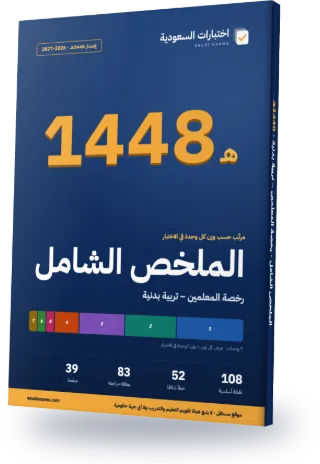
Teacher License – Physical Education Complete Review Guide 2026–2027
Every exam topic in a 39-page Arabic PDF, ordered from the heaviest unit to the lightest. The first three chapters alone cover about 76% of the exam questions.
- 39Pages
- 108Key points
- 52Common mistakes
- 83Flashcards
Guide map
Each chapter is one exam unit, ordered by its weight in the real exam.
| Chapter | Unit | Weight | Exam questions | Key points |
|---|---|---|---|---|
| 1 | Health Sciences | 30% | 26 | 19 |
| 2 | Curriculum and Teaching Methods in Health and PE | 24% | 21 | 18 |
| 3 | Motor Behaviour and Psychology | 22% | 19 | 20 |
| 4 | Theoretical and Applied Foundations of Games | 12% | 11 | 17 |
| 5 | Managing and Organising Health and PE Programmes | 4% | 4 | 11 |
| 6 | Adapted Physical Education | 4% | 4 | 12 |
| 7 | Health and PE and the Community | 4% | 3 | 11 |
Chapter 1 in full: Health Sciences
30% of the exam, about 26 questions. These are its key points, as in the guide.
- The adult skeleton has 206 bones: 80 in the axial skeleton (skull, spine, rib cage) and 126 in the appendicular skeleton. Bone shapes: long, short, flat, irregular and sesamoid (6.21.1, indicator 1).
- There are three muscle types: skeletal (voluntary, striated), smooth (involuntary, non-striated) and cardiac (involuntary, striated). Skeletal fibres are slow-twitch (type I) for endurance and fast-twitch (type II) for strength and speed (6.21.1, indicator 2).
- Joints are fibrous (fixed, such as skull sutures), cartilaginous (slightly movable, such as between vertebrae) or synovial (freely movable). Synovial types include ball-and-socket (shoulder, hip), hinge (elbow, knee), pivot (between the first two neck vertebrae), condyloid (wrist), saddle (thumb) and gliding (6.21.1, indicator 3).
The rest of chapter 1, on this page
- The central nervous system is the brain and spinal cord. The peripheral system has 12 pairs of cranial nerves and 31 pairs of spinal nerves. Nerves are sensory (afferent), motor (efferent) or mixed, and the autonomic system divides into sympathetic and parasympathetic (6.21.1, indicator 4).
- Body composition covers body fat, muscle mass, water and bone density. BMI = weight (kg) ÷ height squared (m): 18.5–24.9 normal, 25–29.9 overweight, 30 or above obese (6.21.1, indicator 5).
- Energy systems: ATP-PC is anaerobic and lasts about 10 seconds (100 m sprint); the glycolytic system is anaerobic and covers about 10 seconds to 2 minutes (400 m run); the aerobic system uses oxygen for long efforts (5 km run) (6.21.2, indicator 2).
- Cardiac output = heart rate × stroke volume. Regular aerobic training lowers resting heart rate and raises stroke volume and maximal oxygen uptake (VO2max) (6.21.2, indicator 1).
- In heat, heart rate rises and dehydration risk increases, so students need water and lower intensity. At altitude the partial pressure of oxygen falls, and the body adapts gradually by making more red blood cells (6.21.2, indicator 1).
- Fitness tests include the Cooper test (12-minute run) for cardiorespiratory endurance, the step test, and the 20 m shuttle run. Basic anthropometric measures: height, circumferences (such as waist), breadths and skinfold thickness (6.21.2, indicators 3 and 4).
- Health-related fitness has five components: cardiorespiratory endurance, muscular strength, muscular endurance, flexibility and body composition. Skill-related fitness has six: speed, agility, balance, coordination, power and reaction time (6.21.5, indicators 2 and 3).
- FITT: frequency (how often per week), intensity (how hard), time (how many minutes) and type (which activity). Training principles: overload, progression, specificity, individuality, and reversibility when training stops (6.21.5, indicator 5).
- Maximum heart rate is roughly estimated as 220 minus age; it is a rough estimate, not a precise measurement. Moderate intensity for health usually falls between 60% and 75% of it (6.21.5, indicator 5).
- Energy per gram: carbohydrate 4 kcal, protein 4, fat 9. Carbohydrate is the main fuel for physical activity, protein builds and repairs tissue, and fat stores energy and helps absorb the fat-soluble vitamins (6.21.6, indicator 2).
- Timing around exercise: a carbohydrate-rich meal 2 to 4 hours before, fluids during, and carbohydrate with protein soon after to restore glycogen and repair muscle (6.21.6, indicator 2).
- The fat-soluble vitamins A, D, E and K are stored in the body; the water-soluble B and C mostly are not. Iron deficiency causes anaemia, and low calcium and vitamin D weaken bone. A strict plant-based diet needs B12 and D supplements (6.21.6, indicator 3).
- Banned doping agents (such as anabolic steroids) harm the heart, liver and hormones and can cause psychological disturbances, and they are prohibited in competition. Dietary supplements may help or harm, and they do not replace a balanced diet (6.21.6, indicators 6 and 7).
- Injuries: sprain (ligament tear), strain (muscle or tendon injury), contusion (bruise from a blow), fracture (broken bone), dislocation (bone out of its joint), muscle cramp and abrasion. RICE first aid: rest, ice for 15–20 minutes, compression with a bandage, elevation of the injured part. PRICE adds protection (6.21.7, indicators 1 and 3).
- Adult CPR: check the scene is safe, check responsiveness and breathing (no more than 10 seconds), call emergency services and get an AED, then give 30 compressions to the centre of the chest, 5–6 cm deep at 100–120 per minute, followed by 2 breaths. With a splint, immobilise the joints above and below the fracture, and do not tighten a bandage enough to restrict circulation (6.21.7, indicators 5 and 6).
- WHO recommendations: ages 5–17 need an average of at least 60 minutes a day of moderate-to-vigorous activity, with vigorous and muscle- and bone-strengthening activity on at least 3 days a week. Adults need 150–300 minutes a week at moderate intensity. Sleep: 9–12 hours for ages 6–12, 8–10 hours for teenagers, 7 or more for adults (6.21.19, indicators 1 and 4).
Common mistakes in this chapter
- A sprain injures a ligament; a strain injures a muscle or tendon. An option that swaps them is wrong.
- Speed, agility, balance, coordination, power and reaction time are skill-related. Cardiorespiratory endurance, muscular strength, muscular endurance, flexibility and body composition are health-related. Do not mix the two groups.
- The ATP-PC system needs no oxygen and lasts about 10 seconds; the glycolytic system is also anaerobic but extends to about 2 minutes. The aerobic system takes over after that. Do not tie an activity to one system only, because the systems work together.
- The fat-soluble vitamins are A, D, E and K; the water-soluble ones are B and C. B12 and D are scarce in plant foods, so they are recommended for a vegetarian. Potassium, sodium and thiamine are not the answer.
- Heat exhaustion (cool, clammy skin, heavy sweating) differs from heat stroke (hot, dry skin, confusion, body temperature above 40 °C). Heat stroke is an emergency: call for help immediately and cool the person.
- Doping agents are banned substances taken to improve performance; stimulants (such as caffeine and nicotine) raise alertness; sedatives lower nervous system activity; narcotics alter consciousness and cause addiction. Read the description of the substance before choosing.
- The adult CPR ratio is 30 compressions to 2 breaths. The recovery position is for someone who is unresponsive but breathing; someone who is not breathing needs CPR. Do not apply heat to a fresh injury: in the first hours use rest, ice, compression and elevation.
- FITT stands for frequency, intensity, time and type. 'How many times a week' is frequency, 'how many minutes' is time, and 'what heart rate' or 'what percentage of effort' is intensity.
The other chapters are in the full guide
One purchase · lifetime access · review guide included
7-day review plan
The chapters are spread over 6 days by weight so each day carries a similar load. Day 7 is a full exam.
Day 1 · 30% of the exam
Chapter 1: Health Sciences
Day 2 · 24% of the exam
Chapter 2: Curriculum and Teaching Methods in Health and PE
Day 3 · 22% of the exam
Chapter 3: Motor Behaviour and Psychology
Day 4 · 12% of the exam
Chapter 4: Theoretical and Applied Foundations of Games
Day 5 · 8% of the exam
Chapter 5: Managing and Organising Health and PE Programmes
Chapter 7: Health and PE and the CommunityDay 6 · 4% of the exam
Chapter 6: Adapted Physical Education
Day 7
Full mock exam: 88 questions in 120 minutes, then review the common mistakes in the units where you lost marks.
How many correct answers do you need?
- Practitioner level 50%44 correct out of 88
- Advanced level 70%62 correct out of 88
- Expert level 80%71 correct out of 88
Before you read: see your score today
10 free questions from the main units, no sign-up. Then you know which chapter to start with.
Try 10 free questions and see your levelA look at each chapter
The first three key points of each chapter, as they appear in the guide (in Arabic in the PDF).
Chapter 1: Health Sciences
- The adult skeleton has 206 bones
- There are three muscle types
- Joints are fibrous (fixed, such as skull sutures), cartilaginous (slightly movable, such as between…
Chapter 2: Curriculum and Teaching Methods in Health and PE
- The three domains of objectives
- A behavioral objective states what the learner will do with a measurable verb, usually…
- Standards-based teaching starts from what students should know and be able to do by…
Chapter 3: Motor Behaviour and Psychology
- The three lever classes
- Newton's three laws applied to movement
- Stability increases with a lower centre of gravity and a wider base of support…
Chapter 4: Theoretical and Applied Foundations of Games
- Whole-part-whole method
- Order of teaching a skill in a lesson
- Racket games (badminton, table tennis, tennis, squash)
Chapter 5: Managing and Organising Health and PE Programmes
- The basic management functions are four
- Sports management works at levels, from the school to the education department and then…
- Three common leadership styles
Chapter 6: Adapted Physical Education
- Adapted PE
- Its aims include developing physical fitness and motor skills, building independence and self-confidence, and…
- The impairments named in the standard
Chapter 7: Health and PE and the Community
- The health and PE teacher builds community awareness through awareness activities, school campaigns and…
- The World Health Organization recommends 150 to 300 minutes a week of moderate activity…
- Health and recreation programmes cover different groups
The full guide comes with lifetime access
The full guide (39 pages) is included with lifetime access to this exam, together with every question and full mock exam. Chapter 1 is free for everyone.
Questions about the guide
Is the guide free?
Chapter 1 is free to read on the guide page. The full guide comes with lifetime access to this exam; 7-day access does not include it.
Is it up to date for 2026–2027?
Yes. Unit weights and exam facts follow what the exam body last published, and the last check date is printed in the guide. If the standards change we update the file and buyers download the new version.
Does the guide have questions?
No. The guide covers key points and common mistakes; scoring, weak-area practice and full mock exams are on the site.
Can I read it on my phone?
Yes. A5 pages in a single column, with chapters linked from the contents.
- Pages
- 39
- Edition
- 1448 AH · 2026–2027
- Language
- Arabic
- Last updated
All Teacher Exams review guides
Back to Teachers' Professional License – Subject Test: Health and Physical Education
Buy this exam
Pick the access that lasts until your test date.
Included
- Full mock exams: 88 questions in 120 minutes, with a score for every unit
- 483 questions, every option explained with its source
- Practice that starts with your weakest units, plus a review of your mistakes
- Complete Review Guide 2026–2027 (PDF), with lifetime access only
Continue with your Google account and you go straight to the payment page.
You pay on the Waffo Pancake checkout page (in English). The amount is in US dollars and your bank converts it to riyals. One payment with no automatic renewal, by Visa, Mastercard (a mada card with either logo works too), Apple Pay or Google Pay. Your statement shows "WAFFO". Purchases are not refundable.