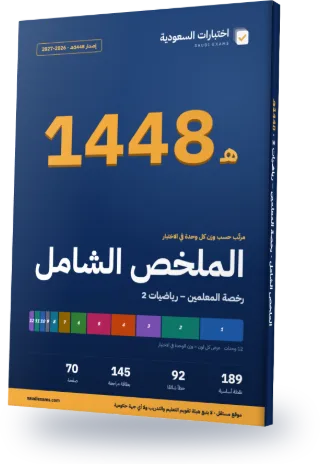
Teacher License – Math 2 Complete Review Guide 2026–2027
Every exam topic in a 70-page Arabic PDF, ordered from the heaviest unit to the lightest. The first three chapters alone cover about 50% of the exam questions.
- 70Pages
- 189Key points
- 92Common mistakes
- 145Flashcards
Guide map
Each chapter is one exam unit, ordered by its weight in the real exam.
| Chapter | Unit | Weight | Exam questions | Key points |
|---|---|---|---|---|
| 1 | Algebra and real functions | 20% | 18 | 16 |
| 2 | Geometry concepts and theorems | 18% | 16 | 17 |
| 3 | Numbers and operations | 12% | 11 | 16 |
| 4 | Statistics and probability | 12% | 10 | 16 |
| 5 | Calculus and its applications | 12% | 10 | 18 |
| 6 | Measurement, units and applications | 8% | 7 | 17 |
| 7 | Logic and mathematical reasoning | 6% | 5 | 17 |
| 8 | Strategies for teaching and learning mathematics | 4% | 3 | 15 |
| 9 | Problem solving and its strategies | 2% | 2 | 14 |
| 10 | Mathematical communication | 2% | 2 | 13 |
| 11 | Mathematical modelling and applications | 2% | 2 | 15 |
| 12 | Mathematical reasoning and critiquing arguments | 2% | 2 | 15 |
Chapter 1 in full: Algebra and real functions
20% of the exam, about 18 questions. These are its key points, as in the guide.
- The empty set \(\varnothing\) is a subset of every set; a set with \(n\) elements has \(2^{n}\) subsets, of which \(2^{n}-1\) are proper.
- The difference of sets is \(A-B=A\cap B'\), and De Morgan's laws are \((A\cup B)'=A'\cap B'\) and \((A\cap B)'=A'\cup B'\).
- Factoring identities: \(a^{2}-b^{2}=(a-b)(a+b)\), \(a^{3}\pm b^{3}=(a\pm b)(a^{2}\mp ab+b^{2})\), \((a\pm b)^{2}=a^{2}\pm 2ab+b^{2}\).
The rest of chapter 1, on this page
- If \(x+\frac{1}{x}=k\) then \(x^{2}+\frac{1}{x^{2}}=k^{2}-2\) and \(x^{3}+\frac{1}{x^{3}}=k^{3}-3k\). Example: \(k=5\) gives \(23\), then \(x^{6}+\frac{1}{x^{6}}=23^{3}-3\cdot 23=12098\).
- The roots of \(ax^{2}+bx+c=0\) are \(x=\frac{-b\pm\sqrt{b^{2}-4ac}}{2a}\); with \(\Delta=b^{2}-4ac\): positive gives two distinct real roots, zero a repeated root, negative no real roots.
- For a quadratic, the sum of the roots is \(-\frac{b}{a}\) and the product is \(\frac{c}{a}\); the vertex of \(y=ax^{2}+bx+c\) is at \(x=-\frac{b}{2a}\).
- Absolute value: \(|x|=a\) with \(a>0\) means \(x=\pm a\); \(|x|<a\) means \(-a<x<a\); \(|x|>a\) means \(x<-a\) or \(x>a\).
- A system of two linear equations is solved by elimination or substitution: one solution if the lines intersect, none if parallel, infinitely many if they coincide. For inequalities, shade the intersection of regions; the boundary is solid for \(\le,\ge\) and dashed for \(<,>\).
- Arithmetic sequence: \(a_{n}=a_{1}+(n-1)d\) and \(S_{n}=\frac{n}{2}(a_{1}+a_{n})\). Geometric sequence: \(a_{n}=a_{1}r^{n-1}\) and \(S_{n}=\frac{a_{1}(1-r^{n})}{1-r}\); if \(|r|<1\) the infinite sum is \(\frac{a_{1}}{1-r}\).
- Two matrices can be added or subtracted only if their dimensions match; \(A_{m\times n}\) times \(B_{n\times p}\) is defined and has dimension \(m\times p\). Matrix multiplication is associative and distributive but not commutative.
- For \(A=\begin{bmatrix}a&b\\c&d\end{bmatrix}\) the determinant is \(ad-bc\) and \(A^{-1}=\frac{1}{ad-bc}\begin{bmatrix}d&-b\\-c&a\end{bmatrix}\) exists only when the determinant is not zero; the system \(AX=B\) has solution \(X=A^{-1}B\).
- A function pairs each element of the domain with exactly one element of the range, which the vertical line test shows on a graph. A polynomial has domain \(\mathbb{R}\), \(\sqrt{g(x)}\) needs \(g(x)\ge 0\), and a rational function excludes the zeros of its denominator.
- The exponential \(a^{x}\) (\(a>0,\ a\neq 1\)) has domain \(\mathbb{R}\) and range \((0,\infty)\); \(\log_{a}x\) has domain \((0,\infty)\) and range \(\mathbb{R}\). The range of \(\sin x\) and \(\cos x\) is \([-1,1]\) with period \(2\pi\), and \(\tan x\) has period \(\pi\).
- The domain of \(f\circ g\) is the set of \(x\) in the domain of \(g\) where \(g(x)\) lies in the domain of \(f\); \(\frac{f}{g}\) excludes zeros of \(g\). A function has an inverse if it is one-to-one; swap \(x\) and \(y\) and solve, domain and range swap, and the graphs are symmetric about \(y=x\).
- Logarithm rules: \(\log_{a}(xy)=\log_{a}x+\log_{a}y\), \(\log_{a}\frac{x}{y}=\log_{a}x-\log_{a}y\), \(\log_{a}x^{n}=n\log_{a}x\), \(\log_{a}1=0\), \(\log_{a}a=1\), and change of base \(\log_{a}x=\frac{\ln x}{\ln a}\). Check roots of a log equation because the argument must be positive.
- The linear function \(y=mx+b\) has slope \(m=\frac{y_{2}-y_{1}}{x_{2}-x_{1}}\) and crosses the \(y\)-axis at \(b\); parallel lines have equal slopes, and perpendicular lines have slopes whose product is \(-1\). In a word problem define the variables, write the equation, then check the answer.
Common mistakes in this chapter
- Multiplying or dividing an inequality by a negative number reverses the sign: from \(-2x>6\) we get \(x<-3\), not \(x>-3\).
- In a rational equation, check the roots after solving: a value that makes any denominator zero is extraneous even if the steps were correct.
- \(\log_{a}(x+y)\) is not \(\log_{a}x+\log_{a}y\); the correct rule is \(\log_{a}(xy)=\log_{a}x+\log_{a}y\). Likewise \((a+b)^{2}\neq a^{2}+b^{2}\).
- Matrix multiplication is not commutative: usually \(AB\neq BA\), and \((AB)^{-1}=B^{-1}A^{-1}\) reverses the order.
- \((f\circ g)(x)\) applies \(g\) first and then \(f\), not the other way round, and usually \(f\circ g\neq g\circ f\). The symbol \(f^{-1}(x)\) does not mean \(\frac{1}{f(x)}\).
- For \(|x|=a\) with \(a<0\) there is no solution, and \(|x|<a\) with \(a<0\) has none either; many answers write \(x=\pm a\) without checking the sign of \(a\).
- In exponential or logarithmic inequalities, a base between 0 and 1 reverses the inequality, and the argument of a logarithm must be positive.
- Counting elements of a union: adding only \(n(A)+n(B)\) counts the intersection twice, so subtract \(n(A\cap B)\). The empty set \(\varnothing\) is not \(\{0\}\).
The other chapters are in the full guide
One purchase · lifetime access · review guide included
7-day review plan
The chapters are spread over 6 days by weight so each day carries a similar load. Day 7 is a full exam.
Day 1 · 20% of the exam
Chapter 1: Algebra and real functions
Day 2 · 18% of the exam
Chapter 2: Geometry concepts and theorems
Day 3 · 16% of the exam
Chapter 3: Numbers and operations
Chapter 8: Strategies for teaching and learning mathematicsDay 4 · 16% of the exam
Chapter 4: Statistics and probability
Chapter 9: Problem solving and its strategies
Chapter 11: Mathematical modelling and applicationsDay 5 · 16% of the exam
Chapter 5: Calculus and its applications
Chapter 10: Mathematical communication
Chapter 12: Mathematical reasoning and critiquing argumentsDay 6 · 14% of the exam
Chapter 6: Measurement, units and applications
Chapter 7: Logic and mathematical reasoningDay 7
Full mock exam: 88 questions in 120 minutes, then review the common mistakes in the units where you lost marks.
How many correct answers do you need?
- Practitioner level 50%44 correct out of 88
- Advanced level 70%62 correct out of 88
- Expert level 80%71 correct out of 88
Before you read: see your score today
10 free questions from the main units, no sign-up. Then you know which chapter to start with.
Try 10 free questions and see your levelA look at each chapter
The first three key points of each chapter, as they appear in the guide (in Arabic in the PDF).
Chapter 1: Algebra and real functions
- The empty set \(\varnothing\) is a subset of every set; a set with \(n\)…
- The difference of sets is \(A-B=A\cap B'\), and De Morgan's laws are \((A\cup B)'=A'\cap…
- Factoring identities
Chapter 2: Geometry concepts and theorems
- The interior angles of an \(n\)-sided polygon sum to \((n-2)\times 180^\circ\); each exterior angle…
- In a parallelogram the diagonals bisect each other; in a rhombus they are perpendicular;…
- Volumes
Chapter 3: Numbers and operations
- Natural numbers \(\mathbb{N}=\{1,2,3,\dots\}\), whole numbers \(\mathbb{W}=\{0,1,2,\dots\}\), integers \(\mathbb{Z}=\{\dots,-2,-1,0,1,2,\dots\}\) (6.4.1.1).
- A rational number can be written \(\frac{a}{b}\) with \(a,b\in\mathbb{Z}\) and \(b\ne0\); its decimal terminates…
- The real numbers \(\mathbb{R}\) are the union of the rationals and irrationals. A complex…
Chapter 4: Statistics and probability
- A bar chart is for categorical data and its bars are separate; a histogram…
- In a stem-and-leaf plot the stem holds the leading digits and the leaf the…
- Five-number summary
Chapter 5: Calculus and its applications
- Limit
- When substitution gives \(\frac{0}{0}\), factor numerator and denominator and cancel the common factor, or…
- Limit of a rational function at \(\infty\)
Chapter 6: Measurement, units and applications
- Metric length
- Area units
- Volume and capacity
Chapter 7: Logic and mathematical reasoning
- Statement
- Negation \(\sim p\)
- Conjunction \(p \wedge q\) ("and")
Chapter 8: Strategies for teaching and learning mathematics
- The US National Research Council (NRC, «Adding It Up», 2001) identified five intertwined strands…
- Conceptual understanding
- Procedural fluency
Chapter 9: Problem solving and its strategies
- Pólya's four steps
- In the understanding step
- In the planning step
Chapter 10: Mathematical communication
- Mathematical communication is exchanging and clarifying mathematical ideas through speech, writing, drawing, or symbols…
- The language of mathematics is made of terms (such as complementary angles), symbols (such…
- The symbol \(=\) means both sides have the same value. It is not written…
Chapter 11: Mathematical modelling and applications
- The mathematical modelling cycle
- A mathematical model is a simplified representation of a real situation in mathematical form…
- Linear model \(y=mx+b\)
Chapter 12: Mathematical reasoning and critiquing arguments
- A conjecture is a statement, often arising from a pattern seen in examples, that…
- A counterexample is a single case that meets the statement's conditions but breaks its…
- Counterexample
The full guide comes with lifetime access
The full guide (70 pages) is included with lifetime access to this exam, together with every question and full mock exam. Chapter 1 is free for everyone.
Questions about the guide
Is the guide free?
Chapter 1 is free to read on the guide page. The full guide comes with lifetime access to this exam; 7-day access does not include it.
Is it up to date for 2026–2027?
Yes. Unit weights and exam facts follow what the exam body last published, and the last check date is printed in the guide. If the standards change we update the file and buyers download the new version.
Does the guide have questions?
No. The guide covers key points and common mistakes; scoring, weak-area practice and full mock exams are on the site.
Can I read it on my phone?
Yes. A5 pages in a single column, with chapters linked from the contents.
- Pages
- 70
- Edition
- 1448 AH · 2026–2027
- Language
- Arabic
- Last updated
All Teacher Exams review guides
Back to Teachers' Professional License – Specialized Test: Mathematics (Level 2)
Buy this exam
Pick the access that lasts until your test date.
Included
- Full mock exams: 88 questions in 120 minutes, with a score for every unit
- 615 questions, every option explained with its source
- Practice that starts with your weakest units, plus a review of your mistakes
- Complete Review Guide 2026–2027 (PDF), with lifetime access only
Continue with your Google account and you go straight to the payment page.
You pay on the Waffo Pancake checkout page (in English). The amount is in US dollars and your bank converts it to riyals. One payment with no automatic renewal, by Visa, Mastercard (a mada card with either logo works too), Apple Pay or Google Pay. Your statement shows "WAFFO". Purchases are not refundable.