Try the questions in the test above first, then open each one here to see the correct answer and why every other option is wrong.
01If \frac{0.063\times 10^{m}}{0.0007\times 10^{n}}=9\times 10^{5}, what is m-n?
Past exam question Unit: Numbers and operations
A3
90\times 10^{k}=9\times 10^{5} gives 10^{k}=10^{4}, not 10^{3}.
B5
This ignores that \frac{0.063}{0.0007}=90, not 9.
C6
This assumes \frac{0.063}{0.0007} equals 0.9.
D4 ✓ Correct answer
\frac{0.063}{0.0007}=90=9\times 10, so 9\times 10^{1+m-n}=9\times 10^{5} and m-n=4.
Reference: ETEC Mathematics Teacher Standards, Level 2 (1441 AH / 2020), specialized standard 6.4.1, indicator 2, p. 8; laws of exponents
Ask your colleagues
02What value of a (where a\ne 0) gives the equation ax^{2}-12x=-9 exactly one solution?
Past exam question Unit: Algebra and real functions
A-4
At a=-4 the discriminant is 144-36(-4)=288>0, so there are two solutions.
B-3
At a=-3 the discriminant is 144+108=252>0, so there are two solutions.
C4 ✓ Correct answer
Write ax^{2}-12x+9=0; there is one solution when the discriminant 144-36a=0, so a=4.
D3
At a=3 the discriminant is 144-108=36>0, so there are two solutions.
Reference: ETEC Mathematics Teacher Standards, Level 2 (1441 AH / 2020), specialized standard 6.4.2.3, indicator 3, p. 8
Ask your colleagues
03A geometric sequence has second term -6 and fifth term 162. What is its general term?
Past exam question Unit: Calculus and its applications
Aa_n=2(-3)^{n-1} ✓ Correct answer
Correct: \frac{a_5}{a_2}=r^3=\frac{162}{-6}=-27, so r=-3 and a_1=\frac{-6}{-3}=2.
Ba_n=3(-2)^{n-1}
Wrong: the second term is -6, but the fifth term is 3(-2)^4=48, not 162.
Ca_n=-2(3)^{n-1}
Wrong: the second term -6 matches, but the fifth term is -2(3)^4=-162, not 162.
Da_n=2(3)^{n-1}
Wrong: the second term is 2(3)=6, not -6; the sign of the ratio was ignored.
Reference: ETEC Mathematics Teacher Standards, Level 2 (1441 AH / 2020), specialized standard 6.4.7, indicator 5, p. 10
Ask your colleagues
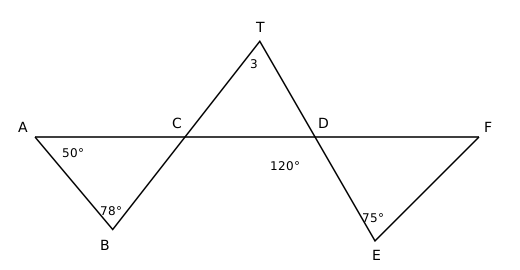
04In the figure, a horizontal line crosses the broken line ABTEF at C and D, where C lies on \overline{BT} and D lies on \overline{TE}. In triangle ABC, \angle A=50^\circ and \angle B=78^\circ; also \angle CDE=120^\circ and \angle E=75^\circ. What is the measure of \angle CTD (angle 3)?
Past exam question Unit: Geometry concepts and theorems
A68^\circ ✓ Correct answer
Correct. The angle at C in the top triangle is 180-50-78=52^\circ (vertical angles) and the angle at D is 180-120=60^\circ, so \angle T=180-52-60=68^\circ.
B52^\circ
This is \angle ACB in triangle ABC (180-50-78), which equals the angle at C in the top triangle by vertical angles; it is not the angle at T.
C60^\circ
This is the angle at D in the top triangle (180-120), not the angle at T.
D75^\circ
This is the given angle E in the lower right triangle; it is not needed to find the angle at T.
Reference: ETEC Mathematics Teacher Standards, Level 2 (1441 AH / 2020), specialized standard 6.4.3, indicator 2, p. 9
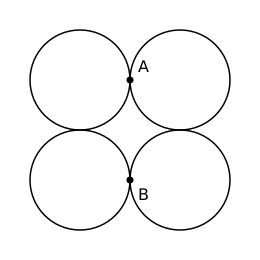
05The figure shows four identical circles, each with diameter 10 cm, where every two neighboring circles touch. Point A is where the two upper circles touch, and point B is where the two lower circles touch. What is the shortest distance a person can travel from A to B while walking only along the circles?
Past exam question Unit: Measurement, units and applications
A10\pi
10\pi is a full circumference, twice the required distance.
B20\pi
20\pi is two full circumferences, much longer than the shortest route.
C25\pi
25\pi is the area of one circle, \pi\times 5^{2}, not a length measured along a circumference.
D5\pi ✓ Correct answer
The shortest route is a quarter of the upper-left circle followed by a quarter of the lower-left circle, which is half a circumference: \frac{1}{2}\times\pi\times 10=5\pi.
Reference: ETEC Mathematics Teacher Standards, Level 2 (1441 AH / 2020), specialized standard 6.4.4, indicator 3, p. 9
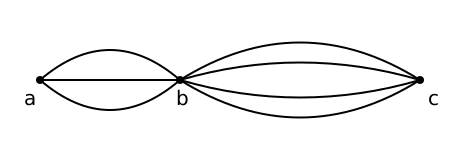
06The figure shows three different paths from a to b and four different paths from b to c. In how many ways can one travel from a to c and then back to a, if the return trip uses the same set of paths and may reuse the very path taken on the way out?
Past exam question Unit: Statistics and probability
A7
7 is 3+4, but paths in succession are multiplied, not added.
B12
12 counts only the outward trip a\to c; the return trip is not counted.
C24
24 is 12\times 2; the outward and return counts must be multiplied, not doubled.
D144 ✓ Correct answer
Outward: 3\times 4=12 ways; return: 4\times 3=12 ways; by the multiplication principle the total is 12\times 12=144.
Reference: ETEC Mathematics Teacher Standards, Level 2 (1441 AH / 2020), specialized standard 6.4.5.6, indicator 6, p. 10
07Which quadrilateral is a counterexample to the conjecture "If the diagonals of a quadrilateral are congruent, then it is a rectangle"?
Past exam question Unit: Logic and mathematical reasoning
ARhombus
The diagonals of a rhombus are congruent only when it is a square, and a square is a rectangle, so a rhombus is not a counterexample.
BIsosceles trapezoid ✓ Correct answer
Its diagonals are congruent but it is not a rectangle: it meets the hypothesis and fails the conclusion.
CParallelogram
A parallelogram whose diagonals are congruent is a rectangle, so it cannot be a counterexample.
DSquare
The diagonals of a square are congruent, but a square is a rectangle, so it meets both the hypothesis and the conclusion.
Reference: ETEC Mathematics Teacher Standards, Level 2 (1441 AH / 2020), specialized standard 6.4.6, indicator 3, p. 10
Ask your colleagues
08A teacher wanted to show her students that the Pythagorean theorem applies only to right triangles, so she showed them a triangle without a right angle and applied the theorem to it to show that it fails. Which technique did the teacher use to teach the concept?
Past exam question Unit: Strategies for teaching and learning mathematics
ANon-examples ✓ Correct answer
Non-examples are cases that do not belong to the concept and are shown to mark its limits; the non-right triangle is a non-example of the condition for using the theorem.
BGeneralization
Generalization extends a rule found in some cases to other cases, whereas here the teacher shows a case where the rule does not hold.
CSet induction
Set induction is a start-of-lesson activity that grabs attention and links to prior knowledge; it is not showing a case that falls outside the concept.
DExplanation
Explanation gives the reason a rule holds, but the teacher did not give a reason; she presented a case the theorem does not cover.
Reference: ETEC Mathematics Teacher Standards, Level 2 (1441 AH / 2020), specialized standard 6.4.8, indicator 2, p. 11
Ask your colleagues
09Deciding which arithmetic operation will solve the problem belongs to which of Pólya's steps?
Past exam question Unit: Problem solving and its strategies
AUnderstanding the problem
Understanding means identifying the givens and the unknown; the operation is not chosen yet.
BDevising a plan ✓ Correct answer
Choosing the operation or strategy that links the givens to the unknown is the core of devising a plan.
CCarrying out the plan
Carrying out the plan performs the operation already chosen; choosing it comes earlier.
DLooking back at the solution
Looking back checks the result after solving; the route to the solution is not chosen there.
Reference: ETEC Mathematics Teacher Standards, Level 2 (1441 AH / 2020), specialized standard 6.4.9, indicator 1, p. 11
Ask your colleagues
10Teacher Amal wants to check her students' mathematical communication skill. Which activity should she focus on?
Past exam question Unit: Mathematical communication
AWriting problems and explaining their solutions ✓ Correct answer
Mathematical communication means expressing ideas and solutions in words and symbols and explaining them, and writing problems and explaining their solutions shows this skill directly.
BWriting a research paper on the life of a mathematician
This is a research activity; it does not measure how well a student expresses and justifies mathematical ideas.
CWriting a summary of mathematical symbols and memorizing their meanings
This measures memory of symbols only, not explanation or justification.
DPreparing a folded brochure that collects mathematical formulas
This is a summarising and memorising activity; it does not measure expressing mathematical ideas.
Reference: ETEC Mathematics Teacher Standards, Level 2 (1441 AH / 2020), specialized standard 6.4.10, indicator 3, p. 11
Ask your colleagues

