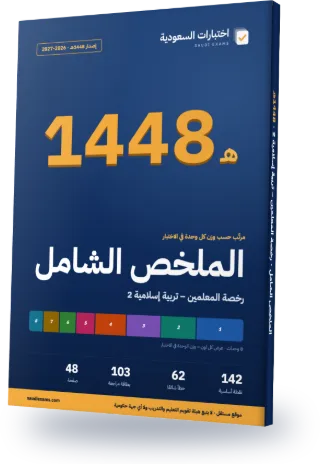
Teacher License – Islamic Education 2 Complete Review Guide 2026–2027
Every exam topic in a 48-page Arabic PDF, ordered from the heaviest unit to the lightest. The first three chapters alone cover about 53% of the exam questions.
- 48Pages
- 142Key points
- 62Common mistakes
- 103Flashcards
Guide map
Each chapter is one exam unit, ordered by its weight in the real exam.
| Chapter | Unit | Weight | Exam questions | Key points |
|---|---|---|---|---|
| 1 | Fiqh of Transactions, Family and Criminal Law | 21% | 19 | 17 |
| 2 | Qur'an and Tafsir | 16% | 14 | 18 |
| 3 | Fiqh of Worship | 16% | 14 | 18 |
| 4 | Creed and Sects | 15% | 13 | 18 |
| 5 | Usul al-Fiqh and Legal Maxims | 9% | 8 | 18 |
| 6 | Hadith and its Sciences | 8% | 7 | 18 |
| 7 | Islamic Culture and Shari'a Etiquette | 8% | 7 | 17 |
| 8 | Teaching Shari'a Sciences | 7% | 6 | 18 |
Chapter 1 in full: Fiqh of Transactions, Family and Criminal Law
21% of the exam, about 19 questions. These are its key points, as in the guide.
- Transactions are lawful by default; a deal is banned if it contains riba, gharar or harm. Quran 2:275: Allah permitted sale and forbade riba. Hadith: there is no harm and no reciprocating harm (hasan, Nawawi's Forty, no. 32). Gharar is a deal whose outcome is unknown or whose goods cannot be delivered. The Prophet forbade selling by gharar (Muslim), including hable al-habala (Bukhari) and selling what is in the womb of animals. (6.1.8 · 2)
- Conditions for a valid sale: mutual consent (Quran 4:29), capable parties, goods that are lawful to use, owned by the seller or sold with the owner's permission, deliverable, and known in both goods and price. Options to cancel include tadlis (hiding a defect or dressing up the goods), defect (an old defect shows up after the sale) and ghabn (a gross overcharge to a buyer who does not know the price). The holder may cancel or confirm the sale. (6.1.8 · 4)
- Riba has two types: riba al-fadl (an excess when a ribawi item is exchanged for the same kind) and riba al-nasi'a (an excess or delay in return for time). A modern form is a lender demanding extra benefit on a loan. (6.1.8 · 5)
The rest of chapter 1, on this page
- Contracts are either exchange contracts (sale, lease) or gratuitous (gift, loan of use, loan). Ghasb is taking another's property wrongfully by force, so it must be returned or compensated if lost. Hajr is barring someone from handling their money for a good reason (minority, insanity, imprudence). Partnership is either co-ownership or by contract. In mudaraba one side supplies capital and the other the work; profit follows the agreed shares, financial loss falls on the capital owner and the worker loses his effort. (6.1.8 · 6, 7)
- Luqata is lost property picked up by someone else; it is announced for a year (hadith: announce it for a year, Bukhari) and returned if the owner appears. A hiba is a gift of property during life without return, and parents must treat children equally in gifts (Nu'man ibn Bashir's hadith, Bukhari). Murabaha is a sale at the original cost plus a stated profit. Tawarruq is buying goods on credit and selling them for cash to a third party to raise money. In instalment sales the price is fixed with the instalments at signing. (6.1.8 · 8, 9)
- Marriage is a contract that makes intimacy lawful between spouses. Its conditions, in the view of most jurists, are the spouses' consent, a guardian and witnesses. The mahr is the wife's right (Quran 4:4) and maintenance is the husband's duty. (6.1.9 · 1–3)
- Divorce is twice, then keeping her kindly or releasing her well (Quran 2:229). Khul' is separation for compensation paid by the wife; its text is 2:229: there is no blame on either of them over what she gives to free herself. Ila' is the husband's oath to stay away from his wife for more than four months, with a four-month wait (Quran 2:226). Zihar is likening the wife to a mahram woman such as his mother; the expiation is freeing a slave, then fasting two months in a row, then feeding sixty poor people (58:3-4). Li'an is the husband accusing his wife of adultery without witnesses, followed by sworn oaths (24:6-9). (6.1.9 · 4)
- Iddah: three qur' for a divorced woman who menstruates (Quran 2:228), four months and ten days for a widow (2:234) and delivery for a pregnant woman. Hadana is caring for and raising a young child, and the mother has first claim unless something prevents her. Milk kinship: what is forbidden through lineage is forbidden through nursing (Bukhari). (6.1.9 · 5)
- Causes of inheritance: marriage, kinship and wala'. Conditions: the deceased's death, the heir being alive, and knowing the heir's relationship. Barriers: slavery, killing and difference of religion. Burial costs, debts and then the bequest (up to one third) come out of the estate first. (6.1.9 · 6)
- There are six fixed shares: one half, one quarter, one eighth, two thirds, one third and one sixth. A husband gets one half with no descendants and one quarter with them; a wife gets one quarter with none and one eighth with them. A son and daughter together share two to one (Quran 4:11). Ta'sib: give the fixed shares to their holders, and what remains goes to the nearest male relative (Bukhari). The residuary heir takes what is left after the share-holders, and a nearer heir excludes a farther one, so a son excludes brothers and uncles. (6.1.9 · 7-8, 8)
- Food is lawful by default. The named prohibitions are carrion, flowing blood, pork and what was offered to other than Allah (Quran 6:145, 5:3), domestic donkeys (Bukhari), every fanged predator (Bukhari and Muslim), every clawed bird of prey and intoxicants. They become permitted under necessity, only as much as needed. Slaughter (dhakat) is killing an animal under control with a sharp tool that drains blood, not a tooth or nail, while mentioning Allah's name (Bukhari). Hunting is killing a wild animal by wounding, saying Allah's name when sending the hound or arrow. A man's awra is, for most jurists, between the navel and the knee. (6.1.10 · 1, 2-3)
- A woman's lawful dress covers her, is not see-through or tight enough to outline her body, and does not copy men's clothing. Men and women may not imitate each other: the Prophet cursed men who imitate women and women who imitate men (Bukhari). Gold and silk are forbidden to men. (6.1.10 · 4-6)
- An oath is swearing by Allah or His names and attributes; swearing by anything else, such as one's fathers, is forbidden (Bukhari). Its expiation is feeding ten poor people, clothing them or freeing a slave, and fasting three days if none is possible (Quran 5:89). A slip of the tongue in an oath carries no expiation. A vow commits yourself to an act of worship. The hadith: whoever vows to obey Allah should obey Him, and whoever vows to disobey Him must not do it (Bukhari). A vow of obedience must be fulfilled; a vow to sin must not be. An unfulfilled vow carries the expiation of an oath according to the Hanbali school. (6.1.10 · 8-9)
- Jihad is a communal duty, and it becomes an individual duty in some cases, including standing in the battle line, an enemy besieging the land and the imam's call to arms. Its wisdom is to uphold Allah's word and repel aggression. Those who do not fight, such as women and children, are not killed. Dhimmis live in Muslim lands under a covenant and a musta'min enters under temporary safe conduct; both are protected: whoever kills a covenanted person will not smell Paradise (Bukhari). Hisba is enjoining good and forbidding wrong (Quran 3:110). The way: change it by hand, then by tongue, then by heart (Muslim). Its manners include knowing what you enjoin, gentleness and weighing the benefit. (6.1.11 · 1-2, 3)
- Killing is deliberate (intending the act and the death, with something that usually kills), quasi-deliberate (intending the act with something that usually does not kill) or accidental (no intent). Deliberate killing carries qisas (Quran 2:178), diya or forgiveness. The diya for a life is 100 camels, for a tooth 5 and for a finger 10. (6.1.11 · 4-5)
- Hudud: for adultery, 100 lashes for an unmarried person (Quran 24:2) and stoning for a married one; for false accusation of adultery, 80 lashes (24:4); for theft, cutting off the hand at a quarter dinar or more (5:38; Bukhari); for drinking wine, lashing. For apostasy: whoever changes his religion, kill him (Bukhari). For hirabah the penalties are those in 5:33, and rebels are fought to bring them back to obedience after attempts at reconciliation (49:9). (6.1.11 · 6-8)
- Judiciary is declaring the ruling of the Shari'a and enforcing it. The claimant must bring proof and the one who denies swears an oath (hasan hadith). Means of proof are testimony, confession, oath and circumstantial evidence. No one may intercede for a hadd once it reaches the judge: the Prophet's words, will you intercede about a limit set by Allah (Bukhari). Turning to the Shari'a for judgment is obligatory (Quran 4:65). Hudud and qisas aim to deter and protect the five necessities. (6.1.11 · 9-11)
Common mistakes in this chapter
- Gharar is uncertainty in the goods or inability to deliver them (like selling what is in the womb), riba is a forbidden excess, and tadlis is hiding a defect or dressing up the goods. Ask where the flaw sits before choosing.
- The tadlis option comes from the seller hiding a defect or dressing up the goods. The ghabn option is for a buyer who paid far above the going price without knowing. Selling something you do not own is a problem of ownership, not of options.
- Khul' is separation for compensation paid by the wife; talaq has no compensation. Ila' is the husband's oath to abstain from relations, zihar is likening the wife to a mahram woman such as his mother, and li'an is accusing the wife of adultery without proof. Go by the husband's words.
- A pregnant woman's iddah ends at delivery, whether she was divorced or widowed. A widow who is not pregnant waits four months and ten days; a divorced woman who menstruates waits three qur'.
- A son is a residuary heir who excludes brothers and uncles. The mother gets one sixth with a descendant or several siblings, and one third otherwise. Debts and the bequest (up to one third) come out before the estate is divided.
- Food is lawful by default. The named exceptions are carrion, flowing blood, pork, intoxicants, domestic donkeys, fanged predators and clawed birds of prey. The wild ass is not a domestic donkey.
- An oath is swearing by Allah or His names and attributes; a vow commits yourself to an act of worship. The oath's expiation is a choice of feeding ten poor people, clothing them or freeing a slave, and fasting three days only if none of these is possible.
- Hadd is a penalty fixed by the texts for a named crime; ta'zir is not fixed and the judge sets it; qisas is equal retaliation for harm to life or limb; diya is money paid in place of a life or limb. Match each term to the kind of crime.
The other chapters are in the full guide
One purchase · lifetime access · review guide included
7-day review plan
The chapters are spread over 6 days by weight so each day carries a similar load. Day 7 is a full exam.
Day 1 · 21% of the exam
Chapter 1: Fiqh of Transactions, Family and Criminal Law
Day 2 · 16% of the exam
Chapter 2: Qur'an and Tafsir
Day 3 · 16% of the exam
Chapter 3: Fiqh of Worship
Day 4 · 15% of the exam
Chapter 4: Creed and Sects
Day 5 · 16% of the exam
Chapter 5: Usul al-Fiqh and Legal Maxims
Chapter 8: Teaching Shari'a SciencesDay 6 · 16% of the exam
Chapter 6: Hadith and its Sciences
Chapter 7: Islamic Culture and Shari'a EtiquetteDay 7
Full mock exam: 88 questions in 120 minutes, then review the common mistakes in the units where you lost marks.
How many correct answers do you need?
- Practitioner level 50%44 correct out of 88
- Advanced level 70%62 correct out of 88
- Expert level 80%71 correct out of 88
Before you read: see your score today
10 free questions from the main units, no sign-up. Then you know which chapter to start with.
Try 10 free questions and see your levelA look at each chapter
The first three key points of each chapter, as they appear in the guide (in Arabic in the PDF).
Chapter 1: Fiqh of Transactions, Family and Criminal Law
- Transactions are lawful by default; a deal is banned if it contains riba, gharar…
- Conditions for a valid sale
- Riba has two types
Chapter 2: Qur'an and Tafsir
- Etiquette of recitation includes sincerity, purity, seeking refuge, measured recitation and beautifying the voice…
- A clear error is an evident mistake in pronunciation that readers and non-specialists notice…
- The general areas of articulation are five
Chapter 3: Fiqh of Worship
- Ghusl is required after janabah and when menstruation or postpartum bleeding ends; janabah results…
- Among the natural practices in the hadith of Aisha, may God be pleased with…
- Tayammum applies when water is missing or cannot be used
Chapter 4: Creed and Sects
- The science of creed studies what must be believed about Allah, His angels, books…
- The pillars of faith are six
- Tawhid has three types
Chapter 5: Usul al-Fiqh and Legal Maxims
- Fiqh
- Usul al-fiqh
- The four agreed evidences
Chapter 6: Hadith and its Sciences
- Sunnah literally means a way; technically it is whatever is reported from the Prophet…
- One proof of the authority of the Sunnah is
- Also
Chapter 7: Islamic Culture and Shari'a Etiquette
- Islamic culture is a system of knowledge, values and outlooks drawn from revelation. It…
- The two basic sources of Islamic culture are the Quran and the Sunnah; the…
- Among the main characteristics of Islamic culture
Chapter 8: Teaching Shari'a Sciences
- The general landmarks and core issues of each school stage are written as learning…
- The standard gives two examples of modern approaches
- Active learning
The full guide comes with lifetime access
The full guide (48 pages) is included with lifetime access to this exam, together with every question and full mock exam. Chapter 1 is free for everyone.
Questions about the guide
Is the guide free?
Chapter 1 is free to read on the guide page. The full guide comes with lifetime access to this exam; 7-day access does not include it.
Is it up to date for 2026–2027?
Yes. Unit weights and exam facts follow what the exam body last published, and the last check date is printed in the guide. If the standards change we update the file and buyers download the new version.
Does the guide have questions?
No. The guide covers key points and common mistakes; scoring, weak-area practice and full mock exams are on the site.
Can I read it on my phone?
Yes. A5 pages in a single column, with chapters linked from the contents.
- Pages
- 48
- Edition
- 1448 AH · 2026–2027
- Language
- Arabic
- Last updated
All Teacher Exams review guides
Back to Teachers' Professional License – Subject Test: Islamic Education (2)
Buy this exam
Pick the access that lasts until your test date.
Included
- Full mock exams: 88 questions in 120 minutes, with a score for every unit
- 471 questions, every option explained with its source
- Practice that starts with your weakest units, plus a review of your mistakes
- Complete Review Guide 2026–2027 (PDF), with lifetime access only
Continue with your Google account and you go straight to the payment page.
You pay on the Waffo Pancake checkout page (in English). The amount is in US dollars and your bank converts it to riyals. One payment with no automatic renewal, by Visa, Mastercard (a mada card with either logo works too), Apple Pay or Google Pay. Your statement shows "WAFFO". Purchases are not refundable.