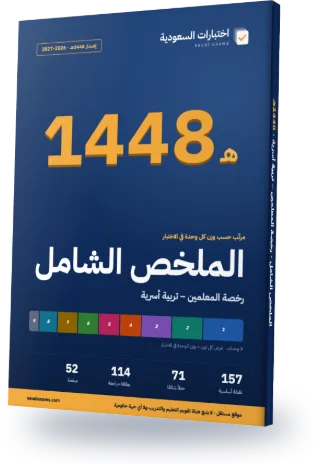
Teacher License – Family Education Complete Review Guide 2026–2027
Every exam topic in a 52-page Arabic PDF, ordered from the heaviest unit to the lightest. The first three chapters alone cover about 46% of the exam questions.
- 52Pages
- 157Key points
- 71Common mistakes
- 114Flashcards
Guide map
Each chapter is one exam unit, ordered by its weight in the real exam.
| Chapter | Unit | Weight | Exam questions | Key points |
|---|---|---|---|---|
| 1 | Food and Nutrition | 18% | 16 | 17 |
| 2 | Family and Society | 14% | 12 | 18 |
| 3 | Human Development | 14% | 12 | 18 |
| 4 | Safety and First Aid | 10% | 9 | 17 |
| 5 | Clothing and Textiles | 10% | 9 | 18 |
| 6 | Housing and Interior Design | 10% | 9 | 18 |
| 7 | Personal Care and Grooming | 10% | 9 | 18 |
| 8 | Consumer Awareness | 9% | 8 | 18 |
| 9 | Teaching and Learning | 5% | 4 | 15 |
Chapter 1 in full: Food and Nutrition
18% of the exam, about 16 questions. These are its key points, as in the guide.
- A balanced diet contains all the nutrients in proportions suited to the person's age, sex and activity, and combines variety, moderation and adequacy (6.23.4/1).
- There are six nutrient groups: carbohydrates, proteins, fats, vitamins, minerals and water. The first three provide energy; vitamins, minerals and water do not (6.23.4/2).
- Energy values: 4 kcal per gram of carbohydrate, 4 kcal per gram of protein and 9 kcal per gram of fat (6.23.5/2).
The rest of chapter 1, on this page
- The acceptable split of energy sources for adults is 45–65% carbohydrate, 20–35% fat and 10–35% protein of total calories (6.23.5/2).
- Fat-soluble vitamins A, D, E and K are stored in the body; water-soluble vitamins (B-complex and C) are mostly not stored and the excess is excreted (6.23.4/2).
- Digestion: starch digestion begins in the mouth with amylase, protein in the stomach with pepsin and hydrochloric acid, and the digestion of fat, protein and starch is completed in the small intestine, where the products are absorbed through the villi (6.23.4/3).
- Enzymes are proteins that speed up biological reactions without being used up; hormones are chemical messengers secreted by glands (some protein-based, some steroid); nucleic acids, DNA and RNA, are built from units called nucleotides (6.23.4/5).
- Nutritional status is assessed in four ways: anthropometric (weight, height, BMI), dietary intake (24-hour recall), clinical examination, and laboratory tests (for example for anaemia) (6.23.4/11).
- BMI = weight in kilograms ÷ height in metres squared. 18.5 to 24.9 is a healthy weight, 25 to 29.9 is overweight and 30 or more is obesity (6.23.5/2).
- On the plate model, half the plate is vegetables and fruit, a quarter is grains (preferably whole) and a quarter is protein. The exchange system lets you swap one food for another in the same group with a similar nutritive value (6.23.5/4).
- Read a nutrition label in order: serving size and servings per pack, then calories, then fat, sodium, sugar, fibre and protein, then percent daily value. The ingredient list runs in descending order by weight (6.23.5/7).
- Food safety: the temperature danger zone is about 5 to 60 °C. Keep chilled food below 5 °C and frozen food at -18 °C or lower, and cook poultry until the centre reaches 74 °C (6.23.6/3 and 5).
- HACCP is a preventive system built on seven principles: hazard analysis, identifying critical control points, setting critical limits, monitoring, corrective actions, verification and record-keeping (6.23.6/8).
- Heat travels in three ways: conduction (the pan touching the food), convection (moving hot water or air, as in boiling) and radiation (grilling over coals, or a microwave) (6.23.6/11).
- Steaming keeps more water-soluble vitamins than boiling because the food is not immersed in water. High-heat grilling can form harmful compounds if the food chars (6.23.6/10).
- Preserving with salt or sugar solutions relies on osmotic pressure: a high concentration draws water out of microbial cells so they cannot grow. Concentration by weight = weight of solute ÷ total weight of solution × 100 (6.23.6/7).
- Factors that affect bacterial growth: food, acidity, time, temperature, oxygen and moisture. The shapes are spherical (cocci), rod-shaped (bacilli) and spiral (6.23.4/12).
Common mistakes in this chapter
- Carbohydrate and protein give 4 kcal per gram and fat gives 9 kcal. Swapping the numbers or giving fat 4 kcal leads to a wrong calorie count.
- Water-soluble vitamins (B-complex and C) are lost in boiling and long storage. Vitamins A, D, E and K dissolve in fat and are stored in the body.
- Carbohydrate digestion starts in the mouth with amylase, protein digestion starts in the stomach with pepsin, and fat digestion is mainly completed in the small intestine. Most nutrients are absorbed in the small intestine, not the stomach.
- A food-guide serving is a standard amount set by a food guide, while the serving size on a label is the amount the listed values are calculated for. A label serving is not necessarily a recommended serving.
- The temperature danger zone is between chilling and hot holding (about 5 to 60 °C), not above 60 °C. Chilling slows bacterial growth without killing bacteria, and freezing stops growth without sterilising the food.
- Conduction passes heat through contact (pan base to food), convection through moving hot liquid or air (boiling, a fan oven) and radiation through waves with no medium (grilling over coals). Students often mix up the examples.
- Highly perishable foods (meat, dairy, fish) differ from semi-perishable (bread, potatoes, eggs) and non-perishable or stable foods (rice, dried pulses, sugar). A common error is placing eggs or bread in the first group.
- Not all bacteria are harmful: some, like those in yoghurt, are useful and others, like Salmonella, cause disease. They are classified by shape (cocci, rods, spirals) and by oxygen and temperature requirements.
The other chapters are in the full guide
One purchase · lifetime access · review guide included
7-day review plan
The chapters are spread over 6 days by weight so each day carries a similar load. Day 7 is a full exam.
Day 1 · 18% of the exam
Chapter 1: Food and Nutrition
Day 2 · 14% of the exam
Chapter 2: Family and Society
Day 3 · 14% of the exam
Chapter 3: Human Development
Day 4 · 20% of the exam
Chapter 4: Safety and First Aid
Chapter 7: Personal Care and GroomingDay 5 · 19% of the exam
Chapter 5: Clothing and Textiles
Chapter 8: Consumer AwarenessDay 6 · 15% of the exam
Chapter 6: Housing and Interior Design
Chapter 9: Teaching and LearningDay 7
Full mock exam: 88 questions in 120 minutes, then review the common mistakes in the units where you lost marks.
How many correct answers do you need?
- Practitioner level 50%44 correct out of 88
- Advanced level 70%62 correct out of 88
- Expert level 80%71 correct out of 88
Before you read: see your score today
10 free questions from the main units, no sign-up. Then you know which chapter to start with.
Try 10 free questions and see your levelA look at each chapter
The first three key points of each chapter, as they appear in the guide (in Arabic in the PDF).
Chapter 1: Food and Nutrition
- A balanced diet contains all the nutrients in proportions suited to the person's age…
- There are six nutrient groups
- Energy values
Chapter 2: Family and Society
- The family is the basic social unit that begins with marriage and performs biological…
- Stages of the family life cycle
- Family types
Chapter 3: Human Development
- Human development is continuous and sequential, proceeding from head to toe (cephalocaudal) and from…
- There are five dimensions
- Piaget's cognitive stages
Chapter 4: Safety and First Aid
- A water extinguisher suits ordinary solid-material fires (wood, paper, cloth). Do not use it…
- A carbon dioxide extinguisher suits electrical equipment and flammable liquid fires and leaves no…
- A multipurpose dry powder extinguisher suits most home fires, and the spray is aimed…
Chapter 5: Clothing and Textiles
- Cotton absorbs sweat and breathes but wrinkles; linen is strong and cool but wrinkles…
- Clothing taste is the ability to choose the colours, lines, fabrics and accessories that…
- Elements of design
Chapter 6: Housing and Interior Design
- A home is made up of living areas (reception and sitting), service areas (kitchen…
- Smart home systems (such as light and motion sensors, thermostats, and water-leak, gas and…
- A safe home needs emergency exits, smoke detectors and fire extinguishers, sound electrical wiring…
Chapter 7: Personal Care and Grooming
- Skin has three layers
- Skin types
- Suitable masks
Chapter 8: Consumer Awareness
- Consumer behaviour is what an individual or family does when buying, using and disposing…
- Types of consumer behaviour
- Factors that affect consumption include income, customs and culture, family size and life stage…
Chapter 9: Teaching and Learning
- A teaching strategy is a set of procedures the teacher plans to reach the…
- Criteria for choosing a strategy
- Lecture
The full guide comes with lifetime access
The full guide (52 pages) is included with lifetime access to this exam, together with every question and full mock exam. Chapter 1 is free for everyone.
Questions about the guide
Is the guide free?
Chapter 1 is free to read on the guide page. The full guide comes with lifetime access to this exam; 7-day access does not include it.
Is it up to date for 2026–2027?
Yes. Unit weights and exam facts follow what the exam body last published, and the last check date is printed in the guide. If the standards change we update the file and buyers download the new version.
Does the guide have questions?
No. The guide covers key points and common mistakes; scoring, weak-area practice and full mock exams are on the site.
Can I read it on my phone?
Yes. A5 pages in a single column, with chapters linked from the contents.
- Pages
- 52
- Edition
- 1448 AH · 2026–2027
- Language
- Arabic
- Last updated
All Teacher Exams review guides
Back to Teachers' Professional License – Subject Test: Family Education
Buy this exam
Pick the access that lasts until your test date.
Included
- Full mock exams: 88 questions in 120 minutes, with a score for every unit
- 475 questions, every option explained with its source
- Practice that starts with your weakest units, plus a review of your mistakes
- Complete Review Guide 2026–2027 (PDF), with lifetime access only
Continue with your Google account and you go straight to the payment page.
You pay on the Waffo Pancake checkout page (in English). The amount is in US dollars and your bank converts it to riyals. One payment with no automatic renewal, by Visa, Mastercard (a mada card with either logo works too), Apple Pay or Google Pay. Your statement shows "WAFFO". Purchases are not refundable.