PMP
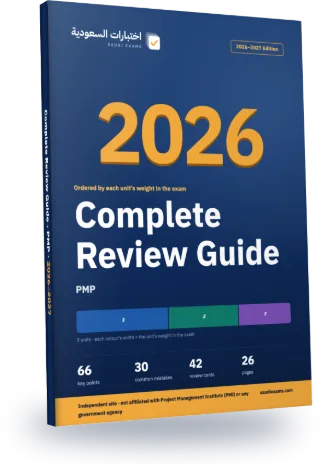
PMP Complete Review Guide 2026–2027
Every exam topic in a 26-page Arabic PDF, ordered from the heaviest unit to the lightest. The first three chapters alone cover about 100% of the exam questions.
- 26Pages
- 66Key points
- 30Common mistakes
- 42Flashcards
Guide map
Each chapter is one exam unit, ordered by its weight in the real exam.
| Chapter | Unit | Weight | Exam questions | Key points |
|---|---|---|---|---|
| 1 | Process | 41% | 74 | 22 |
| 2 | People | 33% | 59 | 22 |
| 3 | Business Environment | 26% | 47 | 22 |
Chapter 1 in full: Process
41% of the exam, about 74 questions. These are its key points, as in the guide.
- Predictive fits stable requirements, agile fits changing requirements and frequent delivery, and hybrid combines the two. (ECO Task 1)
- The integrated plan combines scope, schedule, cost, quality, resource, communication, risk and procurement plans, and is updated throughout the project. (ECO Task 1)
- Estimating types: analogous (past projects), parametric (rate × quantity), three-point (O+4M+P)/6, and bottom-up. (ECO Task 1)
The rest of chapter 1, on this page
- The work breakdown structure (WBS) decomposes total scope hierarchically down to work packages, covering 100% of the work and nothing more. (ECO Task 2)
- The scope baseline is the scope statement + WBS + WBS dictionary. Changing it requires change control. (ECO Task 2)
- In agile, scope is broken into a prioritized backlog owned by the product owner and refined continuously. (ECO Task 2)
- MoSCoW classifies requirements: Must, Should, Could, Won't (this time). (ECO Task 3)
- A minimum viable product (MVP) is the smallest version that delivers value and gives early feedback to learn from. (ECO Task 3)
- Measure benefits with indicators agreed with stakeholders, and review business value throughout the project, not only at the end. (ECO Task 3)
- Resource leveling adjusts the schedule to resolve shortages and may delay completion; smoothing adjusts within float. (ECO Task 4)
- Contract types: fixed price (FFP) puts risk on the seller; cost reimbursable (CPFF, CPIF) puts it on the buyer; time and materials (T&M) shares it. (ECO Task 5)
- Common procurement documents: RFI to gather information, RFQ to request a price, RFP to request a full proposal. Bids are scored against criteria set in advance. (ECO Task 5)
- Before negotiating, define your best alternative (BATNA) and your limits; after signing, track performance and compliance with contract terms. (ECO Task 5)
- Contingency reserve covers identified risks and is inside the cost baseline; management reserve covers unknown unknowns and is outside it. (ECO Task 6)
- Earned value: CV = EV − AC, SV = EV − PV, CPI = EV ÷ AC, SPI = EV ÷ PV. (ECO Task 6)
- Forecasting: EAC = BAC ÷ CPI (if current performance continues), ETC = EAC − AC, VAC = BAC − EAC. (ECO Task 6)
- Cost of quality: conformance (prevention, appraisal) and nonconformance (internal and external failure). Prevention costs less than fixing defects later. (ECO Task 7)
- Quality tools: Pareto for the biggest causes, fishbone for root cause, control chart for process stability, and histogram. (ECO Task 7)
- The critical path is the longest path in the network with zero total float; any delay on it delays the project. (ECO Task 8)
- Story points are a relative effort estimate; velocity is the points completed per iteration and is used for forecasting. (ECO Task 8)
- A burndown chart shows remaining work; a burnup chart shows completed work and scope changes together. (ECO Task 9)
- Before closing: formal acceptance, validate readiness to hand over, close procurement and finances, hold lessons learned, and release resources. (ECO Task 10)
Common mistakes in this chapter
- Choosing the approach by personal preference. Correct: assess complexity, requirement volatility, and team and customer readiness, then recommend the best fit.
- Implementing a change as soon as it is requested. Correct: assess impact first and send it through change control; no baseline changes outside it.
- Mixing up contingency and management reserves. Contingency covers identified risks and sits inside the cost baseline; management reserve covers unknowns, sits outside it, and needs management approval.
- Confusing crashing with fast tracking. Crashing adds resources and usually raises cost; fast tracking overlaps activities and raises risk. Both apply to the critical path.
- Confusing resource leveling with smoothing. Leveling can change the critical path and end date; smoothing works within float and changes neither.
- Gold plating (adding features nobody requested) or letting scope creep in unchecked. Correct: deliver what was agreed; any addition goes through change control.
- Reading SPI and CPI backwards. Above 1 is good (ahead of schedule or under budget); below 1 means behind schedule or over budget.
- Choosing a fixed-price contract when scope is unclear. Correct: vague scope fits time and materials or cost reimbursable; fixed price pushes risk onto the seller, who raises the price.
- Closing without documented acceptance from the customer or sponsor. Correct: get formal acceptance, hand over deliverables, close contracts, record lessons learned and release resources.
- Skipping lessons learned when a project ends early. Correct: early termination still follows closure steps, documenting reasons, lessons and deliverable status.
The other chapters are in the full guide
One purchase · lifetime access · review guide included
7-day review plan
The chapters are spread over 6 days by weight so each day carries a similar load. Day 7 is a full exam.
Day 1 · 41% of the exam
Chapter 1: Process
Day 2 · 33% of the exam
Chapter 2: People
Day 3 · 26% of the exam
Chapter 3: Business Environment
Day 4
Full mock exam: 180 questions in 240 minutes, then review the common mistakes in the units where you lost marks.
Before you read: see your score today
10 free questions from the main units, no sign-up. Then you know which chapter to start with.
Try 10 free questions and see your levelA look at each chapter
The first three key points of each chapter, as they appear in the guide (in Arabic in the PDF).
Chapter 1: Process
- Predictive fits stable requirements, agile fits changing requirements and frequent delivery, and hybrid combines…
- The integrated plan combines scope, schedule, cost, quality, resource, communication, risk and procurement plans…
- Estimating types
Chapter 2: People
- Shared vision
- When the vision is misunderstood
- Common conflict resolution modes
Chapter 3: Business Environment
- Governance is the structure, rules, procedures, reporting, and policies that guide the project, drawn…
- Success metrics are defined and agreed with stakeholders early, then used to measure performance…
- An escalation path states who receives an issue and at what threshold of time…
The full guide comes with lifetime access
The full guide (26 pages) is included with lifetime access to this exam, together with every question and full mock exam. Chapter 1 is free for everyone.
Questions about the guide
Is the guide free?
Chapter 1 is free to read on the guide page. The full guide comes with lifetime access to this exam; 7-day access does not include it.
Is it up to date for 2026–2027?
Yes. Unit weights and exam facts follow what the exam body last published, and the last check date is printed in the guide. If the standards change we update the file and buyers download the new version.
Does the guide have questions?
No. The guide covers key points and common mistakes; scoring, weak-area practice and full mock exams are on the site.
Can I read it on my phone?
Yes. A5 pages in a single column, with chapters linked from the contents.
- Pages
- 26
- Edition
- 1448 AH · 2026–2027
- Language
- Arabic
- Last updated
Buy this exam
Pick the access that lasts until your test date.
Included
- Full mock exams: 180 questions in 240 minutes, with a score for every unit
- 914 questions, every option explained with its source
- Practice that starts with your weakest units, plus a review of your mistakes
- Complete Review Guide 2026–2027 (PDF), with lifetime access only
Continue with your Google account and you go straight to the payment page.
You pay on the Waffo Pancake checkout page (in English). The amount is in US dollars and your bank converts it to riyals. One payment with no automatic renewal, by Visa, Mastercard (a mada card with either logo works too), Apple Pay or Google Pay. Your statement shows "WAFFO". Purchases are not refundable.