GAT
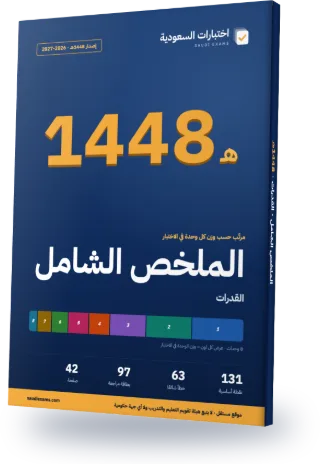
Qudurat (GAT) Complete Review Guide 2026–2027
Every exam topic in a 42-page Arabic PDF, ordered from the heaviest unit to the lightest. The first three chapters alone cover about 61% of the exam questions.
- 42Pages
- 131Key points
- 63Common mistakes
- 97Flashcards
Guide map
Each chapter is one exam unit, ordered by its weight in the real exam.
| Chapter | Unit | Weight | Exam questions | Key points |
|---|---|---|---|---|
| 1 | Arithmetic | 23% | 28 | 17 |
| 2 | Reading Comprehension | 21% | 25 | 16 |
| 3 | Verbal Analogy | 17% | 20 | 16 |
| 4 | Contextual Error | 10% | 12 | 16 |
| 5 | Geometry | 10% | 12 | 17 |
| 6 | Data Interpretation | 8% | 10 | 15 |
| 7 | Sentence Completion | 7% | 8 | 16 |
| 8 | Algebra | 4% | 5 | 18 |
Chapter 1 in full: Arithmetic
23% of the exam, about 28 questions. These are its key points, as in the guide.
- Order of operations: brackets, then powers and roots, then multiplication and division left to right, then addition and subtraction (u5.1).
- A number is divisible by 3 if its digit sum is divisible by 3, and by 9 if its digit sum is divisible by 9 (u5.1).
- A number is divisible by 4 if its last two digits form a number divisible by 4, and by 5 if it ends in 0 or 5 (u5.1).
The rest of chapter 1, on this page
- An arithmetic sequence has a constant difference: \(a_n = a_1 + (n-1)d\). A geometric one has a constant ratio: \(a_n = a_1 \cdot r^{n-1}\) (u5.1).
- To compare two fractions, use a common denominator or cross-multiply: \(\frac{a}{b} < \frac{c}{d}\) when \(ad < bc\) (for positive denominators) (u5.2).
- \(p\%\) of \(x\) equals \(\frac{p}{100} \times x\). Mental tip: 10% of a number means shifting the decimal point one place, and 5% is half of that (u5.2).
- Percentage change = \(\frac{\text{change}}{\text{original value}} \times 100\), always dividing by the original value (u5.2).
- To split a quantity in the ratio \(a:b\), add the parts \(a+b\); the first share is \(\frac{a}{a+b}\) of the quantity (u5.2).
- Direct proportion: the quotient is constant (\(\frac{y}{x} = k\)); inverse proportion: the product is constant (\(xy = k\)) (u5.2).
- Exponent laws: \(a^m \cdot a^n = a^{m+n}\), \((a^m)^n = a^{mn}\), \(a^0 = 1\), \(a^{-n} = \frac{1}{a^n}\) (u5.3).
- Roots: \(\sqrt{ab} = \sqrt{a}\cdot\sqrt{b}\) for non-negative numbers, so \(\sqrt{50} = 5\sqrt{2}\). Memorize squares up to 15² (u5.3).
- Speed = distance ÷ time, so distance = speed × time and time = distance ÷ speed (u5.4).
- Average speed = total distance ÷ total time. When two objects move toward each other, add their speeds to find the meeting time (u5.4).
- To convert km/h to m/s multiply by \(\frac{5}{18}\), and for the reverse multiply by \(\frac{18}{5}\). A map scale of 1:100000 means 1 cm represents 1 km (u5.4).
- Mean = sum of values ÷ number of values, so sum = mean × count. The median is the middle value after sorting, the mode is the most frequent, and range = largest − smallest (u5.5).
- Probability = favorable outcomes ÷ total outcomes, its value lies between 0 and 1, and P(not happening) = 1 − P(happening) (u5.5).
- Comparison choices: first is greater, second is greater, equal, or the data are insufficient. Pick the first, second or equal only if it holds in every possible case (u5.6).
Common mistakes in this chapter
- A 20% increase followed by a 20% decrease does not return the original number: the result is 96% of it, because the second percentage is taken from the new number.
- Successive discounts of 20% and 10% are not a 30% discount; the real discount is 28%, because the price is multiplied by 0.8 and then by 0.9.
- Average speed is not the mean of two speeds when the time for each leg differs; always use total distance ÷ total time.
- \(\sqrt{a+b}\) does not equal \(\sqrt{a}+\sqrt{b}\), and \((a+b)^2\) does not equal \(a^2+b^2\).
- A ratio of 2:3 does not mean the first part is \(\frac{2}{3}\) of the whole; it is \(\frac{2}{5}\), because the whole = 2 + 3.
- The median is taken after sorting the values in ascending order; taking the middle value of an unsorted list is a common mistake.
- In a comparison, testing one value is not enough to pick "first is greater"; try zero, fractions and negatives, and if the results differ the data are insufficient.
- Unit-conversion slips: multiplying by 60 instead of dividing, or forgetting to square the factor for area (1 m² = 10000 cm²).
The other chapters are in the full guide
One purchase · lifetime access · review guide included
7-day review plan
The chapters are spread over 6 days by weight so each day carries a similar load. Day 7 is a full exam.
Day 1 · 23% of the exam
Chapter 1: Arithmetic
Day 2 · 21% of the exam
Chapter 2: Reading Comprehension
Day 3 · 17% of the exam
Chapter 3: Verbal Analogy
Day 4 · 14% of the exam
Chapter 4: Contextual Error
Chapter 8: AlgebraDay 5 · 10% of the exam
Chapter 5: Geometry
Day 6 · 15% of the exam
Chapter 6: Data Interpretation
Chapter 7: Sentence CompletionDay 7
Full mock exam: 120 questions in 125 minutes, then review the common mistakes in the units where you lost marks.
Before you read: see your score today
10 free questions from the main units, no sign-up. Then you know which chapter to start with.
Try 10 free questions and see your levelA look at each chapter
The first three key points of each chapter, as they appear in the guide (in Arabic in the PDF).
Chapter 1: Arithmetic
- Order of operations
- A number is divisible by 3 if its digit sum is divisible by 3…
- A number is divisible by 4 if its last two digits form a number…
Chapter 2: Reading Comprehension
- A task is a passage followed by questions about its content. One passage can…
- Skim the questions before the passage so you know what is asked, then read…
- While reading, note each paragraph's specific idea in a few words. Most detail questions…
Chapter 3: Verbal Analogy
- A verbal analogy question
- Solving steps
- Synonymy
Chapter 4: Contextual Error
- The question
- You must identify the offending word and mark its letter; you are not asked…
- The error is contextual
Chapter 5: Geometry
- The angles of a triangle add to 180°, those of any quadrilateral to 360°;…
- Vertically opposite angles are equal. Adjacent angles on a straight line are supplementary: they…
- When a line crosses two parallel lines, corresponding angles are equal, alternate angles are…
Chapter 6: Data Interpretation
- A fixed routine for every question
- Bar charts compare separate categories; line graphs show how a value changes over time;…
- The percentages in a pie chart add up to 100%, so a missing share…
Chapter 7: Sentence Completion
- In every question you choose the option that fills the blank or blanks so…
- Solving routine
- Contrast is signalled by "but", "rather" and "yet"
Chapter 8: Algebra
- Linear equation
- Translating words
- Pair of equations by elimination
The full guide comes with lifetime access
The full guide (42 pages) is included with lifetime access to this exam, together with every question and full mock exam. Chapter 1 is free for everyone.
Questions about the guide
Is the guide free?
Chapter 1 is free to read on the guide page. The full guide comes with lifetime access to this exam; 7-day access does not include it.
Is it up to date for 2026–2027?
Yes. Unit weights and exam facts follow what the exam body last published, and the last check date is printed in the guide. If the standards change we update the file and buyers download the new version.
Does the guide have questions?
No. The guide covers key points and common mistakes; scoring, weak-area practice and full mock exams are on the site.
Can I read it on my phone?
Yes. A5 pages in a single column, with chapters linked from the contents.
- Pages
- 42
- Edition
- 1448 AH · 2026–2027
- Language
- Arabic
- Last updated
Buy this exam
Pick the access that lasts until your test date.
Included
- Full mock exams: 120 questions in 125 minutes, with a score for every unit
- 1060 questions, every option explained with its source
- Practice that starts with your weakest units, plus a review of your mistakes
- Complete Review Guide 2026–2027 (PDF), with lifetime access only
Continue with your Google account and you go straight to the payment page.
You pay on the Waffo Pancake checkout page (in English). The amount is in US dollars and your bank converts it to riyals. One payment with no automatic renewal, by Visa, Mastercard (a mada card with either logo works too), Apple Pay or Google Pay. Your statement shows "WAFFO". Purchases are not refundable.