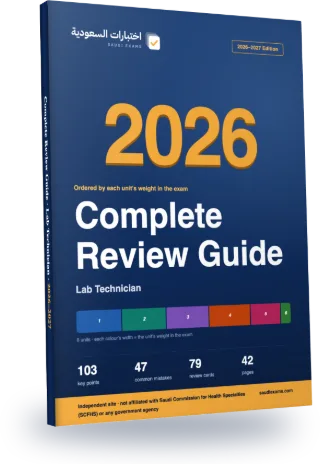
Lab Technician Complete Review Guide 2026–2027
Every exam topic in a 42-page Arabic PDF, ordered from the heaviest unit to the lightest. The first three chapters alone cover about 60% of the exam questions.
- 42Pages
- 103Key points
- 47Common mistakes
- 79Flashcards
Guide map
Each chapter is one exam unit, ordered by its weight in the real exam.
| Chapter | Unit | Weight | Exam questions | Key points |
|---|---|---|---|---|
| 1 | Microbiology | 20% | 30 | 17 |
| 2 | Clinical Chemistry | 20% | 30 | 18 |
| 3 | Hematology | 20% | 30 | 18 |
| 4 | Blood Bank | 20% | 30 | 18 |
| 5 | Immunology / Serology | 15% | 22 | 17 |
| 6 | Histo/Cyto-Techniques | 5% | 8 | 15 |
Chapter 1 in full: Microbiology
20% of the exam, about 30 questions. These are its key points, as in the guide.
- (Specimen collection) Collect specimens before antibiotics into a sterile container, label with name, date and specimen type, and transport promptly; reject a leaking or unlabeled container.
- (Specimen collection) Blood agar is nutrient and shows hemolysis; MacConkey is selective and differential for Gram-negative rods and shows lactose fermentation (pink colonies); chocolate agar supports Neisseria and Haemophilus.
- (Specimen collection) The autoclave uses steam at 121 °C for about 15 minutes under pressure; its performance is verified with the Geobacillus stearothermophilus biological indicator and chemical indicators.
The rest of chapter 1, on this page
- (Gram-positive bacteria) S. aureus: Gram-positive cocci in clusters, catalase- and coagulase-positive, beta-hemolytic; MRSA is methicillin-resistant.
- (Gram-positive bacteria) S. pyogenes (group A) is beta-hemolytic and bacitracin-sensitive; S. agalactiae (group B) is CAMP-positive and bacitracin-resistant, and is screened for in pregnancy.
- (Gram-positive bacteria) S. pneumoniae: alpha-hemolytic, optochin-sensitive, bile-soluble, lancet-shaped diplococci; the viridans group is optochin-resistant.
- (Gram-negative bacteria) Enterobacterales ferment glucose, are oxidase-negative and reduce nitrate; E. coli ferments lactose (pink on MacConkey) and is the commonest cause of urinary tract infection.
- (Gram-negative bacteria) Pseudomonas aeruginosa is a non-lactose fermenter, oxidase-positive, and produces a blue-green pigment (pyocyanin) with a grape-like odor.
- (Gram-negative bacteria) Neisseria are Gram-negative coffee-bean diplococci, oxidase-positive, growing on chocolate or Thayer-Martin agar; N. gonorrhoeae ferments glucose only, while N. meningitidis ferments glucose and maltose.
- (Anaerobes) Anaerobes grow without oxygen and are cultured in an anaerobic jar or chamber; abscesses and deep wounds are common specimen sources.
- (Anaerobes) Mycobacteria stain red on a blue background with Ziehl-Neelsen, are cultured on Löwenstein-Jensen medium and need weeks to grow; Mycobacterium tuberculosis causes tuberculosis.
- (Virology) Viruses replicate only inside cells and are diagnosed by antigen or antibody detection or PCR; hepatitis B is detected by HBsAg, and HBsAb indicates immunity.
- (Virology) HIV is screened first by ELISA and then confirmed with a supplementary test; the viral load is monitored by PCR.
- (Parasitology) Malaria is diagnosed with thin (species identification) and thick (detection) blood films stained with Giemsa; Plasmodium falciparum shows ring forms and crescent-shaped gametocytes.
- (Parasitology) Stool examination for parasites includes a direct saline and iodine mount and concentration techniques; Entamoeba histolytica cysts have several nuclei and the trophozoite engulfs red cells, while Giardia lamblia shows pear-shaped trophozoites and cysts.
- (Mycology) A KOH preparation dissolves cells and reveals fungi in skin and nail specimens; cultures grow on Sabouraud agar (acidic pH) at room temperature.
- (Mycology) Candida albicans is a yeast that forms germ tubes in serum within about two hours at 37 °C; Cryptococcus neoformans is a capsulated yeast shown with India ink.
Common mistakes in this chapter
- Do not mix catalase and coagulase: catalase separates staphylococci (positive) from streptococci (negative), while coagulase separates S. aureus from the other staphylococci.
- Oxidase is positive in Pseudomonas, Neisseria and Vibrio and negative in Enterobacterales; mixing them up loses an easy question.
- Over-decolorizing a Gram stain makes Gram-positive cells look Gram-negative; old cultures can also lose the purple stain.
- Blood cultures need skin disinfection before the draw and a sample taken before antibiotics start; skin contamination is the commonest cause of a false-positive culture.
- Mycobacteria stain poorly with Gram; the stain to choose is Ziehl-Neelsen or auramine, not Gram.
- Anaerobes do not grow with oxygen: transport the specimen in an anaerobic transport medium, not on a plain dry swab.
- Viruses do not grow on ordinary agar or show on Gram stain; they need cell culture, molecular or serologic testing.
- Filamentous fungi are incubated at room temperature (about 25 to 30 °C), while most yeasts and bacteria grow at 35 to 37 °C.
The other chapters are in the full guide
One purchase · lifetime access · review guide included
7-day review plan
The chapters are spread over 6 days by weight so each day carries a similar load. Day 7 is a full exam.
Day 1 · 20% of the exam
Chapter 1: Microbiology
Day 2 · 20% of the exam
Chapter 2: Clinical Chemistry
Day 3 · 20% of the exam
Chapter 3: Hematology
Day 4 · 20% of the exam
Chapter 4: Blood Bank
Day 5 · 15% of the exam
Chapter 5: Immunology / Serology
Day 6 · 5% of the exam
Chapter 6: Histo/Cyto-Techniques
Day 7
Full mock exam: 150 questions in 180 minutes, then review the common mistakes in the units where you lost marks.
How many correct answers do you need?
- Pass mark 55%83 correct out of 150
Before you read: see your score today
10 free questions from the main units, no sign-up. Then you know which chapter to start with.
Try 10 free questions and see your levelA look at each chapter
The first three key points of each chapter, as they appear in the guide (in Arabic in the PDF).
Chapter 1: Microbiology
- (Specimen collection) Collect specimens before antibiotics into a sterile container, label with name, date…
- (Specimen collection) Blood agar is nutrient and shows hemolysis; MacConkey is selective and differential…
- (Specimen collection) The autoclave uses steam at 121 °C for about 15 minutes under…
Chapter 2: Clinical Chemistry
- (General chemistry, photometry and specimen quality) Spectrophotometer parts: light source, wavelength selector (filter or…
- (General chemistry, photometry and specimen quality) Order of draw: blood culture, light blue (citrate)…
- (General chemistry, photometry and specimen quality) Internal quality control uses controls of known level…
Chapter 3: Hematology
- (Hematopoiesis, CBC and red cell indices) Red cell maturation runs rubriblast, prorubricyte, rubricyte, metarubricyte…
- (Hematopoiesis, CBC and red cell indices) MCV = Hct x 10 / RBC, in…
- (Hematopoiesis, CBC and red cell indices) RDW reflects variation in cell size (anisocytosis). It…
Chapter 4: Blood Bank
- (ABO, Rh and blood group genetics) ABO antigens are carbohydrates: H is the precursor…
- (ABO, Rh and blood group genetics) Subgroup A2 may carry anti-A1 in the serum;…
- (ABO, Rh and blood group genetics) In the Rh system D is the most…
Chapter 5: Immunology / Serology
- (Immune system, antigens and antibodies) An antigen reacts with an antibody, and an immunogen…
- (Immune system, antigens and antibodies) IgG is the most abundant serum class and crosses…
- (Immune system, antigens and antibodies) T cells carry CD3, helper T cells CD4 and…
Chapter 6: Histo/Cyto-Techniques
- (Fixation, tissue processing and microtomy) 10% neutral buffered formalin is the routine fixative, used…
- (Fixation, tissue processing and microtomy) Formalin fixes by cross-linking proteins, while alcohol fixes by…
- (Fixation, tissue processing and microtomy) Other fixatives
The full guide comes with lifetime access
The full guide (42 pages) is included with lifetime access to this exam, together with every question and full mock exam. Chapter 1 is free for everyone.
Questions about the guide
Is the guide free?
Chapter 1 is free to read on the guide page. The full guide comes with lifetime access to this exam; 7-day access does not include it.
Is it up to date for 2026–2027?
Yes. Unit weights and exam facts follow what the exam body last published, and the last check date is printed in the guide. If the standards change we update the file and buyers download the new version.
Does the guide have questions?
No. The guide covers key points and common mistakes; scoring, weak-area practice and full mock exams are on the site.
Can I read it on my phone?
Yes. A5 pages in a single column, with chapters linked from the contents.
- Pages
- 42
- Edition
- 1448 AH · 2026–2027
- Language
- Arabic
- Last updated
Full prep for this exam
All of this in one purchase.
- Full mock exam, same as the real one150 questions in 180 minutes. You get a total score and a score for every unit.
- Practice unit by unit554 questions, every option explained with its source. Starts with your weakest units.
- Complete Review Guide 2026–2027 (PDF)Ordered by each unit's weight in the exam. With lifetime access only.
Choose your access
Continue with your Google account and you go straight to the payment page.
You pay on the Waffo Pancake checkout page (in English). The amount is in US dollars and your bank converts it to riyals. One payment with no automatic renewal, by Visa, Mastercard (a mada card with either logo works too), Apple Pay or Google Pay. Your statement shows "WAFFO". Purchases are not refundable.