Lab Technician Syllabus: 6 Sections and Their Weights
The six Lab Technician exam sections with official weights, what each covers, how our 150-question mock exam splits them, and the official reference books.
- Questions and time
- 150 questions · 3 hours
- Pass mark
- 55%
- correct answers to pass (55%)
- 83 of 150
- Exam fee
- Paid to SCFHS online when you apply through Mumaris Plus; the amount is shown in your application
Start with 10 free questions to find what needs more work. No sign-up, with answer explanations.
Try 10 free questions and see your levelPut what you just read into practice
Start with 10 free questions to find what needs more work. No sign-up, with answer explanations.
Try 10 free questions and see your levelLast checked: 15 November 2026. Weights and content can change at any time, so check the classification exams page on the SCFHS website and the Laboratory Technician content guideline (PDF) before you start studying. This is an independent website, not affiliated with the Saudi Commission for Health Specialties, Prometric or Pearson VUE.
The SCFHS Laboratory Technician exam is a single exam with six sections. Four of them (Microbiology, Clinical Chemistry, Hematology and Blood Bank) carry 20% each, which is 80% of the exam. Use this page to decide where to start.
Exam format at a glance
| Item | Details |
|---|---|
| Questions | 150 multiple-choice questions |
| Time | 3 hours |
| Pass mark | 55% |
| Distribution | The real distribution can differ from the published weights by up to 5% (plus or minus) in each section |
| Exam language | English |
The six sections and their weights
SCFHS publishes one percentage per section. The last column is the split we use in our full mock exams (150 questions): the official percentage times 150, rounded to a whole number, so the total is 150.
| Section | Official weight | Questions in our mock exam |
|---|---|---|
| 1. Microbiology | 20% | 30 |
| 2. Clinical Chemistry | 20% | 30 |
| 3. Hematology | 20% | 30 |
| 4. Blood Bank | 20% | 30 |
| 5. Immunology / Serology | 15% | 22 |
| 6. Histo/Cyto-Techniques | 5% | 8 |
| Total | 100% | 150 |
The four large sections add up to 120 of 150 questions, Immunology is 22, and Histo/Cyto-Techniques is only 8. Our practice questions follow the same split, and your result is shown section by section.
A note on detail: the SCFHS guideline names the six sections and says what falls under two of them. It has no detailed topic list. The topic lists below are our own breakdown, built from those two notes and from the chapters of the reference books SCFHS names, and are not an official outline.
Section 1: Microbiology (20%, 30 questions)
SCFHS says this section includes bacteriology, virology, parasitology and mycology.
- Laboratory basics: specimen collection and transport, Gram and other stains, culture media, sterilization.
- Bacteria: Gram-positive (staphylococci, streptococci, bacilli), Gram-negative (Enterobacterales, non-fermenters, Neisseria, Haemophilus), anaerobes and mycobacteria, and the basics of antimicrobial susceptibility.
- Viruses, parasites and fungi: each is its own topic in the reference books, and questions usually ask you to identify the organism from its appearance or a test result.
How to prepare: start with bacteria, the largest share. Build a table for each organism with its Gram appearance, culture medium and the biochemical tests that separate it from look-alikes, then rebuild the table from memory. Give parasites (life cycle and diagnostic stage) and fungi short sessions of their own; there are fewer questions and they follow a similar pattern.
Section 2: Clinical Chemistry (20%, 30 questions)
SCFHS says this section includes general chemistry, hormones, urinalysis and body fluids.
- General chemistry: photometry and specimen quality; carbohydrates, lipids, proteins and non-protein nitrogen; enzymes and cardiac and liver markers; electrolytes, acid-base balance and renal function.
- Hormones.
- Urinalysis: physical and chemical examination by dipstick, and microscopy.
- Body fluids: for example cerebrospinal, synovial and serous fluids.
How to prepare: this section mixes memory and calculation. Give each group (lipids, enzymes, electrolytes, hormones) its own session, and practise the calculations on paper: dilutions, anion gap and the Friedewald equation for LDL. For hormones, link each one to its axis and to what a high or low result means. For urine and body fluids, learn casts and crystals from images and then test yourself on them.
Section 3: Hematology (20%, 30 questions)
- Hematopoiesis and the CBC: red cell indices (MCV, MCH, MCHC) and how to read them.
- Anemias and red cell disorders.
- White cells and leukemias.
- Hemostasis and coagulation: PT, APTT and the clotting factors.
- Platelets, manual methods and hematology quality control.
How to prepare: classify anemias by cell size first (microcytic, normocytic, macrocytic), then learn the causes of each group and what sets it apart on the blood smear. For the coagulation cascade, draw the pathways and mark where each test sits. Go through the smear images in the Clinical Hematology Atlas from the reference list, because many questions depend on recognising the cell.
Section 4: Blood Bank (20%, 30 questions)
- Blood groups: ABO, Rh and blood group genetics.
- Antibodies and compatibility: antibody screening, identification and crossmatching.
- Donation and components: donor selection, component preparation and storage conditions.
- Immune-mediated problems: transfusion reactions and immune-mediated conditions.
- Hemolytic disease of the fetus and newborn (HDFN) and Rh immune globulin (RhIG).
How to prepare: learn the ABO table (antigens and antibodies for each group, and which groups are compatible for red cells and for plasma) until you can write it from memory. Then work antibody panel questions step by step: rule out, then confirm. Practise "which component do you issue" questions and the RhIG decision for the mother, because these patterns repeat.
Section 5: Immunology / Serology (15%, 22 questions)
- The immune system: antigens and antibodies.
- Immune disorders: hypersensitivity, autoimmunity and immunodeficiency.
- Serologic methods: precipitation, agglutination and immunoassays.
- Infectious disease serology: syphilis, hepatitis and HIV.
How to prepare: understand each method's principle (what binds to what, and what we read) before memorising names. For viral hepatitis serology, write a table of what each marker means in acute infection, chronic infection and after vaccination, and practise reading panels.
Section 6: Histo/Cyto-Techniques (5%, 8 questions)
- Tissue preparation: fixation, processing and microtomy.
- Staining: routine and special stains, and cytology.
How to prepare: this is the smallest section, so give it no more than one or two sessions in the last week. Memorise the processing sequence (fixation, dehydration, clearing, wax infiltration, sectioning, staining) and which stain is used for which purpose.
Official reference list
SCFHS lists these books as a study aid only. It states that the list does not imply endorsement of these references, and that exam questions are not necessarily taken from them.
- Monica Cheesbrough, Laboratory Practice in Tropical Countries
- Meliyanthi M. Gunatillaka, Manual on Standard Operation Procedures, Sample Collection and Reference Ranges for Clinical Chemistry
- Christine Dorresteyn Stevens, Clinical Immunology and Serology
- McPherson, Henry's Clinical Diagnosis and Management by Laboratory Methods
- Denise M. Harmening, Modern Blood Banking and Transfusion Practices (6th ed., 2012; SCFHS also lists it as latest edition)
- Fischbach and Dunning, A Manual of Laboratory and Diagnostic Tests (9th ed.)
- Burtis and Bruns, Tietz Fundamentals of Clinical Chemistry and Molecular Diagnostics
- Greer et al., Wintrobe's Clinical Hematology (14th ed.)
- Mary Louise Turgeon, Clinical Laboratory Science
- Tille, Bailey and Scott's Diagnostic Microbiology (13th ed., 2013)
- Bishop, Fody and Schoeff, Clinical Chemistry: Techniques, Principles, Correlation (6th ed., 2010)
- Suvarna, Layton and Bancroft, Bancroft's Theory and Practice of Histological Techniques (8th ed.)
- Todd, Spickett and Fairclough, Lecture Notes: Immunology (7th ed.)
- Rodak and Carr, Clinical Hematology Atlas (5th ed.)
Where no edition is given, the SCFHS list means the latest edition.
How it differs from the SLLE
This is the technician exam: 150 questions, six sections and a 55% pass mark. The SLLE is the laboratory specialist exam, with 200 questions, nine sections and a pass score of 530 on a 200 to 800 scale. Do not study from the SLLE guide for this exam.
How our practice follows this syllabus
Our questions are in English, as in the real exam. The section split in our full mock exam is the one in the table above, and every practice set ends with your result in each section so you know where to start.
Finished reading? Try a set of questions
Start with 10 free questions to find your weakest units. Keep practising with the full question bank and mock exams from SAR 26.
Put the plan to work here
SAR 34 $9
One purchase · lifetime access · review guide included
- 554 questions, every option explained with its source
- Full mock exams: 150 questions in 180 minutes, like the real one
- Practice that starts with your weakest units, plus a review of your mistakes
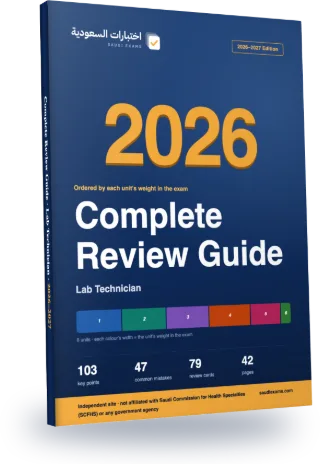 Complete Review Guide 2026–2027 included (PDF)Ordered by the weight of each unit in the examBuy now · SAR 34or 7 days for SAR 26
See everything included
Full mock exams like the real one and 554 explained questions that find your weak spots and train them
- Unlimited full mock exams to practise your pace and check your performance across the whole exam
- Practise 10 weak-area questions, starting where you lose the most marks
- 554 questions explaining why every option is right or wrong
- Arabic and English with one pass
- Unit notes and flashcards, then questions to check your understanding
This exam is part of professional classification as a laboratory technician, and you cannot get a practice licence without classification. If you do not pass you get further attempts under SCFHS rules and pay the evaluation fee. Source Last verified: 2026-11-15