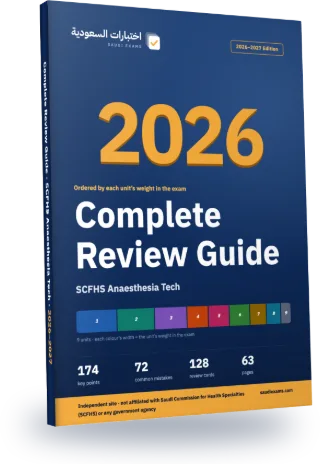
SCFHS Anaesthesia Tech Complete Review Guide 2026–2027
Every exam topic in a 63-page Arabic PDF, ordered from the heaviest unit to the lightest. The first three chapters alone cover about 50% of the exam questions.
- 63Pages
- 174Key points
- 72Common mistakes
- 128Flashcards
Guide map
Each chapter is one exam unit, ordered by its weight in the real exam.
| Chapter | Unit | Weight | Exam questions | Key points |
|---|---|---|---|---|
| 1 | General Anaesthesia | 18% | 27 | 20 |
| 2 | Anaesthesia Equipment | 17% | 26 | 20 |
| 3 | Respiratory/Airway | 15% | 23 | 20 |
| 4 | Cardiovascular | 10% | 15 | 20 |
| 5 | Transfusion | 10% | 15 | 20 |
| 6 | Resuscitation and Crisis | 10% | 15 | 20 |
| 7 | Regional Anaesthesia | 8% | 12 | 19 |
| 8 | Patient safety and Infection control | 7% | 10 | 19 |
| 9 | Ethics, Professionalism and Research | 5% | 7 | 16 |
Chapter 1 in full: General Anaesthesia
18% of the exam, about 27 questions. These are its key points, as in the guide.
- Balanced anaesthesia combines hypnosis, analgesia and muscle relaxation; relaxants ease intubation and surgical access but give neither sleep nor pain relief.
- Preoxygenation replaces lung nitrogen with oxygen, filling the FRC and prolonging safe apnoea time; end-tidal O₂ of about 90% or more shows it is adequate; obese patients desaturate faster.
- Rapid sequence induction shortens the time between loss of airway reflexes and a cuffed tube when aspiration risk exists; cricoid pressure of about 30 N is applied after loss of consciousness; avoid deep extubation with a full stomach or difficult airway.
The rest of chapter 1, on this page
- Pre-induction SOAP-ME: Suction (working, close), Oxygen, Airway, Pharmacy (labelled), Monitors (oximeter, ECG, BP, then capnography after intubation), Equipment; keep the cannula visible and accessible, and the table able to tilt head-down quickly.
- Propofol TIVA avoids volatiles and lowers PONV; a disconnected infusion line risks awareness; use a one-way valve on the fluid line; propofol 1% = 10 mg/mL.
- Sevoflurane suits inhalational induction in children (non-pungent, fast); avoid nitrous oxide in pneumothorax because it expands air spaces; raise fresh gas flow to change the volatile concentration faster.
- Common intra-op findings: a sudden ETCO₂ fall with falling BP suggests low cardiac output or embolism; ETCO₂ rises in laparoscopy from CO₂ absorption; for a high-pressure alarm trace from patient to machine for a kink or blockage.
- Emergence: need TOF 0.9 or more with adequate breathing and command response before extubation (0.7 means residual block); have suction, a mask with oxygen and airway equipment ready; manage laryngospasm with 100% oxygen and CPAP.
- Propofol is a white milky emulsion, discard if separated or discoloured; it stings on injection and lowers BP by vasodilation and reduced contractility; ketamine stimulates the sympathetic system and maintains BP; etomidate transiently suppresses the adrenal gland; dexmedetomidine sedates with little respiratory depression.
- Suxamethonium is stored in the fridge (2–8 °C) and avoided after burns or muscle injury because of hyperkalaemia; rocuronium is non-depolarising and reversed by sugammadex; atracurium breaks down by Hofmann elimination.
- Neostigmine is given with glycopyrrolate to block bradycardia and secretions; glycopyrrolate does not cross the blood–brain barrier so suits the elderly; naloxone reverses opioids, flumazenil reverses midazolam, ondansetron is a 5-HT₃ antagonist for nausea.
- A large fast fentanyl bolus can cause chest wall rigidity; fentanyl accumulates with long infusions whereas remifentanil is broken down rapidly (context-sensitive half-time); never flush residual drug in the cannula as it gives a bolus.
- Calculations: lidocaine 2% in a 10 mL ampoule = 200 mg; atropine 600 micrograms/mL for 300 micrograms = 0.5 mL; fentanyl 50 micrograms/mL for 100 micrograms = 2 mL; ephedrine 50 mg in 10 mL = 5 mg/mL; metaraminol 10 mg in 20 mL = 0.5 mg/mL; phenylephrine 10 mg in 100 mL = 100 micrograms/mL.
- Drug safety: read the label every time, label with drug name and concentration immediately after drawing up, discard syringes at the end of the case; the five rights are patient, drug, dose, route and time; check expiry and separate look-alikes.
- Controlled drugs such as fentanyl are stored locked, recorded and any waste witnessed; leftover syringes are discarded with a witness; high-alert drugs such as concentrated potassium are stored separately and reported if found on the trolley.
- The modified Aldrete score (activity, breathing, circulation, consciousness, SpO₂, each 0–2) needs 9 or more for PACU discharge; minimum monitoring on arrival is SpO₂, heart rate, BP and breathing rate with supplemental oxygen.
- The commonest airway obstruction is the tongue and soft tissue falling back (jaw thrust); snoring means upper airway obstruction; place an unconscious patient in the lateral position; remove the oral airway when gagging; remove a laryngeal mask when awake with suction ready.
- Recovery complications: shivering raises oxygen demand (active warming), hypertension prompts checks for pain, bladder and CO₂, vomiting needs the lateral position and suction, emergence delirium in children, urinary retention after spinal, and negative-pressure pulmonary oedema after laryngospasm.
- Oxygen devices: nasal cannulae 1–4 L/min; simple face mask at least 5 L/min; non-rebreather 15 L/min with the bag filled first (a collapsing bag means too little flow); high-flow nasal oxygen needs heated humidification; every recovery bay needs oxygen, suction, monitor and a self-inflating bag.
- After thyroidectomy, perioral and finger tingling means low calcium; neck swelling with stridor means a compressing haematoma needing urgent help; a patient with sleep apnoea needs continuous SpO₂ and his own CPAP.
Common mistakes in this chapter
- Suction is switched on and placed under the pillow within reach of the anaesthesiologist; test it, never assume it works.
- Preoxygenation delays desaturation during apnoea; an obese patient desaturates faster because of a smaller FRC and higher oxygen consumption.
- A flat capnograph after intubation means suspect oesophageal intubation first; a flat trace with a low-pressure alarm during the case is usually a disconnection.
- Sugammadex does not reverse suxamethonium or atracurium; it binds only the steroidal agents (rocuronium, vecuronium).
- Atracurium breaks down by Hofmann elimination, suiting renal and hepatic failure, and is stored in the fridge like suxamethonium.
- Drug safety: never assume; read the label, discard any unlabelled syringe, use a filter needle for glass ampoules, and check the strength when a drug (such as ketamine) is stocked in several concentrations.
- High-flow oxygen in a COPD patient may cause CO₂ retention and drowsiness; a simple face mask runs at no less than about 5 L/min to avoid rebreathing.
- Drowsiness with a respiratory rate of 6–7/min after morphine is opioid toxicity: stop the pump, alert the team and fetch naloxone; do not give drugs on your own.
The other chapters are in the full guide
One purchase · lifetime access · review guide included
7-day review plan
The chapters are spread over 6 days by weight so each day carries a similar load. Day 7 is a full exam.
Day 1 · 18% of the exam
Chapter 1: General Anaesthesia
Day 2 · 17% of the exam
Chapter 2: Anaesthesia Equipment
Day 3 · 15% of the exam
Chapter 3: Respiratory/Airway
Day 4 · 18% of the exam
Chapter 4: Cardiovascular
Chapter 7: Regional AnaesthesiaDay 5 · 17% of the exam
Chapter 5: Transfusion
Chapter 8: Patient safety and Infection controlDay 6 · 15% of the exam
Chapter 6: Resuscitation and Crisis
Chapter 9: Ethics, Professionalism and ResearchDay 7
Full mock exam: 150 questions in 180 minutes, then review the common mistakes in the units where you lost marks.
How many correct answers do you need?
- Pass mark 60%90 correct out of 150
Before you read: see your score today
10 free questions from the main units, no sign-up. Then you know which chapter to start with.
Try 10 free questions and see your levelA look at each chapter
The first three key points of each chapter, as they appear in the guide (in Arabic in the PDF).
Chapter 1: General Anaesthesia
- Balanced anaesthesia combines hypnosis, analgesia and muscle relaxation; relaxants ease intubation and surgical access…
- Preoxygenation replaces lung nitrogen with oxygen, filling the FRC and prolonging safe apnoea time;…
- Rapid sequence induction shortens the time between loss of airway reflexes and a cuffed…
Chapter 2: Anaesthesia Equipment
- A small oxygen cylinder mounts on the yoke with pins in positions 2 and…
- Pipeline gas pressure is about 4 bar (400 kPa, roughly 50–55 psi); wrong connections…
- The fail-safe valve shuts off or reduces other gases when oxygen supply pressure falls…
Chapter 3: Respiratory/Airway
- Mallampati
- Cormack–Lehane
- The cricoid is the only complete ring in the airway and the functionally narrowest…
Chapter 4: Cardiovascular
- Cardiac output = heart rate × stroke volume (80 × 70 mL = 5.6…
- Normal left ventricular ejection fraction is about 55–70%; by Frank–Starling, stroke volume rises as…
- SVR = (MAP − CVP) ÷ CO × 80 (e.g. (90−10) ÷ 5 ×…
Chapter 5: Transfusion
- Before the patient's group is known, use group O RhD negative red cells; AB…
- A group A patient receives A or O red cells; a group AB patient…
- Platelets are stored at 20–24 °C with continuous gentle agitation; cryoprecipitate is rich in…
Chapter 6: Resuscitation and Crisis
- Adult chest compressions
- Compression-to-ventilation ratio is 30
- VF and pulseless VT are shockable; PEA and asystole are not
Chapter 7: Regional Anaesthesia
- The adult cord ends about L1–L2, so spinals are done below that (often L3–L4);…
- The subarachnoid space is confirmed by free clear CSF; the epidural space is identified…
- Pencil-point needles spread rather than cut dural fibres and reduce post-dural puncture headache, which…
Chapter 8: Patient safety and Infection control
- Spaulding
- Sterilisation kills all microorganisms including spores, whereas high-level disinfection may leave some spores; both…
- Standard precautions apply to all patients regardless of diagnosis and include hand hygiene, gloves…
Chapter 9: Ethics, Professionalism and Research
- Confidentiality means sharing patient information only with those who need it for care or…
- Dignity and respect
- Consent for anaesthesia is obtained by the doctor who explains risks and alternatives; a…
The full guide comes with lifetime access
The full guide (63 pages) is included with lifetime access to this exam, together with every question and full mock exam. Chapter 1 is free for everyone.
Questions about the guide
Is the guide free?
Chapter 1 is free to read on the guide page. The full guide comes with lifetime access to this exam; 7-day access does not include it.
Is it up to date for 2026–2027?
Yes. Unit weights and exam facts follow what the exam body last published, and the last check date is printed in the guide. If the standards change we update the file and buyers download the new version.
Does the guide have questions?
No. The guide covers key points and common mistakes; scoring, weak-area practice and full mock exams are on the site.
Can I read it on my phone?
Yes. A5 pages in a single column, with chapters linked from the contents.
- Pages
- 63
- Edition
- 1448 AH · 2026–2027
- Language
- Arabic
- Last updated
All Health Exams review guides
Back to SCFHS Classification Exam – Anaesthesia Technologist (Specialist)
Buy this exam
Pick the access that lasts until your test date.
Included
- Full mock exams: 150 questions in 180 minutes, with a score for every unit
- 785 questions, every option explained with its source
- Practice that starts with your weakest units, plus a review of your mistakes
- Complete Review Guide 2026–2027 (PDF), with lifetime access only
Continue with your Google account and you go straight to the payment page.
You pay on the Waffo Pancake checkout page (in English). The amount is in US dollars and your bank converts it to riyals. One payment with no automatic renewal, by Visa, Mastercard (a mada card with either logo works too), Apple Pay or Google Pay. Your statement shows "WAFFO". Purchases are not refundable.