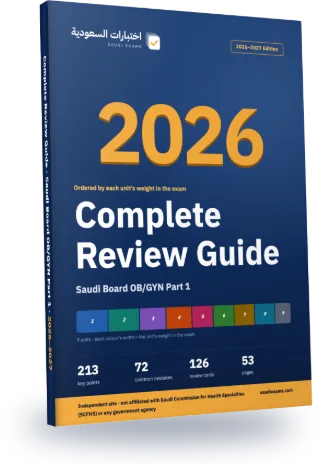
Saudi Board OB/GYN Part 1 Complete Review Guide 2026–2027
Every exam topic in a 53-page Arabic PDF, ordered from the heaviest unit to the lightest. The first three chapters alone cover about 40% of the exam questions.
- 53Pages
- 213Key points
- 72Common mistakes
- 126Flashcards
Guide map
Each chapter is one exam unit, ordered by its weight in the real exam.
| Chapter | Unit | Weight | Exam questions | Key points |
|---|---|---|---|---|
| 1 | Anatomy | 14% | 21 | 24 |
| 2 | Normal Pregnancy (Fetal/Placental/Parturition) | 14% | 21 | 24 |
| 3 | Physiology | 12% | 18 | 24 |
| 4 | Endocrinology & Reproduction | 12% | 18 | 24 |
| 5 | Embryology/Genetics | 10% | 15 | 24 |
| 6 | Pharmacology | 10% | 15 | 24 |
| 7 | Pathology/Histology | 10% | 15 | 23 |
| 8 | Microbiology/Immunology | 10% | 15 | 22 |
| 9 | Biochemistry | 8% | 12 | 24 |
Chapter 1 in full: Anatomy
14% of the exam, about 21 questions. These are its key points, as in the guide.
- The obstetric conjugate runs from the sacral promontory to the nearest point behind the symphysis; normally at least 10 cm. Below 10 cm defines inlet contraction.
- The interspinous diameter is about 10 cm, the narrowest pelvic dimension. Station 0 is defined at the level of the ischial spines.
- Gynecoid pelvis: round inlet, straight side walls, blunt spines and a wide subpubic arch. It is the most favourable for vaginal birth.
The rest of chapter 1, on this page
- Android pelvis: prominent spines, convergent walls and a narrow arch. It predisposes to deep transverse arrest.
- Platypelloid pelvis: short AP and wide transverse inlet. The head engages transversely and may fail to enter the inlet.
- Outlet contraction: intertuberous diameter of 8 cm or less. The head is pushed back onto the perineum and tears become more likely.
- The uterine artery comes from the anterior division of the internal iliac artery. The ovarian artery arises from the aorta below the renal arteries.
- Ovarian vessels run in the infundibulopelvic ligament. It is secured at oophorectomy after the ureter is identified.
- The cardinal ligament is the main lateral support of the cervix and vaginal apex, and carries the uterine vessels.
- The round ligament passes through the inguinal canal to the labium majus. Its stretch causes sharp groin pain in pregnancy.
- Cervical lymph drains to parametrial, obturator and iliac nodes. Ovarian lymph follows the ovarian vessels to para-aortic nodes.
- Fundal and cornual lymph can follow the round ligament to superficial inguinal nodes. Vulval lesions within 2 cm of the midline may drain to both groins.
- The pudendal nerve (S2 to S4) curves around the ischial spine and sacrospinous ligament. Inject just medial and posterior to the spine, aspirating first.
- Puborectalis slings around the anorectal junction and keeps the anorectal angle. It is maximally stretched at crowning.
- POP-Q uses the hymen as zero. Point C at +3 means failure of apical (level I) support, the cardinal-uterosacral complex.
- The right ovarian vein drains into the IVC, so postpartum right ovarian vein thrombosis can extend into it.
- Near the cervix the ureter passes beneath the uterine artery, 1.5 to 2 cm lateral. Clamping the uterine pedicle here is the commonest cause of injury.
- At the pelvic brim the ureter crosses the iliac bifurcation, medial to the ovarian vessels. See it before sealing them.
- A low transverse uterine incision bleeds less and carries a lower later rupture risk than a classical incision.
- In thin women the aortic bifurcation lies close below the umbilicus, so angle the Veress needle about 45° caudally. After midline laparotomies, use Palmer's point.
- Pelvic splanchnic nerves (S2 to S4) are parasympathetic and contract the detrusor. Damage to the inferior hypogastric plexus at radical hysterectomy causes retention.
- Below the arcuate line there is no posterior rectus sheath, only transversalis fascia and peritoneum. A rectus sheath haematoma can spread into the prevesical space.
- Inferior epigastric vessels lie in the lateral umbilical fold; place lateral ports outside them under vision. Close fascia at ports of 10 mm or more.
- About 75% of breast lymph drains to axillary nodes. The long thoracic nerve lies on the medial axillary wall; injury causes a winged scapula.
Common mistakes in this chapter
- The diagonal conjugate is confused with the obstetric conjugate. The diagonal is measured clinically; subtract 1.5 to 2 cm to estimate the obstetric conjugate.
- The ureter is often placed above the uterine artery. It passes beneath it (water under the bridge), about 1.5 to 2 cm lateral to the cervix.
- Both ovarian veins are assumed to drain into the IVC. The right drains into the IVC; the left drains into the left renal vein.
- The ureter is often named as the most injured urinary organ in gynaecological surgery. The bladder is injured more often.
- Methylene blue test: a wet but unstained tampon means a ureterovaginal fistula; a blue tampon means a vesicovaginal fistula.
- A T10 to L1 epidural block is assumed to cover the second stage. Perineal pain travels in the pudendal nerve and needs S2 to S4.
- Internal iliac ligation is thought to stop pelvic flow. It mainly lowers distal pulse pressure, and collateral flow is preserved.
- More than 50% of the external sphincter torn with an intact internal sphincter is 3b, not 3a; anorectal epithelium involvement is fourth degree.
The other chapters are in the full guide
One purchase · lifetime access · review guide included
7-day review plan
The chapters are spread over 6 days by weight so each day carries a similar load. Day 7 is a full exam.
Day 1 · 14% of the exam
Chapter 1: Anatomy
Day 2 · 14% of the exam
Chapter 2: Normal Pregnancy (Fetal/Placental/Parturition)
Day 3 · 20% of the exam
Chapter 3: Physiology
Chapter 9: BiochemistryDay 4 · 12% of the exam
Chapter 4: Endocrinology & Reproduction
Day 5 · 20% of the exam
Chapter 5: Embryology/Genetics
Chapter 7: Pathology/HistologyDay 6 · 20% of the exam
Chapter 6: Pharmacology
Chapter 8: Microbiology/Immunology
How many correct answers do you need?
- Pass mark 65%98 correct out of 150
Before you read: see your score today
10 free questions from the main units, no sign-up. Then you know which chapter to start with.
Try 10 free questions and see your levelA look at each chapter
The first three key points of each chapter, as they appear in the guide (in Arabic in the PDF).
Chapter 1: Anatomy
- The obstetric conjugate runs from the sacral promontory to the nearest point behind the…
- The interspinous diameter is about 10 cm, the narrowest pelvic dimension. Station 0 is…
- Gynecoid pelvis
Chapter 2: Normal Pregnancy (Fetal/Placental/Parturition)
- The umbilical vein carries the most oxygenated blood to the fetus; the two umbilical…
- The foramen ovale shunts IVC blood from right to left atrium and closes functionally…
- HbF binds 2,3-DPG poorly, raising its oxygen affinity.
Chapter 3: Physiology
- Cardiac output rises by about 30 to 50% through stroke volume and heart rate…
- Systemic vascular resistance falls, so blood pressure reaches its nadir in mid-pregnancy.
- Plasma volume rises 40 to 50% and red cell mass 20 to 30%, causing…
Chapter 4: Endocrinology & Reproduction
- Fertilisation occurs in the tubal ampulla; sperm need capacitation before penetrating the zona pellucida.
- Cortical granule release modifies ZP2 and ZP3 and blocks a second sperm.
- At ovulation the oocyte is at metaphase II of meiosis; it completes meiosis after…
Chapter 5: Embryology/Genetics
- Sperm undergo capacitation in the female tract, which allows the acrosome reaction.
- After one sperm enters, cortical granule release alters the zona pellucida (zona reaction) and…
- The inner cell mass forms the embryo; the trophoblast forms the placenta.
Chapter 6: Pharmacology
- Combined pills prevent ovulation by suppressing GnRH pulses and the midcycle LH surge.
- The etonogestrel implant blocks ovulation. The LNG-IUS 52 mg acts locally on endometrium and…
- Irregular bleeding on progestogen methods comes from an atrophic endometrium with fragile vessels.
Chapter 7: Pathology/Histology
- A fibroid is a benign monoclonal tumour of myometrial smooth muscle.
- Fibroid degeneration
- Red degeneration is haemorrhagic infarction as rapid growth in pregnancy outstrips blood supply.
Chapter 8: Microbiology/Immunology
- Lactobacilli dominate vaginal flora and keep pH at 3.8 to 4.5.
- Amsel criteria for BV
- BV is treated with metronidazole.
Chapter 9: Biochemistry
- All steroids come from cholesterol. The rate-limiting step is StAR-mediated transfer of cholesterol into…
- Steroids act through intracellular receptors that regulate gene transcription.
- 3β-HSD converts Δ5 to Δ4 steroids, such as pregnenolone to progesterone and DHEA to…
The full guide comes with lifetime access
The full guide (53 pages) is included with lifetime access to this exam, together with every question and full mock exam. Chapter 1 is free for everyone.
Questions about the guide
Is the guide free?
Chapter 1 is free to read on the guide page. The full guide comes with lifetime access to this exam; 7-day access does not include it.
Is it up to date for 2026–2027?
Yes. Unit weights and exam facts follow what the exam body last published, and the last check date is printed in the guide. If the standards change we update the file and buyers download the new version.
Does the guide have questions?
No. The guide covers key points and common mistakes; scoring, weak-area practice and full mock exams are on the site.
Can I read it on my phone?
Yes. A5 pages in a single column, with chapters linked from the contents.
- Pages
- 53
- Edition
- 1448 AH · 2026–2027
- Language
- Arabic
- Last updated
All Health Exams review guides
Back to Saudi Board Part One Examination – Obstetrics & Gynaecology
Buy this exam
Pick the access that lasts until your test date.
Included
- Timed supplementary practice sessions: 150 questions in 90 minutes
- 515 questions, every option explained with its source
- Practice that starts with your weakest units, plus a review of your mistakes
- Complete Review Guide 2026–2027 (PDF), with lifetime access only
Continue with your Google account and you go straight to the payment page.
You pay on the Waffo Pancake checkout page (in English). The amount is in US dollars and your bank converts it to riyals. One payment with no automatic renewal, by Visa, Mastercard (a mada card with either logo works too), Apple Pay or Google Pay. Your statement shows "WAFFO". Purchases are not refundable.