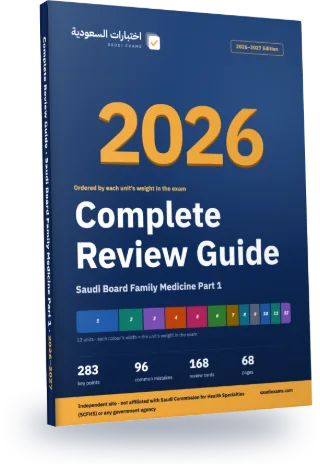
Saudi Board Family Medicine Part 1 Complete Review Guide 2026–2027
Every exam topic in a 68-page Arabic PDF, ordered from the heaviest unit to the lightest. The first three chapters alone cover about 40% of the exam questions.
- 68Pages
- 283Key points
- 96Common mistakes
- 168Flashcards
Guide map
Each chapter is one exam unit, ordered by its weight in the real exam.
| Chapter | Unit | Weight | Exam questions | Key points |
|---|---|---|---|---|
| 1 | Family Medicine | 19% | 29 | 24 |
| 2 | Internal Medicine | 11% | 17 | 24 |
| 3 | Pediatric | 10% | 15 | 23 |
| 4 | Obstetrics and Gynecology | 10% | 15 | 24 |
| 5 | Emergency Medicine (Adult and Pediatric) | 10% | 15 | 24 |
| 6 | Psychiatry | 9% | 14 | 23 |
| 7 | General Surgery | 6% | 9 | 23 |
| 8 | Dermatology | 5% | 8 | 22 |
| 9 | Orthopedic and Musculoskeletal | 5% | 7 | 23 |
| 10 | Ophthalmology | 5% | 7 | 24 |
| 11 | Otolaryngology | 5% | 7 | 24 |
| 12 | Radiology | 5% | 7 | 25 |
Chapter 1 in full: Family Medicine
19% of the exam, about 29 questions. These are its key points, as in the guide.
- Let the patient finish the opening statement uninterrupted, then ask 'Is there something else?' to set the full agenda early.
- A 'doorknob' disclosure may be the key problem. Reopen the consultation and assess exertional chest pain now.
- For brief undifferentiated symptoms without red flags, use time as a diagnostic tool with safety-netting and planned review.
The rest of chapter 1, on this page
- SPIKES: Setting, Perception, Invitation, Knowledge, Emotions, then Strategy and Summary.
- Stages of change: precontemplation, contemplation, preparation (plans to act within a month and has taken steps), action, maintenance.
- Capacity means the patient understands, retains, weighs and communicates a choice. If present, respect the decision even when treatment is refused.
- After a medical error: honest disclosure, apology and explanation of next steps, then report the incident.
- Lung cancer screening (USPSTF 2021): annual low-dose CT at age 50–80 with at least 20 pack-years who smoke now or quit within 15 years.
- AAA: one-time ultrasound for men aged 65–75 who ever smoked. A diameter of 3.0–3.9 cm is followed every 3 years.
- Colorectal cancer: average-risk screening starts at 45. Any positive FIT needs colonoscopy.
- First-degree relative with colorectal cancer before 60: colonoscopy from age 40 or 10 years before the youngest diagnosis, repeated every 5 years.
- Cervical (USPSTF 2018): cytology every 3 years at 21–29; stop after 65 if prior screening was adequate and negative.
- Breast (USPSTF 2024): mammography every 2 years at age 40–74 for average-risk women.
- Osteoporosis: DXA for women 65 and older. A T-score of −2.5 or lower means osteoporosis; first-line treatment is alendronate.
- Screen adults aged 35–70 with overweight or obesity for prediabetes and diabetes. Without symptoms, diagnosis needs two abnormal results.
- Statin for primary prevention at 40–75 with at least one risk factor and 10-year risk of 10% or more. Do not start aspirin for primary prevention at 60 or older.
- Tetanus: a contaminated wound with 3 or more prior doses and the last over 5 years ago needs Td or Tdap only, without immune globulin.
- PPV = true positives ÷ all positives. Specificity = true negatives ÷ all without disease.
- LR+ = sensitivity ÷ (1 − specificity). For post-test probability, convert to odds, multiply by LR, then convert back.
- NNT = 1 ÷ absolute risk reduction (ARR). Relative risk reduction (RRR) = ARR ÷ control risk.
- A 95% CI for a ratio that excludes 1 means p < 0.05. Type I error is a false positive; type II error misses a real difference.
- Intention-to-treat analysis preserves randomisation. Allocation concealment prevents selection bias at enrolment.
- COPD needs post-bronchodilator FEV1/FVC below 0.70. Asthma reversibility is an FEV1 rise of 12% and 200 mL or more.
- Stop metformin at eGFR below 30. Add an SGLT2 inhibitor in CKD with eGFR 20 or more and ACR 20 mg/mmol or more, even without diabetes.
Common mistakes in this chapter
- Early reassurance or imaging to settle anxiety is often chosen. The right step is to explore the patient's concern first and avoid imaging without red flags.
- Sensitivity is confused with PPV. Sensitivity does not change with prevalence, but PPV falls when prevalence is low, as in primary care.
- SnNout and SpPin are often reversed. A negative highly sensitive test rules disease out, and a positive highly specific test rules it in.
- Lead-time bias is confused with length-time bias. Lead time lengthens measured survival without delaying death; length time over-detects slow-growing tumours.
- Using the odds ratio for a cohort study is a common error. Cohort studies give relative risk; case-control studies give the odds ratio.
- Diagnosing CKD from one eGFR reading is wrong. Repeat within 3 months to confirm chronicity and exclude acute kidney injury.
- Stopping allopurinol during a gout flare is often chosen. It should continue, and the flare is treated separately.
- A child or relative is not a suitable interpreter. Use a professional interpreter whenever one is available, for accuracy and confidentiality.
The other chapters are in the full guide
One purchase · lifetime access · review guide included
7-day review plan
The chapters are spread over 6 days by weight so each day carries a similar load. Day 7 is a full exam.
Day 1 · 19% of the exam
Chapter 1: Family Medicine
Day 2 · 16% of the exam
Chapter 2: Internal Medicine
Chapter 11: OtolaryngologyDay 3 · 20% of the exam
Chapter 3: Pediatric
Chapter 8: Dermatology
Chapter 12: RadiologyDay 4 · 15% of the exam
Chapter 4: Obstetrics and Gynecology
Chapter 9: Orthopedic and MusculoskeletalDay 5 · 15% of the exam
Chapter 5: Emergency Medicine (Adult and Pediatric)
Chapter 10: OphthalmologyDay 6 · 15% of the exam
Chapter 6: Psychiatry
Chapter 7: General Surgery
How many correct answers do you need?
- Pass mark 65%98 correct out of 150
Before you read: see your score today
10 free questions from the main units, no sign-up. Then you know which chapter to start with.
Try 10 free questions and see your levelA look at each chapter
The first three key points of each chapter, as they appear in the guide (in Arabic in the PDF).
Chapter 1: Family Medicine
- Let the patient finish the opening statement uninterrupted, then ask 'Is there something else?'…
- A 'doorknob' disclosure may be the key problem. Reopen the consultation and assess exertional…
- For brief undifferentiated symptoms without red flags, use time as a diagnostic tool with…
Chapter 2: Internal Medicine
- AHA/ACC
- A small cuff on a large arm overestimates pressure. The bladder should encircle about…
- First-line classes
Chapter 3: Pediatric
- Faltering growth (NICE NG75)
- Mid-parental height for boys
- Familial short stature
Chapter 4: Obstetrics and Gynecology
- GDM (IADPSG/WHO 2013)
- After GDM
- Pre-eclampsia
Chapter 5: Emergency Medicine (Adult and Pediatric)
- Adult chest compressions
- VF is shockable. PEA is organised electrical activity without a pulse, non-shockable; treat with…
- Adrenaline 1 mg IV
Chapter 6: Psychiatry
- Major depression
- GAD
- Moderate depression
Chapter 7: General Surgery
- Appendicitis
- Acute cholecystitis
- Cholangitis
Chapter 8: Dermatology
- Atopic eczema
- Plaque psoriasis
- First-line topical psoriasis treatment
Chapter 9: Orthopedic and Musculoskeletal
- Acute non-specific back pain
- STarT Back at first contact. High risk
- Cauda equina
Chapter 10: Ophthalmology
- Infective conjunctivitis
- Seasonal allergic conjunctivitis
- Angle-closure glaucoma
Chapter 11: Otolaryngology
- Uncomplicated otitis externa
- Necrotising otitis externa
- Earwax
Chapter 12: Radiology
- Ottawa knee rule
- Pregnant woman with renal colic
- Suspected DVT (Wells 2 or more)
The full guide comes with lifetime access
The full guide (68 pages) is included with lifetime access to this exam, together with every question and full mock exam. Chapter 1 is free for everyone.
Questions about the guide
Is the guide free?
Chapter 1 is free to read on the guide page. The full guide comes with lifetime access to this exam; 7-day access does not include it.
Is it up to date for 2026–2027?
Yes. Unit weights and exam facts follow what the exam body last published, and the last check date is printed in the guide. If the standards change we update the file and buyers download the new version.
Does the guide have questions?
No. The guide covers key points and common mistakes; scoring, weak-area practice and full mock exams are on the site.
Can I read it on my phone?
Yes. A5 pages in a single column, with chapters linked from the contents.
- Pages
- 68
- Edition
- 1448 AH · 2026–2027
- Language
- Arabic
- Last updated
Buy this exam
Pick the access that lasts until your test date.
Included
- Timed supplementary practice sessions: 150 questions in 90 minutes
- 750 questions, every option explained with its source
- Practice that starts with your weakest units, plus a review of your mistakes
- Complete Review Guide 2026–2027 (PDF), with lifetime access only
Continue with your Google account and you go straight to the payment page.
You pay on the Waffo Pancake checkout page (in English). The amount is in US dollars and your bank converts it to riyals. One payment with no automatic renewal, by Visa, Mastercard (a mada card with either logo works too), Apple Pay or Google Pay. Your statement shows "WAFFO". Purchases are not refundable.