PGAT
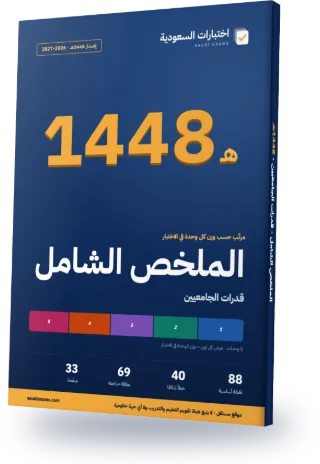
PGAT Complete Review Guide 2026–2027
Every exam topic in a 33-page Arabic PDF, ordered from the heaviest unit to the lightest. The first three chapters alone cover about 60% of the exam questions.
- 33Pages
- 88Key points
- 40Common mistakes
- 69Flashcards
Guide map
Each chapter is one exam unit, ordered by its weight in the real exam.
| Chapter | Unit | Weight | Exam questions | Key points |
|---|---|---|---|---|
| 1 | Verbal | 20% | 24 | 18 |
| 2 | Quantitative | 20% | 24 | 18 |
| 3 | Critical thinking | 20% | 24 | 18 |
| 4 | Figures | 20% | 24 | 16 |
| 5 | Logic | 20% | 24 | 18 |
Chapter 1 in full: Verbal
20% of the exam, about 24 questions. These are its key points, as in the guide.
- The verbal components listed on the ETEC website: semantic relations, linguistic structures and comprehension.
- There are four verbal question types: verbal analogy, sentence completion, contextual error and reading comprehension.
- The test has 120 questions in two hours and five minutes, is computer-based and Arabic-only, and each section has 24 questions according to ETEC; that averages roughly one minute per question.
The rest of chapter 1, on this page
- Common analogy relations: synonymy, antonymy, gradation in intensity, part and whole, necessary place, cause and effect, tool and function, maker and product, thing and attribute, and general and specific.
- Gradation: two words from the same semantic field where the second is more intense, such as «inclination : infatuation» and «jog : run».
- Necessary place: the thing exists only in that place, as in «fish : water» and «planet : space»; this differs from a usual but non-exclusive place, as in «medicine : pharmacy».
- Analogy steps: phrase the relation as a sentence, apply it to each option, check the direction of the pair, then tighten the wording with an extra condition if more than one option fits.
- Contrast connectives (but, rather, however, despite) make what follows oppose what precedes; result connectives (therefore, so, hence) make what follows a consequence of what precedes.
- Reason connectives (because, since, due to) make what follows the cause of what precedes, and the pattern «it is not enough to... rather...» requires the second element to go further than the first.
- Restriction patterns such as «not... except» make what follows «except» the sole condition or cause of what precedes, e.g. people will only advance through knowledge.
- Sentence-completion steps: read the whole sentence, identify its direction, predict the word before looking at the options, then reread the sentence with your choice.
- In contextual-error questions the candidate words are marked in the sentence, and you must pick the one word whose meaning clashes with the overall sense.
- Recurring contextual-error patterns: a word in place of its opposite, an attribute that does not suit its subject, a reversed direction of movement (decline instead of aspire), and a result that does not follow from its cause.
- Solving a contextual error starts with the sentence's main idea: words that serve that idea are sound, and the word that undermines it is the error.
- A reading passage usually carries several questions, so the time spent reading it is shared across them; skim the questions first to guide your reading.
- «Emphasis» between two phrases: the second shares and reinforces the meaning of the first, as with «high standing» and «firm footing»; «general and specific» means one is contained within the other.
- A literal expression conveys its real meaning without metaphor or metonymy, such as «exceptional ability»; «high heel» and «firm footing» are idioms for mastery.
- A pronoun's referent is usually in the preceding sentence; check it by putting the noun in place of the pronoun and rereading.
Common mistakes in this chapter
- The same-topic trap: an option from the same subject area as the stem words does not share the same relation; what matters is the type of link between the words, not their meaning.
- Ignoring word order: «ink : pen» is not the same as «pen : ink»; if the relation fits an option only in reverse, that option is wrong.
- Confusing synonyms with degree: «happiness : delight» are synonyms, whereas «jog : run» share a field but the second is more intense; one cannot stand in for the other.
- Hunting for a spelling or grammar mistake in contextual-error questions: the sentence is grammatically sound, and the target word is correct Arabic in itself but contradicts the overall meaning.
- Picking what is true in reality rather than in the passage: many options are factually true statements the passage never makes, and they are the most common reading trap.
- Settling for the dictionary meaning: the question asks for the meaning in context, as with «al-mutarjimūn», which in a passage about a scholar's life means biographers, not translators.
- Choosing an option broader than required: meaning and relation questions often include a wider term than intended (historians instead of biographers); the right answer is the one that fits the context most precisely.
- Missing negation and exception words in the question, such as «which is NOT among them» or «which the passage does NOT support», and choosing a statement the passage does contain when the opposite is required.
The other chapters are in the full guide
One purchase · lifetime access · review guide included
7-day review plan
The chapters are spread over 6 days by weight so each day carries a similar load. Day 7 is a full exam.
Day 1 · 20% of the exam
Chapter 1: Verbal
Day 2 · 20% of the exam
Chapter 2: Quantitative
Day 3 · 20% of the exam
Chapter 3: Critical thinking
Day 4 · 20% of the exam
Chapter 4: Figures
Day 5 · 20% of the exam
Chapter 5: Logic
Day 6
Full mock exam: 120 questions in 125 minutes, then review the common mistakes in the units where you lost marks.
Before you read: see your score today
10 free questions from the main units, no sign-up. Then you know which chapter to start with.
Try 10 free questions and see your levelA look at each chapter
The first three key points of each chapter, as they appear in the guide (in Arabic in the PDF).
Chapter 1: Verbal
- The verbal components listed on the ETEC website
- There are four verbal question types
- The test has 120 questions in two hours and five minutes, is computer-based and…
Chapter 2: Quantitative
- Calculators are not allowed; the test is digital and in Arabic only. With 120…
- Percentage = part ÷ whole × 100, and percent change = (new − old)…
- Handy fractions as percentages
Chapter 3: Critical thinking
- An argument consists of premises (reasons and evidence) and a conclusion; the conclusion is…
- Conclusion indicators
- An assumption is an unstated premise the argument relies on; if it is false…
Chapter 4: Figures
- Timing
- The most common sequence rules
- Turning by 90° steps returns the figure to its start after 4 steps, and…
Chapter 5: Logic
- The Education and Training Evaluation Commission's website defines the Logic part as covering methods…
- Official booklet (2017)
- Order relations are transitive
The full guide comes with lifetime access
The full guide (33 pages) is included with lifetime access to this exam, together with every question and full mock exam. Chapter 1 is free for everyone.
Questions about the guide
Is the guide free?
Chapter 1 is free to read on the guide page. The full guide comes with lifetime access to this exam; 7-day access does not include it.
Is it up to date for 2026–2027?
Yes. Unit weights and exam facts follow what the exam body last published, and the last check date is printed in the guide. If the standards change we update the file and buyers download the new version.
Does the guide have questions?
No. The guide covers key points and common mistakes; scoring, weak-area practice and full mock exams are on the site.
Can I read it on my phone?
Yes. A5 pages in a single column, with chapters linked from the contents.
- Pages
- 33
- Edition
- 1448 AH · 2026–2027
- Language
- Arabic
- Last updated
Buy this exam
Pick the access that lasts until your test date.
Included
- Full mock exams: 120 questions in 125 minutes, with a score for every unit
- 1024 questions, every option explained with its source
- Practice that starts with your weakest units, plus a review of your mistakes
- Complete Review Guide 2026–2027 (PDF), with lifetime access only
Continue with your Google account and you go straight to the payment page.
You pay on the Waffo Pancake checkout page (in English). The amount is in US dollars and your bank converts it to riyals. One payment with no automatic renewal, by Visa, Mastercard (a mada card with either logo works too), Apple Pay or Google Pay. Your statement shows "WAFFO". Purchases are not refundable.