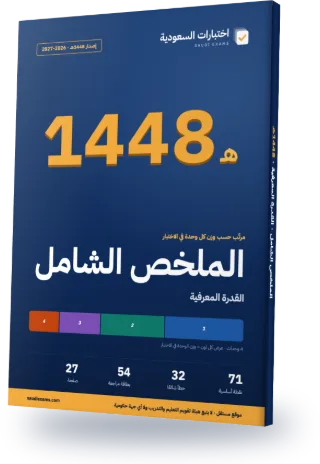
Cognitive Ability Complete Review Guide 2026–2027
Every exam topic in a 27-page Arabic PDF, ordered from the heaviest unit to the lightest. The first three chapters alone cover about 85% of the exam questions.
- 27Pages
- 71Key points
- 32Common mistakes
- 54Flashcards
Guide map
Each chapter is one exam unit, ordered by its weight in the real exam.
| Chapter | Unit | Weight | Exam questions | Key points |
|---|---|---|---|---|
| 1 | Quantitative Ability | 35% | 35 | 18 |
| 2 | Verbal Ability | 30% | 30 | 18 |
| 3 | Reasoning Ability | 20% | 20 | 17 |
| 4 | Spatial Ability | 15% | 15 | 18 |
Chapter 1 in full: Quantitative Ability
35% of the exam, about 35 questions. These are its key points, as in the guide.
- Order of operations (arithmetic): brackets first, then multiplication and division from left to right, then addition and subtraction from left to right.
- Fraction–percentage equivalents (fractions): one half 50%, one quarter 25%, one fifth 20%, one eighth 12.5%, three eighths 37.5%, one tenth 10%, one third about 33.3%.
- Percentage shortcut (percentages): x% of y = y% of x; for example, 18% of 50 = 50% of 18 = 9.
The rest of chapter 1, on this page
- Profit and loss (percentages): selling price = cost × (1 + profit rate) or × (1 − loss rate), and cost = selling price ÷ that same factor.
- Successive changes (percentages): multiply the change factors in order; a 20% then 10% discount = 0.8 × 0.9 = 0.72, i.e. a total discount of 28%.
- Dividing in a ratio (ratio and proportion): add the parts of the ratio, divide the total by that sum to get the value of one part, then multiply by each share's parts.
- Inverse proportion (ratio and proportion): workers × days = a fixed amount of work; when three quantities change together, multiply by the direct factor and divide by the inverse one.
- Joint work (word problems): add the work rates; if one finishes in a hours and the other in b hours, together they take (a × b) ÷ (a + b); when one fills and the other drains, subtract the rates.
- Motion of two bodies (word problems): in the same direction subtract the speeds, in opposite directions add them, then apply distance = speed × time.
- Ages (word problems): the age difference between two people never changes, and each person ages by the same number of years; write both current ages, then add or subtract the years from both.
- Days of the week (word problems): divide the number of days by 7; the remainder is how many days to count forward from the given day, and with no remainder it is the same weekday.
- Unit conversion (arithmetic): 1 km = 1000 m, 1 m = 100 cm, 1 kg = 1000 g, 1 litre = 1000 ml, 1 hour = 60 minutes = 3600 seconds, 1 riyal = 100 halalas; multiply when going from larger to smaller units and divide when going from smaller to larger.
- Measures of central tendency (arithmetic): mean = sum of values ÷ their count; median = the middle value after sorting (or the mean of the two middle values when the count is even); mode = the most frequent value.
- Periodic events (arithmetic): if two events repeat every 4 days and every 6 days, they coincide every 12 days, the least common multiple of the two numbers.
- Common series patterns (number series): a constant difference, a constant ratio, differences that grow regularly (constant or doubling second differences), two alternating rules, squares and cubes, each term being the sum of the previous two, or multiplying by 1, then 2, then 3.
- Reading direction (number series): in Arabic text the series reads from right to left, so the first term is on the right, and the blank may be at the start, in the middle or at the end.
- Two-way check (number series): confirm the rule with a second independent method, such as differences and then a general-term formula; the series 3, 6, 11, 18 has differences 3, 5, 7 and is also position squared + 2, and both give the next term 27.
- Share in a table (charts and tables): a category's share = its value ÷ the row or column total × 100, and growth between two years = (new − old) ÷ old × 100.
Common mistakes in this chapter
- Increasing and then decreasing by the same percentage does not return to the original: 100 increased by 10% is 110, and 110 decreased by 10% is 99, not 100.
- A 20% discount followed by 10% is not a 30% discount but 28%, because the second discount applies to the reduced price; the 30% option is a common trap.
- Profit, loss and percentage change are calculated on the original value (cost price or old value), not on the new value.
- The number of posts or trees along an open line = distance ÷ gap + 1, doubled for both sides of the road; forgetting the +1 gives a ready-made wrong option.
- 'Between' is not 'from … to': the number of people between positions 5 and 12 is 12 − 5 − 1 = 6, while the number of pages from 40 to 60 is 60 − 40 + 1 = 21.
- The average speed for a round trip is not the mean of the two speeds: going at 60 km/h and returning at 40 km/h gives 2 × 60 × 40 ÷ 100 = 48 km/h, not 50.
- Mixing units: 45 minutes is 0.75 hours, not 0.45 hours, and a chart axis labelled 'in thousands' means 12 stands for 12,000.
- In series, a rule may fit only the first two or three terms; the correct rule fits every term, and an option that repeats a term already in the series is usually not the answer.
The other chapters are in the full guide
One purchase · lifetime access · review guide included
7-day review plan
The chapters are spread over 6 days by weight so each day carries a similar load. Day 7 is a full exam.
Day 1 · 35% of the exam
Chapter 1: Quantitative Ability
Day 2 · 30% of the exam
Chapter 2: Verbal Ability
Day 3 · 20% of the exam
Chapter 3: Reasoning Ability
Day 4 · 15% of the exam
Chapter 4: Spatial Ability
Day 5
Full mock exam: 100 questions in 125 minutes, then review the common mistakes in the units where you lost marks.
Before you read: see your score today
10 free questions from the main units, no sign-up. Then you know which chapter to start with.
Try 10 free questions and see your levelA look at each chapter
The first three key points of each chapter, as they appear in the guide (in Arabic in the PDF).
Chapter 1: Quantitative Ability
- Order of operations (arithmetic)
- Fraction–percentage equivalents (fractions)
- Percentage shortcut (percentages)
Chapter 2: Verbal Ability
- (General) Verbal ability is 30% of the test, about 30 of the 100 questions…
- (Synonyms) A synonym is a word that carries the same meaning and can replace…
- (Synonyms) Method
Chapter 3: Reasoning Ability
- Deduction moves from a general rule to a particular case, and its conclusion is…
- 'All A are B' and 'All B are C' ⇒ 'All A are C'…
- 'All A are B' and 'Some C are A' ⇒ 'Some C are B'…
Chapter 4: Spatial Ability
- (The cube) A cube has 6 faces, 12 edges and 8 vertices; each face…
- (Nets) A cube net is 6 squares, and there are 11 different nets; a…
- (Adjacency) Two squares sharing an edge in the net become adjacent faces of the…
The full guide comes with lifetime access
The full guide (27 pages) is included with lifetime access to this exam, together with every question and full mock exam. Chapter 1 is free for everyone.
Questions about the guide
Is the guide free?
Chapter 1 is free to read on the guide page. The full guide comes with lifetime access to this exam; 7-day access does not include it.
Is it up to date for 2026–2027?
Yes. Unit weights and exam facts follow what the exam body last published, and the last check date is printed in the guide. If the standards change we update the file and buyers download the new version.
Does the guide have questions?
No. The guide covers key points and common mistakes; scoring, weak-area practice and full mock exams are on the site.
Can I read it on my phone?
Yes. A5 pages in a single column, with chapters linked from the contents.
- Pages
- 27
- Edition
- 1448 AH · 2026–2027
- Language
- Arabic
- Last updated
Buy this exam
Pick the access that lasts until your test date.
Included
- Full mock exams: 100 questions in 125 minutes, with a score for every unit
- 545 questions, every option explained with its source
- Practice that starts with your weakest units, plus a review of your mistakes
- Complete Review Guide 2026–2027 (PDF), with lifetime access only
Continue with your Google account and you go straight to the payment page.
You pay on the Waffo Pancake checkout page (in English). The amount is in US dollars and your bank converts it to riyals. One payment with no automatic renewal, by Visa, Mastercard (a mada card with either logo works too), Apple Pay or Google Pay. Your statement shows "WAFFO". Purchases are not refundable.