Try the questions in the test above first, then open each one here to see the correct answer and why every other option is wrong.
01Choose the word closest in meaning to the Arabic word «اللَّمَم».
Past exam question Unit: Verbal Ability
Aصغائر الذنوب (minor sins) ✓ Correct answer
«اللَّمَم» means minor sins that a person commits occasionally without persisting in them.
Bكبائر الذنوب (major sins)
Major sins are the opposite; «اللَّمَم» refers to the small ones.
Cالهموم المتراكمة (accumulated worries)
Accumulated worries is not a dictionary meaning of the word.
Dالخصومة الشديدة (fierce dispute)
A fierce dispute has nothing to do with «اللَّمَم».
Reference: ETEC, Cognitive Ability Test page: Verbal Ability (30% of the test); question type: synonyms
Ask a friend
02Choose the word opposite in meaning to the Arabic word «تأليب».
Past exam question Unit: Verbal Ability
Aتحريض (incitement)
Tahreed means incitement, a synonym of ta'leeb.
Bتأنيب (reproach)
Ta'neeb means harsh reproach; it looks like ta'leeb but is not its opposite.
Cتأليف (composing)
Ta'leef means composing or bringing together; it resembles ta'leeb in form only.
Dتهدئة (calming) ✓ Correct answer
Correct: ta'leeb means stirring people up against something; its opposite is tahdi'a, calming down.
Reference: ETEC, Cognitive Ability Test page: Verbal Ability (30% of the test); question type: antonyms
Ask a friend
03Choose the option that best fills the blanks: «لا سبيل إلى ........ على المنفعة العامة إلا إذا ........ في قلوب الأفراد حبُّ الوطن كمنزلٍ واحدٍ هم ........ وأعضاؤه.» (There is no way to ________ for the common good unless love of the homeland is ________ in individuals' hearts, as one home of which they are the ________ and members.)
Past exam question Unit: Verbal Ability
Aالتنافس – انتُزع – ضيوفه (compete – torn out – guests)
Competition does not fit the common good here, tearing out love of the homeland contradicts the meaning, and citizens are not guests in their own country.
Bالتعاون – انتُزع – أهله (cooperate – torn out – family)
«Cooperate» and «family» are right, but tearing love of the homeland out of hearts would not lead to cooperation.
Cالتنازع – رُسِّخ – زوّاره (quarrel – rooted – visitors)
Quarrelling is the opposite of cooperation and is no goal, and citizens are the homeland's family, not its visitors.
Dالتعاون – أُشرِب – أهله (cooperate – instilled – family) ✓ Correct answer
Cooperation for the common good happens when hearts are imbued with love of the homeland, so people see themselves as one household.
Reference: ETEC, Cognitive Ability Test page: Verbal Ability (30% of the test); question type: sentence completion
Ask a friend
04Khalid sits in a theatre in the corner seat of the front row. There are 8 seats to his left and 12 rows behind him. If all rows have the same number of seats, how many seats does the theatre have?
Past exam question Unit: Quantitative Ability
A96
96 = 8 × 12, which leaves out Khalid's own seat and the front row he sits in.
B117 ✓ Correct answer
Correct: each row has 8 + 1 = 9 seats and there are 12 + 1 = 13 rows, so 9 × 13 = 117.
C104
104 = 8 × 13, which counts the front row but forgets Khalid's seat in each row.
D108
108 = 9 × 12, which counts Khalid's seat but forgets the front row.
Reference: ETEC, Cognitive Ability Test page: Quantitative Ability (35% of the test); question type: arithmetic and word problems
Ask a friend
05A shop worker earns 50 halalas for himself for each item he sells worth 40 riyals. What percentage of the item's value does he earn? (1 riyal = 100 halalas)
Past exam question Unit: Quantitative Ability
A1.25% ✓ Correct answer
50 halalas = 0.5 riyal, and 0.5 ÷ 40 = 0.0125 = 1.25%.
B12.5%
12.5% would be 5 riyals out of 40; the decimal point is misplaced.
C2.5%
2.5% would be a full riyal out of 40, treating 50 halalas as one riyal.
D0.125%
0.125% would be only 5 halalas out of 40 riyals, less than the actual earning.
Reference: ETEC, Cognitive Ability Test page: Quantitative Ability (35% of the test); question type: ratio, proportion, percentages and fractions
Ask a friend
06What is the next number in the following series: 8, 81, 16, 27, 24, 9, ...?
Past exam question Unit: Quantitative Ability
A3
This continues the even-position terms (81, 27, 9, dividing by 3), but the next term is in an odd position.
B32 ✓ Correct answer
Correct: two series are interleaved; the odd-position terms 8, 16, 24 rise by 8, and the next (7th) term belongs to them, so 24 + 8 = 32.
C40
This adds 16 to 24 as if the difference doubled, but the difference in the odd-position terms stays at 8.
D30
This adds 6 to 24; the odd-position terms increase by 8, not 6.
Reference: ETEC, Cognitive Ability Test page: Quantitative Ability (35% of the test); question type: number series
Ask a friend
07The table below shows the number of employees appointed at a government agency by grade and gender in the years 1433–1438 AH:
Year | Grade 7 (men) | Grade 7 (women) | Grade 6 (men) | Grade 6 (women)
1433 | 2500 | 1050 | 3000 | 2200
1434 | 2400 | 1100 | 3500 | 2500
1435 | 2000 | 1200 | 2500 | 2000
1436 | 1500 | 900 | 1800 | 1600
1437 | 1200 | 1100 | 1500 | 1400
1438 | 1000 | 800 | 1100 | 1200
In which year was the total number of appointees (men and women in both grades) the highest?
Past exam question Unit: Quantitative Ability
A1434 ✓ Correct answer
Correct: the 1434 total is 2400 + 1100 + 3500 + 2500 = 9500, the highest of all years.
B1433
The 1433 total is 2500 + 1050 + 3000 + 2200 = 8750, lower than 1434, even though it has the most Grade 7 men.
C1435
The 1435 total is 2000 + 1200 + 2500 + 2000 = 7700; it has the most Grade 7 women, but its overall total is lower.
D1436
The 1436 total is 1500 + 900 + 1800 + 1600 = 5800, one of the lowest totals.
Reference: ETEC, Cognitive Ability Test page: Quantitative Ability (35% of the test); question type: interpreting charts and tables
Ask a friend
08Ibrahim bought an expensive car. All German cars are expensive, and all expensive cars have a visual (camera) system. We can conclude that:
Past exam question Unit: Reasoning Ability
AIbrahim's car is German
All German cars are expensive, but not all expensive cars are German; his car may be from elsewhere.
BIbrahim's car has a visual system ✓ Correct answer
Correct: Ibrahim's car is expensive, and every expensive car has a visual system, so his car has one.
Ccheap cars have no visual system
The premises speak only about expensive cars and say nothing about cheap ones.
Devery car with a visual system is German
An invalid reversal: expensive non-German cars may also have a visual system.
Reference: ETEC, Cognitive Ability Test page: Reasoning Ability (20% of the test); question type: syllogisms and conditional statements
Ask a friend
09Ahmed is Turki's brother through their mother. Haifa is Ahmed's daughter. Turki is Huda's son, and Huda is Rakan's mother. How is Rakan related to Haifa?
Past exam question Unit: Reasoning Ability
AHer paternal uncle (amm) ✓ Correct answer
Correct: Ahmed and Turki share their mother Huda, who is also Rakan's mother, so Rakan is Ahmed's brother, and a father's brother is an amm.
BHer maternal uncle (khal)
A khal is the mother's brother; Rakan is not her mother's brother but her father's brother.
CHer paternal cousin (son of her paternal uncle)
A cousin is from Haifa's own generation, but Rakan is from her father's generation as his brother.
DHer maternal cousin (son of her maternal uncle)
Rakan has no link to Haifa's maternal uncles, and he belongs to her father's generation, not hers.
Reference: ETEC, Cognitive Ability Test page: Reasoning Ability (20% of the test); question type: drawing conclusions from statements and situations
Ask a friend
10Which of the following cubes can be made by folding the net?
Past exam question Unit: Spatial Ability
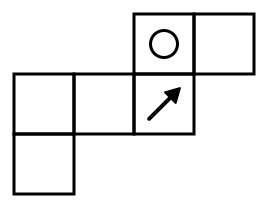
A Figure A ✓ Correct answer
Correct: the folded cube can be turned to show the arrow on top, a blank face at the front and a blank face on the right, each symbol pointing exactly as the fold produces.
B Figure B
Wrong: these faces really are neighbours after folding, but the direction of the arrow on the right in this cube does not match the fold.
C Figure C
Wrong: these faces really are neighbours after folding, but the direction of the arrow on top in this cube does not match the fold.
D Figure D
Wrong: these faces really are neighbours after folding, but the direction of the arrow at the front in this cube does not match the fold.
Reference: ETEC, Cognitive Ability Test page: Spatial Ability (15% of the test); question type: folding nets and visualising solids

