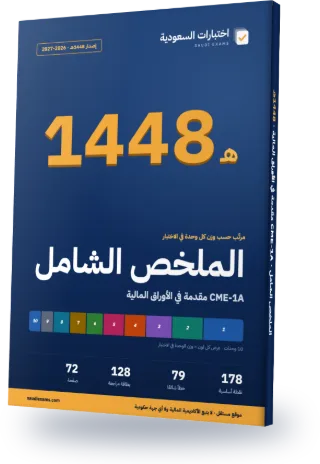
CME-1A Securities Intro Complete Review Guide 2026–2027
Every exam topic in a 72-page Arabic PDF, ordered from the heaviest unit to the lightest. The first three chapters alone cover about 44% of the exam questions.
- 72Pages
- 178Key points
- 79Common mistakes
- 128Flashcards
Guide map
Each chapter is one exam unit, ordered by its weight in the real exam.
| Chapter | Unit | Weight | Exam questions | Key points |
|---|---|---|---|---|
| 1 | Equities/Stocks | 18% | 9 | 18 |
| 2 | Bonds | 14% | 7 | 18 |
| 3 | Investment Funds | 12% | 6 | 18 |
| 4 | Other Markets and Investments | 10% | 5 | 18 |
| 5 | Financial Services Regulation | 10% | 5 | 17 |
| 6 | Economic Environment | 8% | 4 | 17 |
| 7 | Derivatives | 8% | 4 | 18 |
| 8 | Other Financial Products | 8% | 4 | 18 |
| 9 | Introduction to the Financial Services Sector | 6% | 3 | 18 |
| 10 | Financial Advice | 6% | 3 | 18 |
Chapter 1 in full: Equities/Stocks
18% of the exam, about 9 questions. These are its key points, as in the guide.
- Company formation, private and public companies (3.1.1): founders lodge documents with the relevant authority and the process differs between countries; only public companies may issue shares to the public, and in the UK the name shows which it is (plc for public, ltd or limited for private).
- Ordinary shares (3.1.2): carry the full risk and reward; on a winding up shareholders are paid after all creditors (tax authorities, banks, suppliers), anything left is theirs, and their liability is normally limited to the amount they agreed to pay on subscription. An ordinary shareholder normally has one vote per share, cast in person or by proxy.
- Preference shares (3.1.2): a hybrid between debt and equity; they normally pay a fixed dividend set at issue and paid before ordinary dividends, rank ahead of ordinary shares for income and for assets on a winding up, and are normally non-voting except in cases such as unpaid dividends.
The rest of chapter 1, on this page
- Types of preference share (3.1.2): cumulative shares carry forward arrears, non-cumulative shares lose them, participating shares can receive a larger dividend when profits are high, convertible shares can be converted into ordinary shares on preset terms, and redeemable shares are repaid at nominal value on a set date and cancelled.
- Share repurchases or buybacks (3.1.2, 3.1.6): the company buys its own shares, which reduces the number of shares in issue and returns cash to shareholders, and is an alternative to cash dividends; the regulatory detail differs between markets.
- Dividend yield (3.1.3): dividend per share ÷ share price; a US$0.05 dividend on a US$2.50 share gives 2%; the yield is higher for mature companies with limited growth (such as utilities) and lower for growth companies that reinvest profits and have a high share price.
- Risks (3.1.4): price risk is a general fall in share prices; liquidity risk is difficulty selling at a reasonable price (thinly traded smaller companies); issuer risk is the company collapsing so the shares become worthless; foreign exchange risk is a currency movement affecting the value of a foreign investment, which can reduce or increase the gain.
- Rights issues and open offers (3.1.5 to 3.1.7): an offer of new shares to existing shareholders in proportion to their holdings at a discount; the holder can take up the rights, sell them, or do nothing (the rights are sold and the net proceeds passed on); underwriters agree for a fee to buy whatever is not taken up. Example: 4 shares at £4.00 and one new share at £2.00 gives (4×4 + 1×2) ÷ 5 = £3.60.
- Bonus issues (3.1.6, 3.1.7): the company gives shareholders extra shares with no payment, also called a capitalisation or scrip issue, and it is mandatory; example: a one-for-one bonus when the price is US$12 gives a theoretical ex-bonus price of 12 ÷ 2 = US$6. A stock split cuts the price in proportion to the split and makes shares easier to trade, and a reverse split raises it.
- Takeovers and mergers (3.1.5): in a takeover one company (the predator) seeks to buy another (the target), friendly or hostile, and succeeds on acquiring more than 50% of its shares; a merger is usually done by exchanging new shares for the other company's shares; a takeover bid is a voluntary action in which each shareholder decides whether to accept.
- Annual general meetings (3.1.8): held by public companies so shareholders can question the directors on strategy and operations and vote on appointing and removing directors and on the final dividend; an ordinary resolution needs more than 50% of votes cast, and a special resolution (such as changing the company's constitution) generally needs at least 75%.
- Exchange and listing (3.1.9): listing (an IPO) allows raising capital, using shares for takeovers and attracting staff, but brings wider disclosure, continuing costs, exposure to takeover and pressure for short-term targets.
- Indices (3.1.11): they act as a market barometer, a performance benchmark, the basis for index trackers, ETFs and index derivatives, and an input to asset allocation research; the Dow Jones Industrial Average and Nikkei 225 are price-weighted, while the S&P 500, FTSE 100, CAC 40 and DAX are market cap-weighted, and equal weighting gives every stock the same impact.
- Depositary receipts (3.1.10): ADRs are dollar-denominated and issued in bearer form with the depository bank as registered shareholder, give the same rights, and can be cancelled to obtain the underlying shares; GDRs are issued outside the US; up to 20% of voting share capital may be converted, and a pre-release before the actual deposit is closed out when the shares are delivered.
- How shares are traded (3.1.12): in an order-driven system (an electronic order book or an auction) buy and sell orders are matched by price and then time with no market maker; in a quote-driven system (NASDAQ) market makers continuously quote bid and offer prices and profit from the spread; multilateral trading facilities compete with exchanges; over-the-counter trades are made directly between counterparties, as with very large orders.
- Holding title (3.1.13): in registered form the investor's name is on the share register; bearer shares pass by delivery of the certificate and carry risks of loss and money laundering, so they are usually immobilised in a depository; dematerialised shares have their records held by a central securities depository and ownership moves electronically.
- Clearing and the central counterparty (3.1.14): clearing defines and legally formalises each side's obligations; in bilateral settlement each party bears the credit risk of the other; a central counterparty steps between the parties by novation, becoming the buyer to every seller and the seller to every buyer, keeping them anonymous to each other and spreading the risk across participants.
- Settlement (3.1.15): the final phase of trading, with delivery versus payment by electronic book-entry transfer as the accepted method; stages: trade execution, input of the details to the settlement system, matching, then delivery of stock and payment of cash on settlement day; T+2 (two business days after the trade) has been the global standard, and North America moved to T+1 in May 2024.
Common mistakes in this chapter
- Confusing «listed» with «public»: every listed company is public, but not every public company is listed; an option saying all public companies are listed is wrong.
- Mixing up cumulative and non-cumulative preference shares: unpaid dividends build up and are paid later on cumulative shares (a US$2 preference dividend becomes US$4 the next year), whereas on non-cumulative shares they are lost.
- Assuming preference shares always carry a vote: they are normally non-voting except in certain circumstances such as unpaid dividends, and they rank ahead of ordinary shares if the company is wound up.
- Confusing a rights issue with a bonus issue: a rights issue requires payment for the new shares and is mandatory with options, while a bonus issue gives shares with no payment and is mandatory; in both, the share price falls in theory.
- Confusing a rights issue with an open offer: rights in a rights issue are tradable and can be sold, whereas the entitlement in an open offer is not transferable and cannot be sold.
- Mixing up a stock split and a reverse split: a split increases the number of shares and lowers the price (a US$10 share split into five is worth US$2 each), a reverse split does the opposite (ten shares become one and the price rises tenfold), and the total value held is unchanged.
- Mixing up the two ratio styles: 1:4 in Europe and Asia means one new share for four held, while the same event is written 5:4 in the US (the first number is the final holding); a holder of 10,000 shares on a 5:4 ratio ends up with 12,500.
- Mixing up ADRs and GDRs: ADRs are dollar-denominated and listed in the US, whereas GDRs are issued outside it; GDR holders cannot take up rights issues, so the rights are sold and the cash is distributed.
The other chapters are in the full guide
One purchase · lifetime access · review guide included
7-day review plan
The chapters are spread over 6 days by weight so each day carries a similar load. Day 7 is a full exam.
Day 1 · 18% of the exam
Chapter 1: Equities/Stocks
Day 2 · 14% of the exam
Chapter 2: Bonds
Day 3 · 18% of the exam
Chapter 3: Investment Funds
Chapter 10: Financial AdviceDay 4 · 18% of the exam
Chapter 4: Other Markets and Investments
Chapter 8: Other Financial ProductsDay 5 · 16% of the exam
Chapter 5: Financial Services Regulation
Chapter 9: Introduction to the Financial Services SectorDay 6 · 16% of the exam
Chapter 6: Economic Environment
Chapter 7: DerivativesDay 7
Full mock exam: 50 questions in 60 minutes, then review the common mistakes in the units where you lost marks.
How many correct answers do you need?
- Pass mark 70%35 correct out of 50
Before you read: see your score today
10 free questions from the main units, no sign-up. Then you know which chapter to start with.
Try 10 free questions and see your levelA look at each chapter
The first three key points of each chapter, as they appear in the guide (in Arabic in the PDF).
Chapter 1: Equities/Stocks
- Company formation, private and public companies (3.1.1)
- Ordinary shares (3.1.2)
- Preference shares (3.1.2)
Chapter 2: Bonds
- A bond is a tradeable debt instrument with a secondary market, through which an…
- The coupon is the annual interest as a percentage of nominal value. It is…
- Bonds are priced per 100 nominal. Example
Chapter 3: Investment Funds
- Direct investment is buying a specific asset such as a company share; indirect investment…
- Passive management (indexation) builds a portfolio that mimics a recognised index on the assumption…
- Active management seeks to beat a benchmark using fundamental and technical analysis and usually…
Chapter 4: Other Markets and Investments
- An instant access account allows withdrawal at any time and pays the lowest rate…
- An Islamic savings account avoids interest and works on shared risk: the bank invests…
- Advantages of cash
Chapter 5: Financial Services Regulation
- Origins of regulation (8.1.1)
- Benefits of regulation (8.1.1)
- Authorisation (8.1.1)
Chapter 6: Economic Environment
- State-controlled economy (2.1.1)
- Market economy (2.1.1)
- Mixed and open economies (2.1.1)
Chapter 7: Derivatives
- A derivative is a financial instrument whose price is derived from an underlying asset…
- The main purpose of derivatives is to reduce risk through hedging, for example by…
- Arbitrage is a risk-free profit from simultaneously buying and selling the same asset in…
Chapter 8: Other Financial Products
- A pension (9.1.1)
- State pension (9.1.2)
- Corporate schemes (9.1.2)
Chapter 9: Introduction to the Financial Services Sector
- Role of the sector (1.1.1)
- Wholesale (professional or institutional) business (1.1.2)
- Retail business (1.1.2)
Chapter 10: Financial Advice
- Financial advice (10.1.1)
- Budgeting (10.1.1)
- Borrowing (10.1.1)
The full guide comes with lifetime access
The full guide (72 pages) is included with lifetime access to this exam, together with every question and full mock exam. Chapter 1 is free for everyone.
Questions about the guide
Is the guide free?
Chapter 1 is free to read on the guide page. The full guide comes with lifetime access to this exam; 7-day access does not include it.
Is it up to date for 2026–2027?
Yes. Unit weights and exam facts follow what the exam body last published, and the last check date is printed in the guide. If the standards change we update the file and buyers download the new version.
Does the guide have questions?
No. The guide covers key points and common mistakes; scoring, weak-area practice and full mock exams are on the site.
Can I read it on my phone?
Yes. A5 pages in a single column, with chapters linked from the contents.
- Pages
- 72
- Edition
- 1448 AH · 2026–2027
- Language
- Arabic
- Last updated
All Finance & Insurance Exams review guides
Back to CME-1A: Introduction to Securities and Investment (International)
Buy this exam
Pick the access that lasts until your test date.
Included
- Full mock exams: 50 questions in 60 minutes, with a score for every unit
- 278 questions, every option explained with its source
- Practice that starts with your weakest units, plus a review of your mistakes
- Complete Review Guide 2026–2027 (PDF), with lifetime access only
Continue with your Google account and you go straight to the payment page.
You pay on the Waffo Pancake checkout page (in English). The amount is in US dollars and your bank converts it to riyals. One payment with no automatic renewal, by Visa, Mastercard (a mada card with either logo works too), Apple Pay or Google Pay. Your statement shows "WAFFO". Purchases are not refundable.